
McGraw Hill Q1 2026: Modest K-12 Revenue Growth and Strong Profitability Amid Stable Debt
McGraw Hill reported modest revenue growth in Q1 2026 driven by deferred revenue timing in its K-12 segment, alongside improved profitability and stable leverage.
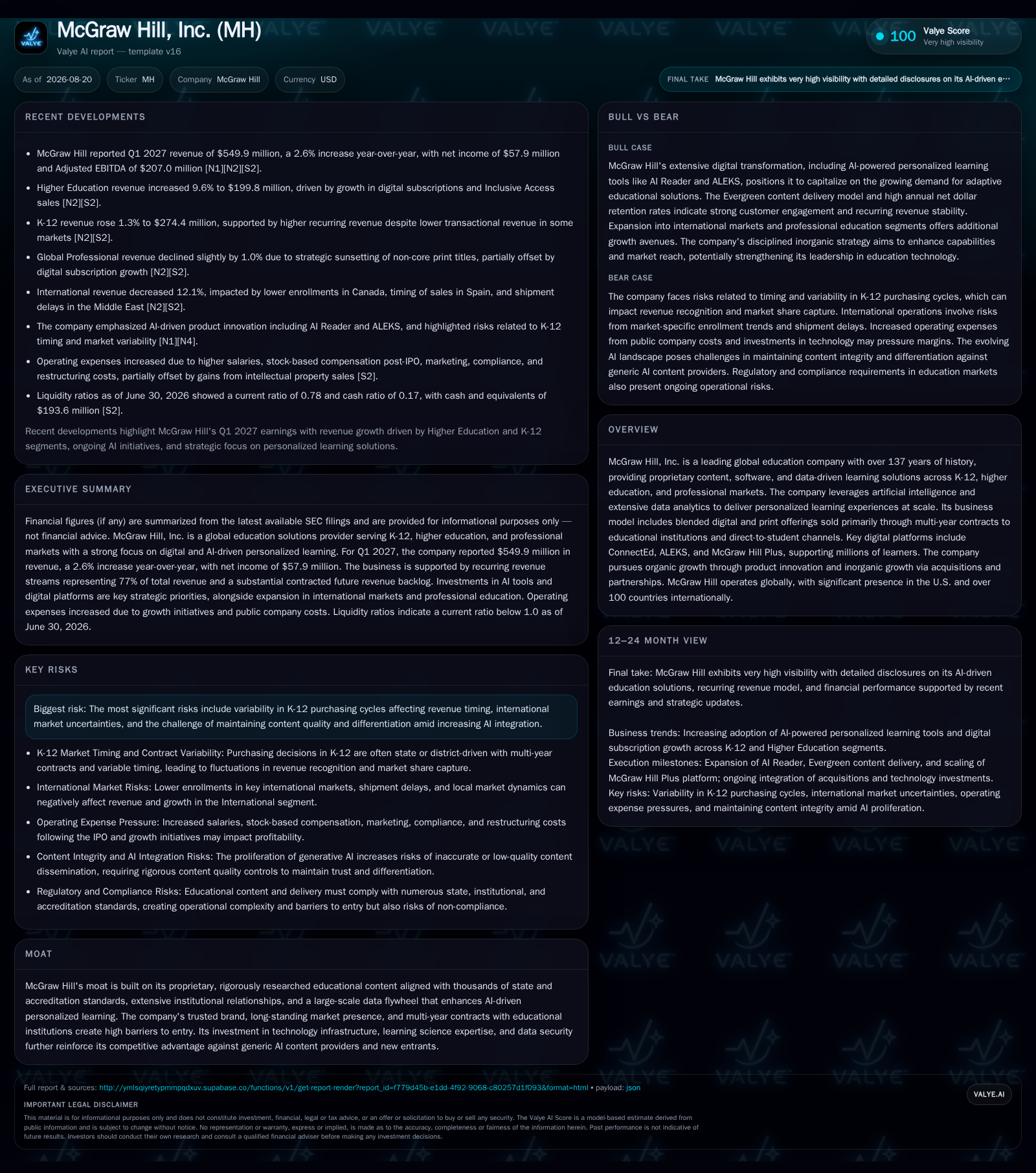
In the fiscal first quarter ended June 30, 2026, McGraw Hill, Inc. generated $549.9 million in revenue, a 2.6% increase from $535.7 million in the year-ago quarter, primarily due to timing-related recurring revenue in the K-12 segment. Net income rose sharply to $57.9 million from $0.5 million, reflecting operating leverage and effective expense management despite higher compensation costs. The company maintained stable leverage with $2.63 billion in total debt and $193.6 million in cash, supporting ongoing investments in product development and strategic initiatives. McGraw Hill’s entrenched market position, proprietary content, and AI-driven personalized learning solutions underpin its competitive positioning amid sector seasonality and deferred revenue recognition effects.
Q1 2026 Operating Performance and Revenue Drivers
McGraw Hill, Inc. reported total revenue of $549.9 million for the fiscal first quarter ended June 30, 2026, representing a 2.6% increase from $535.7 million in the same period of 2025 [S2][S3]. The key driver was approximately $13 million of higher recurring revenue attributed to the timing of deferred revenue recognition related to prior year sales in major U.S. states including California, Florida, and Texas [S2]. This indicates that the revenue growth largely reflects shifts in the timing of revenue recognition rather than a broad acceleration in underlying demand.
In the education content and technology industry, recurring revenue and deferred revenue timing are critical metrics due to the multi-year contracts and institutional purchasing cycles that govern revenue recognition [S1]. McGraw Hill’s reliance on multi-year licensing agreements with school districts and institutions means that revenue can fluctuate quarter to quarter based on contract timing and renewal schedules. The company’s blended digital and print learning solutions, sold directly to U.S. K-12 school districts and through various channels in higher education and professional markets, underpin these recurring revenue streams.
Profitability and Expense Dynamics
Net income improved markedly to $57.9 million in Q1 2026 from $0.5 million in Q1 2025, reflecting the benefits of operating leverage and effective expense management despite increased compensation costs [S2][S3]. Operating and administrative expenses rose by 5.6% to $255.1 million, driven mainly by approximately $9.3 million in higher salaries and wages due to merit increases and headcount growth, as well as $3.9 million in new stock-based compensation expense following the company’s July 2025 IPO [S2].
This expense increase was more than offset by stable revenue growth and operational efficiencies, resulting in improved adjusted EBITDA margins and net income. The ability to leverage scale and control expenses during modest revenue growth is a key economic mechanism in the education content sector, where fixed content development costs are amortized over large institutional customer bases. This dynamic supports margin expansion even when top-line growth is moderate.
Liquidity, Leverage, and Capital Allocation
As of June 30, 2026, McGraw Hill held $193.6 million in cash and cash equivalents against total debt of $2.63 billion, resulting in net debt of approximately $2.44 billion and a current ratio of 0.78 [S2][F1]
The company’s leverage remains elevated but stable, with long-term debt primarily composed of term loans carrying an interest rate of approximately 6.394% per annum as of June 30, 2026 [S2]. Historically, McGraw Hill has generated sufficient operating cash flows to fund seasonal working capital needs, capital expenditures, product development, and strategic acquisitions [S2]. The stable liquidity and debt profile provide a foundation for continued investment in digital transformation and AI-enabled personalized learning solutions.
Business Model and Competitive Positioning
McGraw Hill operates at the intersection of proprietary educational content, software platforms, and data analytics. Its business model centers on selling blended digital and print curricula and adaptive learning solutions through multi-year contracts to educational institutions, including approximately 91% of U.S. public K-12 districts, as well as direct-to-student sales in higher education and professional markets [S1]. The company leverages its proprietary content rigorously aligned to state and accreditation standards, extensive institutional relationships, and large-scale learning data, which may create barriers to substitution. Its AI-driven personalization platforms utilize learning analytics to tailor educational experiences, potentially enhancing customer retention and engagement [S1]. These factors could support recurring revenue stability and may provide differentiation relative to low-cost or AI-generated generic content offerings, which face challenges in meeting rigorous educational standards.
Scenario Analysis and Forward-Looking Considerations
The base case scenario envisions McGraw Hill sustaining modest recurring revenue growth supported by stable institutional contracts and incremental adoption of AI-enhanced learning solutions, maintaining profitability and manageable leverage. This scenario is plausible given the company’s entrenched market position and demonstrated ability to manage seasonality and deferred revenue timing [S1][S2][S3]. Confirmation would come from consistent recurring revenue growth, stable adjusted EBITDA margins, and sustained cash flow generation.
A bull case would involve accelerated adoption of AI-driven personalized learning products leading to above-trend revenue growth and margin expansion. McGraw Hill’s proprietary data assets and content could enable premium pricing and improved customer retention if regulatory and market conditions favor digital education innovation [S1][S2]. Conversely, a bear case would see increased competition from low-cost or AI-generated content providers and adverse timing shifts in K-12 purchasing cycles causing revenue pressure and margin contraction, potentially stressing liquidity and leverage [S1][S2].
Watchpoints
Key indicators to monitor include subsequent quarterly recurring revenue growth and deferred revenue trends, customer renewal rates and contract wins or losses in K-12 and higher education, progression of operating margins and adjusted EBITDA, cash flow generation and changes in net debt or liquidity, and the impact of AI integration on product adoption and competitive positioning. These metrics will provide insight into whether McGraw Hill can sustain its current growth trajectory and profitability amid evolving industry dynamics.
In summary, McGraw Hill’s Q1 2026 results reflect modest revenue growth driven by deferred revenue timing effects in the K-12 segment, alongside improved profitability and stable leverage [S2][S3]. The company’s proprietary content, institutional relationships, and AI-driven learning platforms underpin its competitive positioning in a sector characterized by seasonality and contract-based revenue recognition. Continued execution on these fronts will be critical to navigating the evolving education technology landscape.
Disclaimer: This is research-only, informational analysis and not investment advice. It may include AI-generated interpretation and general industry context. Always verify important details using primary sources.

Comments