
M/I Homes Inc: Navigating Residential Construction Amid Market Cycles and Operational Challenges
M/I Homes Inc reported mixed Q4 2025 results amid a challenging housing market environment, reflecting operational execution within a cyclical industry.
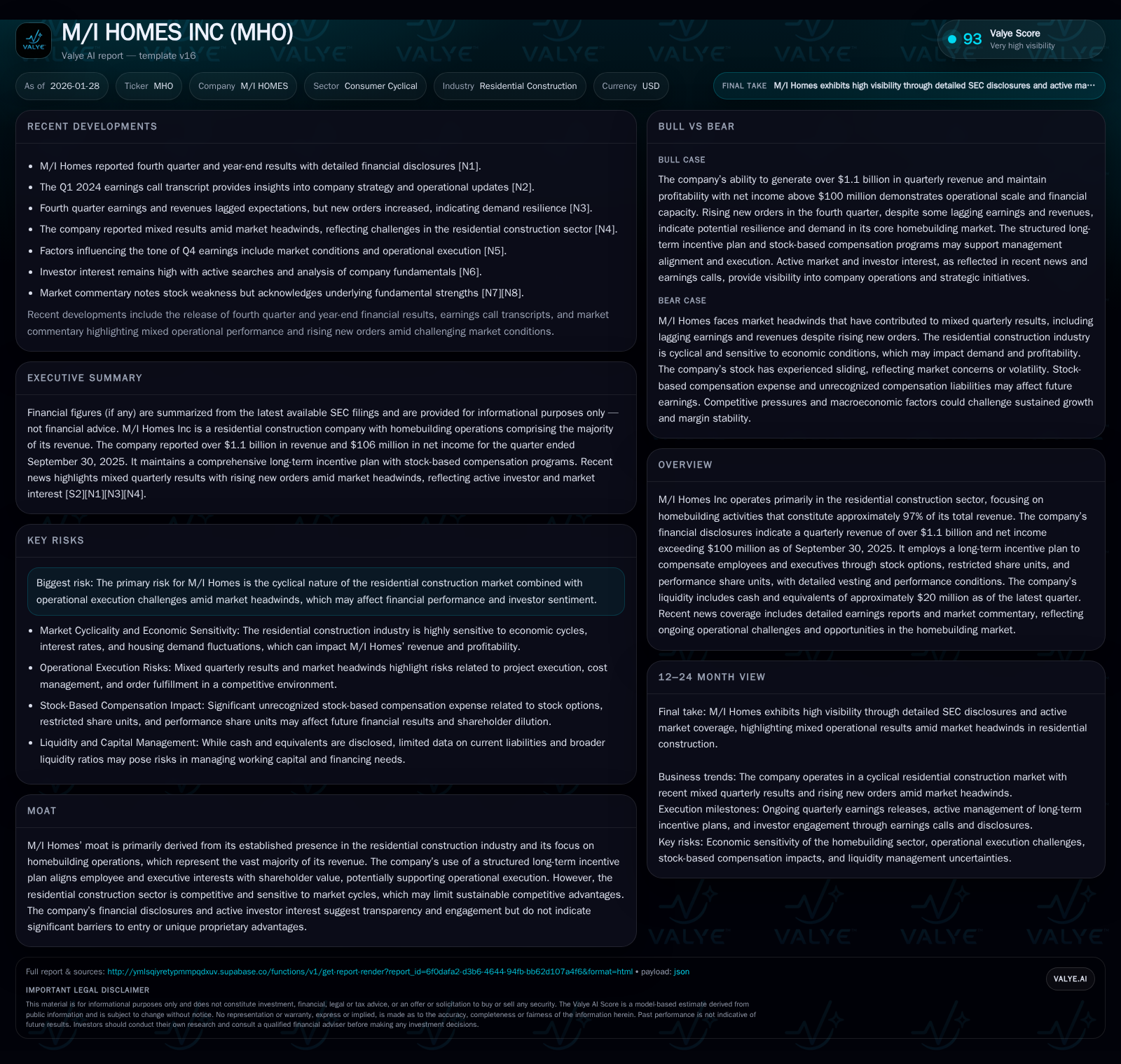
M/I Homes Inc, a residential homebuilder generating over $1.1 billion quarterly revenue, disclosed Q4 and full-year 2025 results highlighting revenue growth offset by margin pressures. The company’s business model centers on land acquisition, home construction, and sales, with employee incentives aligned to long-term performance. The residential construction industry remains highly cyclical and competitive, emphasizing the importance of cost management and inventory controls. Key risks include sensitivity to interest rates and demand fluctuations, while recent order increases signal potential demand resilience amid macro headwinds.
What Changed Recently
M/I Homes reported its fourth quarter and full-year 2025 financial results in late January 2026, revealing a nuanced picture of performance in a challenging residential construction market [N1]. The company posted quarterly revenues surpassing $1.1 billion and net income exceeding $100 million, reflecting solid scale but noticeable margin pressures [N3][S1]. New home orders rose in Q4, which some interpret as a positive signal for underlying demand despite broader macroeconomic headwinds, including elevated interest rates and inflationary cost pressures [N3]. Earnings calls and market commentary emphasized execution challenges amid these headwinds, with management highlighting operational initiatives to bolster efficiency and control costs [N2][N4]. Investor interest remains high, reflected by search traffic and market commentary, though stock performance has been mixed amidst sector volatility [N7][N9].
Business Model as a System
M/I Homes operates primarily in residential construction, with approximately 97% of its revenue derived from homebuilding activities [S1]. The company’s business model revolves around acquiring land parcels, developing and constructing single-family homes, and selling these units to consumers. The residential construction process is capital intensive and time-sensitive, requiring careful management of land acquisition timing, build schedules, and sales absorption rates to optimize cash flow and margins.
Employee and executive compensation includes a long-term incentive plan featuring stock options, restricted share units (RSUs), and performance share units (PSUs), designed to align employee interests with shareholder value creation [N1]. This compensation structure helps incentivize operational rigor and financial discipline, which are critical in a cyclical industry where execution directly impacts profitability.
Liquidity is a key consideration given the capital requirements of land and construction. As of September 30, 2025, M/I Homes held approximately $20 million in cash and equivalents, a relatively modest buffer given the scale of operations [S1]. The absence of detailed public disclosures on current liabilities or debt structure means that capital efficiency and access to financing are potential operational constraints.
Industry Map & Competitive Battlefield
The residential construction industry is characterized by intense competition, cyclical demand, and sensitivity to macroeconomic variables such as mortgage interest rates, consumer confidence, and regional housing supply-demand dynamics. Homebuilders like M/I Homes compete on land acquisition capability, construction efficiency, product design appeal, and sales and marketing effectiveness.
M/I Homes does not appear to possess significant proprietary advantages or barriers to entry beyond its established geographic footprint and operational scale. The sector’s low switching costs and fragmented regional markets mean competitive pressures remain persistent. Other publicly traded homebuilders and numerous private regional players vie for market share, often competing on price and product customization.
Industry bottlenecks include labor shortages, rising material costs, and supply chain disruptions, all of which can extend build times and erode margins. Regulatory and zoning challenges add complexity to land acquisition and development. The cyclical nature of the market means that downturns can quickly pressure revenues and cash flows, emphasizing the need for flexible cost structures and prudent inventory management.
Where the Economics Become Real
At the unit economics level, M/I Homes’ profitability depends critically on land acquisition costs, construction efficiencies, pricing power in the local market, and the speed of home sales (absorption rates). Land costs represent a significant portion of the total cost basis; overpaying or misjudging market timing can materially impact returns.
Construction efficiency is another key lever, impacted by labor availability, subcontractor relationships, and supply chain reliability for materials. Inflationary pressures on lumber, steel, and other inputs have been notable industry-wide. The company’s ability to pass these costs onto buyers depends on local market conditions and buyer sensitivity.
Inventory turnover influences working capital requirements and exposure to market fluctuations. Slow sales can lead to increased carrying costs and margin erosion. The modest cash position suggests M/I Homes may rely on credit facilities or capital markets access to fund operations, especially during slower sales periods.
Margins are vulnerable to pricing competition and fixed overhead absorption. The company’s long-term incentive plans potentially motivate efforts to optimize these economics but cannot fully insulate results from external market shocks.
Diligence Questions / Disconfirming Signals
- What is the breakdown and geographic mix of M/I Homes’ land inventory? Are there signs of overexposure to particularly soft or volatile markets?
- How does the company manage supply chain risks, especially regarding labor and material costs? Are there multi-year contracts or partnerships mitigating price volatility?
- Given the modest cash balance, what is the company's debt profile and access to financing under stressed market conditions?
- How sensitive are new order volumes and cancellations to rising mortgage rates? Is recent order growth sustainable or driven by localized demand spikes?
- What is the pace of home closings relative to order intake? Are there significant backlogs that could pressure working capital?
- How are long-term incentives structured in detail, and what performance hurdles must be met? Could incentive misalignment arise if market headwinds persist?
- Are there emerging regulatory or zoning changes in key markets that could affect land acquisition or development timelines?
- How does M/I Homes monitor and respond to competitor pricing actions or product innovations?
- What contingency plans exist for prolonged market downturns or sudden cost escalations?
This analysis synthesizes publicly available information and recent disclosures to provide a structured understanding of M/I Homes Inc's operational and market context. It does not constitute investment advice or recommendations. Readers should consider broader market conditions and seek additional sources before forming conclusions.
Disclaimer: This is research-only, informational analysis and not investment advice. It may include AI-generated interpretation and general industry context. Always verify important details using primary sources.

Comments