
TPG Mortgage Investment Trust Sustains Solid Returns While Managing Leverage and Diversification Challenges
The REIT balances growth through its mortgage origination pipeline and securitization strategy against macroeconomic risks affecting the mortgage sector.
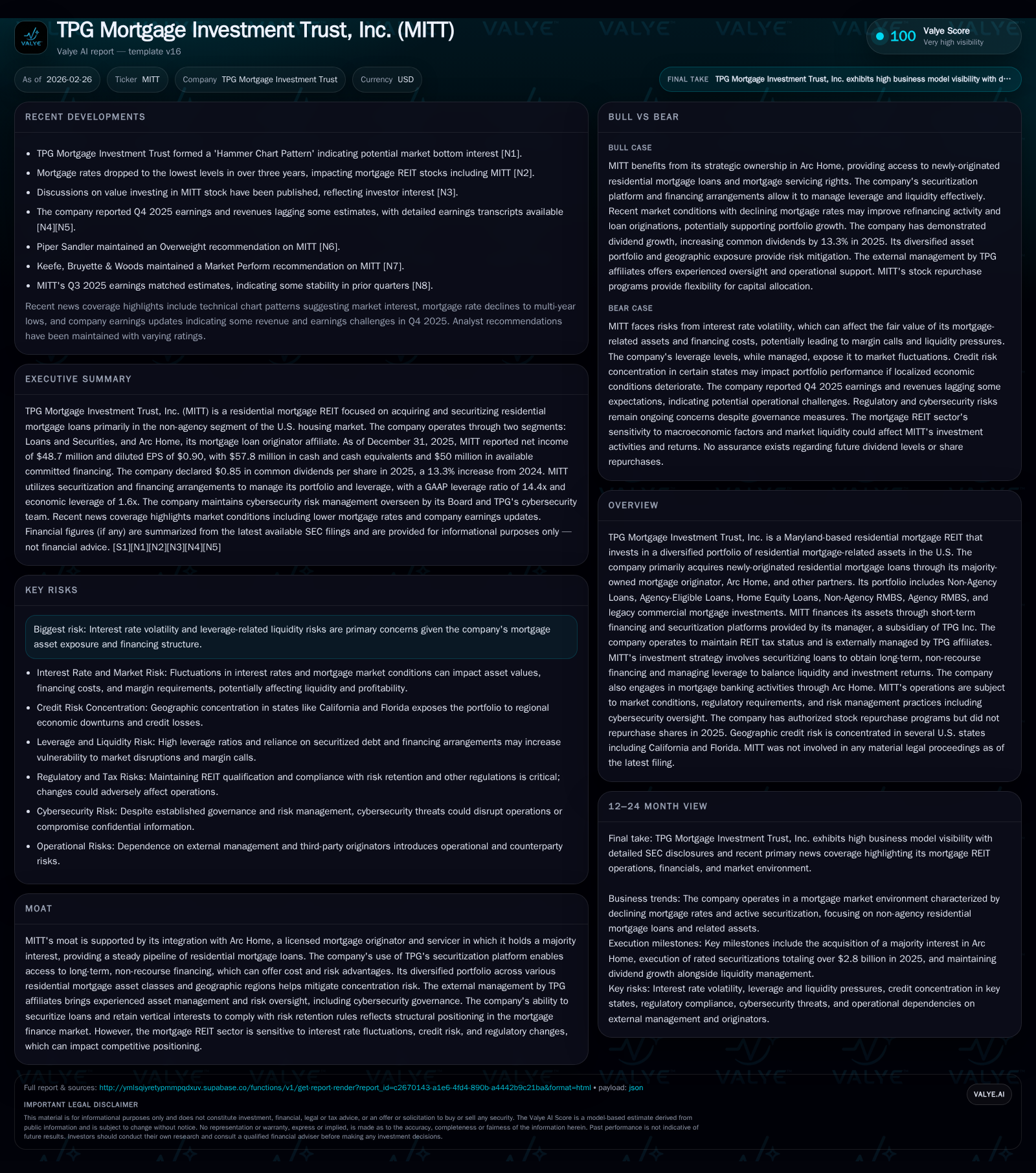
TPG Mortgage Investment Trust, Inc. (MITT) leverages its integration with Arc Home and TPG’s securitization platform to generate steady mortgage-related income. Historical results show fluctuating net income with a recent decline amid higher interest rate volatility and an increased investment scale. The firm maintains strong operating cash flow and a diversified portfolio but faces capital allocation tradeoffs between dividends, stock repurchases, and sustaining liquidity against margin calls. Future growth hinges on maintaining favorable financing terms, managing leverage prudently, and navigating regulatory risk in a volatile interest rate environment.
Company Overview
TPG Mortgage Investment Trust, Inc. (MITT) operates as a residential mortgage real estate investment trust focused on the U.S. residential mortgage market [S1]. The company's competitive advantage arises from its ownership of Arc Home, a licensed majority-owned mortgage originator which serves as a consistent source of newly originated loans for acquisition. Leveraging TPG Inc.'s securitization platform allows MITT to obtain long-term, non-recourse financings that effectively replace short-term leveraged borrowings [S1], [S12]. This vertical integration supports recurring investment activity across multiple residential mortgage asset classes.
Historical Performance and Growth Drivers
MITT's net income declined by approximately 12.7% year-over-year in fiscal 2025 to $48.7 million following a rebound from a significant net loss experienced in 2022 amid heightened market stress [F1]. Operating cash flow exhibited resilience rising roughly 6.7% year-over-year to nearly $59.6 million reflecting continued strong interest income from their mortgage portfolios [F1]. Equity expanded steadily reaching over $560 million by end-2025 underpinning an approximate ROE near 8.7% based on reported figures [F1].
Investment activity is centered around loan purchases primarily sourced from Arc Home under forward purchase commitments executed on best-efforts bases contingent upon loan closings [S9]. In addition to newly originated loans within non-agency segments (such as Non-Agency loans and Home Equity loans), MITT maintains exposure to legacy commercial mortgage investments and agency RMBS as opportunistic liquidity deployments [S1], [S20]. Geographic diversification across key states such as California, Florida, New York, and Texas reduces concentration risk in individual markets [S20].
Financing Structure and Leverage Management
MITT employs leverage extensively through multi-billion dollar repurchase agreements backed by pools of residential loans and securities, complemented by securitized debt issuance within variable-interest entities (VIEs). As of December 31, 2025, total financing arrangements amounted to approximately $8.2 billion including both recourse repurchase agreements and non-recourse securitized debt [S10], [S21]. The firm also carries senior unsecured notes totaling nearly $100 million maturing in early-to-mid 2029 [S10], [S12].
A critical element of MITT's strategy is balancing portfolio leverage with sufficient liquidity buffers — as margin calls can arise quickly due to asset price declines or widening haircuts on collateral pledged in financing arrangements [S6], [S13]. At year-end 2025, liquidity was robust with roughly $108.7 million comprising cash reserves and committed lines of financing available specifically for meeting margin requirements without forced asset sales [S6], [S13]. The company remains compliant with all leverage covenants as of December 31, 2025 [S13].
Capital Allocation: Dividends and Share Repurchases
MITT declared quarterly common stock dividends totaling $0.85 per share in calendar year 2025 up from $0.75 per share the prior year reflecting confidence in stable distributable earnings though without establishing minimum levels [S14]. Preferred stock dividends were also maintained on Series A-C preferred stock issues.
Despite board approval over two separate share repurchase programs authorizing up to $30 million aggregate common stock buybacks since mid-2022, no shares were repurchased during fiscal years ending December 31st in both 2024 and 2025 [S4], [S14]. This likely reflects management prioritizing liquidity maintenance amid persisting market uncertainties over opportunistic capital returns.
Risk Factors
Interest rate volatility remains the dominant risk factor given MITT's asset sensitivity to changes in borrowing costs and collateral valuations leading directly to potential margin calls or reduced net interest margins on floating-rate assets/financing combinations [S23]. Credit risk across the non-agency loan portfolios is mitigated but remains present.
Regulatory developments impacting REIT qualification requirements or leverage limits may introduce additional constraints on capital structure flexibility going forward.
Enterprise-level operational risks include cybersecurity threats—which are actively overseen by MITT’s board audit committee with direct reporting from a dedicated Chief Information Security Officer embedded within TPG's broader enterprise risk framework—thus strengthening controls though residual digital risks persist given sector vulnerabilities [S1].
Future Growth Prospects
Looking ahead, MITT's growth potential concentrats largely on:
- Sustaining high origination volumes from Arc Home’s distribution franchise;
- Successfully executing securitization transactions that optimize funding costs while preserving structural risks;
- Tactical repositioning among residential loan types responding dynamically to evolving market pricing or regulatory changes;
- Prudent management of liquidity levels balancing readiness for margin calls against maximizing invested capital. The company emphasizes a flexible approach adjusted for market duration signals, prepayment trends modeled via Constant Prepayment Rates (CPR), and anticipated shifts in interest rate curves [S27], allowing it to recalibrate portfolio construct accordingly.
Absent explicit management guidance for near-term milestones or dividend policy beyond continuation intents [N1], monitoring will focus on leverage ratios relative to equity levels, realized net interest margins trending amidst changing cost-of-funds dynamics, and capital deployment decisions including possible resumption or suspension of share repurchases.
Summary Financial Metrics Table
Historical performance (annual)
| FY | Net ($mm) | CFO ($mm) | Net YoY |
|---|---|---|---|
| 2025 | 49 | 60 | -12.7% |
| 2024 | 56 | 56 | +3.6% |
| 2023 | 54 | 28 | +201.3% |
| 2022 | -53 | 23 |
Source: SEC companyfacts cache [F1].
Capital returns and efficiency (annual)
| FY | Buybacks ($mm) | ROE% |
|---|---|---|
| 2025 | 8.7 | |
| 2024 | 0 | 10.3 |
| 2023 | 6 | 10.2 |
| 2022 | 18 | -11.5 |
Source: SEC companyfacts cache [F1].
Dividends per share represent annualized payouts; buybacks show no activity since FY2023 except historical run rates.
Final Observations
TPG Mortgage Investment Trust demonstrates operational rigor melding origination strength with structured finance capabilities crucial for a REIT competing amid dynamic interest rate cycles and regulatory environments. While recent earnings have softened relative to the prior year peak post-recovery period reflecting broader sector headwinds including elevated rate volatility and credit scrutiny,[F1] the firm sustains solid operating cash generation supporting shareholder distributions within prudently managed leverage constraints. Strategic attention remains sharply focused on maintaining liquidity buffers given margin call sensitivities intrinsic to their repo-backed lending model alongside ongoing evaluation of capital return programs vs reinvestment needs. Success will rely heavily on continued seamless coordination between portfolio acquisition through Arc Home pipelines and refinancing execution in securitizations combined with adept risk governance highlighted by their thorough cybersecurity engagement.[S1]
Disclosure: This analysis provides factual information based solely on publicly available filings and news sources as cited; it does not constitute investment advice or recommendations.
Disclaimer: This is research-only, informational analysis and not investment advice. It may include AI-generated interpretation and general industry context. Always verify important details using primary sources.

Comments