Marvell Technology’s Strategic Role in Data Infrastructure Amid Market Challenges
Marvell Technology stands as a pivotal fabless semiconductor player for data infrastructure with a focus on AI, cloud, and networking, facing market demand volatility and competitive pressures.
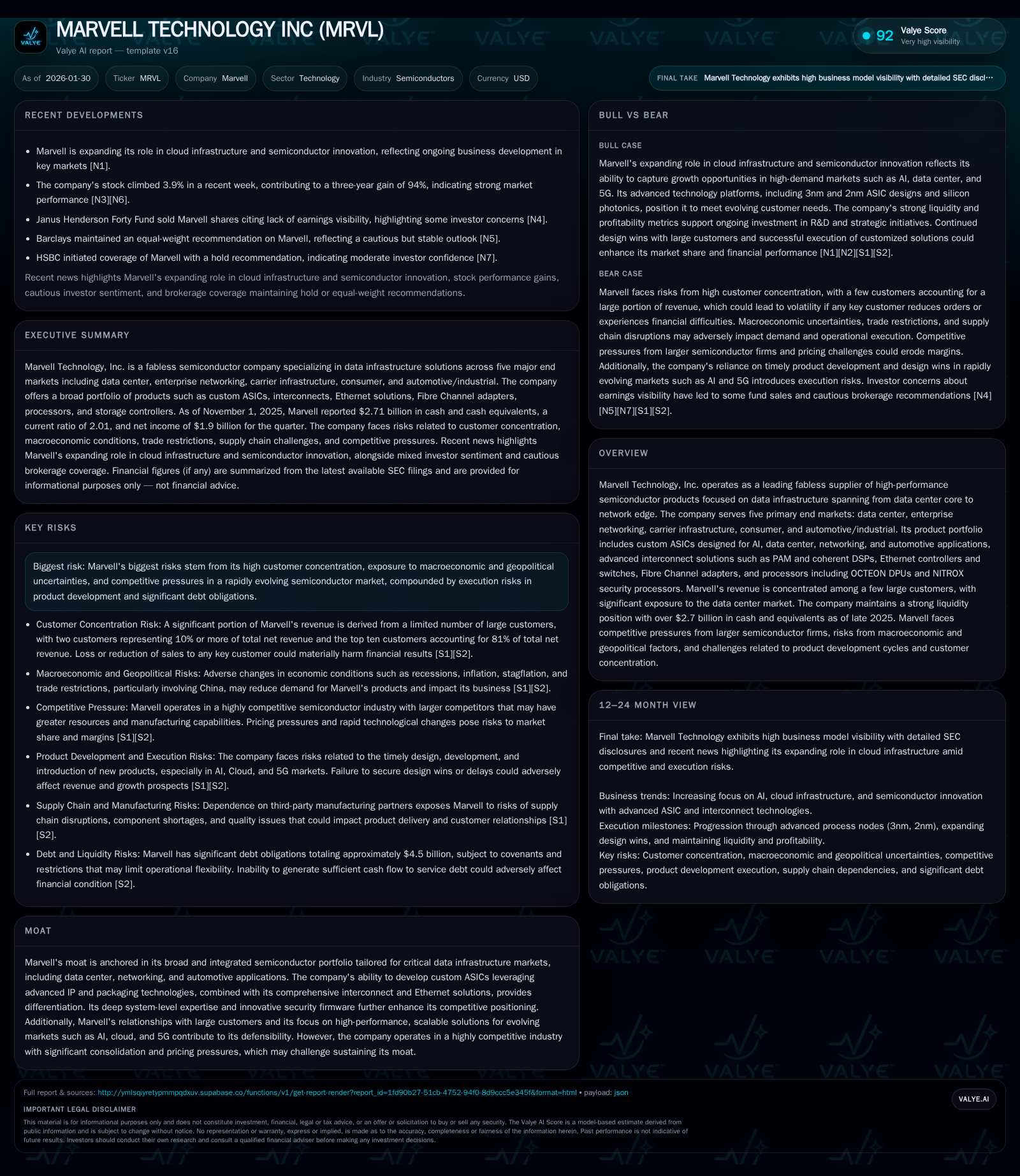
Marvell Technology operates a complex semiconductor ecosystem centered on data center and networking applications with a diversified yet concentrated customer base. Recent developments highlight its expanding cloud infrastructure footprint but also underscore concerns about earnings visibility amid evolving AI and 5G markets. The company’s integrated portfolio, deep customer relationships, and custom ASIC capabilities form the basis of its moat, though it navigates significant execution and macroeconomic risks. Competitive dynamics and supply chain constraints remain critical considerations for future performance.
What Changed Recently
Marvell Technology has recently attracted attention for expanding its role in cloud infrastructure semiconductor innovation, emphasizing its strategic importance in AI and data center markets [N2][N3]. Despite these advances, some investors, such as the Janus Henderson Forty Fund, have divested due to concerns over earnings visibility and unpredictable demand in AI and 5G sectors [N1]. Meanwhile, analyst coverage remains cautious with HSBC initiating coverage at a Hold and Barclays maintaining an Equal-Weight stance, reflecting tempered expectations despite share price gains over the past three years [N5][N8]. This cautious tone underscores the market’s uncertainty about Marvell’s near-term revenue trajectory amid competitive and macroeconomic headwinds.
Business Model as a System
Marvell operates as a fabless semiconductor design company focused on high-performance products for data infrastructure. Its product suite spans custom ASICs tailored for AI, data center, networking, and automotive applications, complemented by advanced interconnect technologies such as PAM (Pulse Amplitude Modulation) and coherent DSPs, Ethernet controllers, switches, Fibre Channel adapters, and specialized processors including OCTEON DPUs and NITROX security processors [S6]. The company serves five primary end markets: data center, enterprise networking, carrier infrastructure, consumer, and automotive/industrial, with a heavy revenue concentration in the data center segment.
The business model involves a mix of standard and custom/semi-custom product development, where significant upfront non-recurring engineering (NRE) expenses are incurred to meet customer specifications [S8][S10]. Timelines from design wins to commercial shipments can extend from six months up to three years, reflecting the long and capital-intensive product development cycle [S15]. Marvell relies on purchase orders rather than long-term contracts, which creates revenue volatility due to customers’ ability to cancel or delay orders with short notice [S9]. Approximately 81% of revenues derive from the top 10 customers, including distributors and direct customers, intensifying dependence on a few large accounts and increasing exposure to demand fluctuations and consolidation risks [S6][S7].
Marvell sources manufacturing and packaging through third parties, which introduces supply chain risks related to component availability, pricing inflation, and production capacity constraints [S8][S22]. The company’s capital structure includes approximately $4.5 billion of outstanding debt as of mid-2025, with covenants restricting additional borrowings and certain corporate actions, potentially limiting strategic agility [S11][S12][S13]. Liquidity remains robust with over $2.7 billion in cash and equivalents and a current ratio above 2.0, providing a cushion against short-term shocks [XBRL].
Industry Map & Competitive Battlefield
The semiconductor industry for data infrastructure is intensely competitive and rapidly evolving. Marvell contends with several larger incumbents, many of which operate their own fabrication facilities, enjoy broader product portfolios, and possess greater financial and technical resources [S5]. Notable competitors include integrated device manufacturers (IDMs) and other fabless companies expanding through acquisitions, such as AMD’s acquisition of Xilinx and Qualcomm’s Veonner buy, intensifying consolidation and competitive pressures.
Customers’ demands have shifted towards turnkey, highly integrated solutions with committed roadmaps that carry technical risks. Winning design wins—where Marvell’s products are selected for incorporation into customer systems—is critical and highly competitive. Early selection is pivotal because switching suppliers later is costly and complex for customers [S21]. This dynamic grants incumbents a strong defensive position but also demands continuous innovation and timely product delivery.
Emerging trends in AI, 5G, and cloud infrastructure drive growth opportunities but remain nascent and subject to regulatory uncertainties, geopolitical trade restrictions, and shifting technology adoption patterns [S1][S7][S20]. Developments such as vertical integration by large cloud customers developing their own semiconductor solutions pose additional threats to Marvell’s business [S3].
Where the Economics Become Real
Marvell’s unit economics hinge on balancing significant upfront R&D and NRE investments against the successful commercialization and volume ramp of custom ASICs and integrated solutions [S8][S15]. Pricing pressures in competitive segments and component cost inflation, particularly for complex IC packaging and substrates, compress margins [S8][S9]. Demand forecasting is challenging as customers often operate with tight inventory management and may defer or cancel orders without penalty, risking excess obsolete inventory or lost sales opportunities [S9][S22].
Custom and semi-custom products, while higher value and more embedded, depend heavily on the success of customers’ end products and require ongoing innovation and support [S10]. Failure to achieve anticipated design wins or delays in product adoption can lead to underutilized R&D spend and margin erosion.
On the capital side, servicing $4.5 billion of debt necessitates substantial operating cash flow, constraining discretionary spending and heightening financial risk during downturns [S11][S13]. The company’s liquidity position provides near-term resilience, but leverage limits flexibility in pursuing opportunistic acquisitions or absorbing market shocks.
Operational bottlenecks include dependence on third-party manufacturing partners, which can face capacity constraints or supply disruptions, affecting shipment linearity and customer satisfaction [S22]. Intellectual property litigation risk, prevalent in the semiconductor industry, poses potential financial and operational disruptions [S18].
Diligence Questions / Disconfirming Signals
- How is Marvell addressing the unpredictability in AI and 5G product demand, especially given recent investor concerns about earnings visibility [N1]?
- What are the company’s strategies to mitigate risks from customer concentration and potential vertical integration by large cloud and data center customers?
- How effectively can Marvell shorten design-win cycles and accelerate time-to-market to keep pace with evolving customer expectations and competitive threats?
- To what extent can Marvell manage supply chain complexity and component cost inflation without eroding gross margins?
- How will the company navigate debt covenants and financial leverage constraints while investing in R&D and potential acquisitions?
- What are the contingency plans for potential intellectual property disputes or regulatory changes impacting AI and 5G semiconductor products?
- How sustainable is Marvell’s moat in an industry trending toward consolidation with larger players possessing fabrication capabilities?
- What is the outlook for the automotive and industrial segments after divestiture of certain business lines, and how does this affect revenue diversification?
Marvell Technology holds a strategically important position in the semiconductor ecosystem for data infrastructure, leveraging a broad portfolio and strong customer relationships. However, it operates in a highly dynamic and competitive environment with significant operational and financial risks. Investors and stakeholders should carefully monitor execution on product development, demand forecasting accuracy, macroeconomic conditions, and the evolving competitive landscape. The company’s future performance will likely depend on its ability to innovate, manage supply chain and capital structure effectively, and navigate regulatory and geopolitical headwinds.
This analysis is based on publicly available information and does not constitute investment advice.
Disclaimer: This is research-only, informational analysis and not investment advice. It may include AI-generated interpretation and general industry context. Always verify important details using primary sources.

Comments