
Navigating Fee Pressure and Regulatory Uncertainties: MSCI Inc.'s Enduring Index Franchise and ESG Innovation
MSCI Inc. combines a robust recurring revenue base from its entrenched index business with expanding sustainability products amid evolving industry and regulatory challenges.
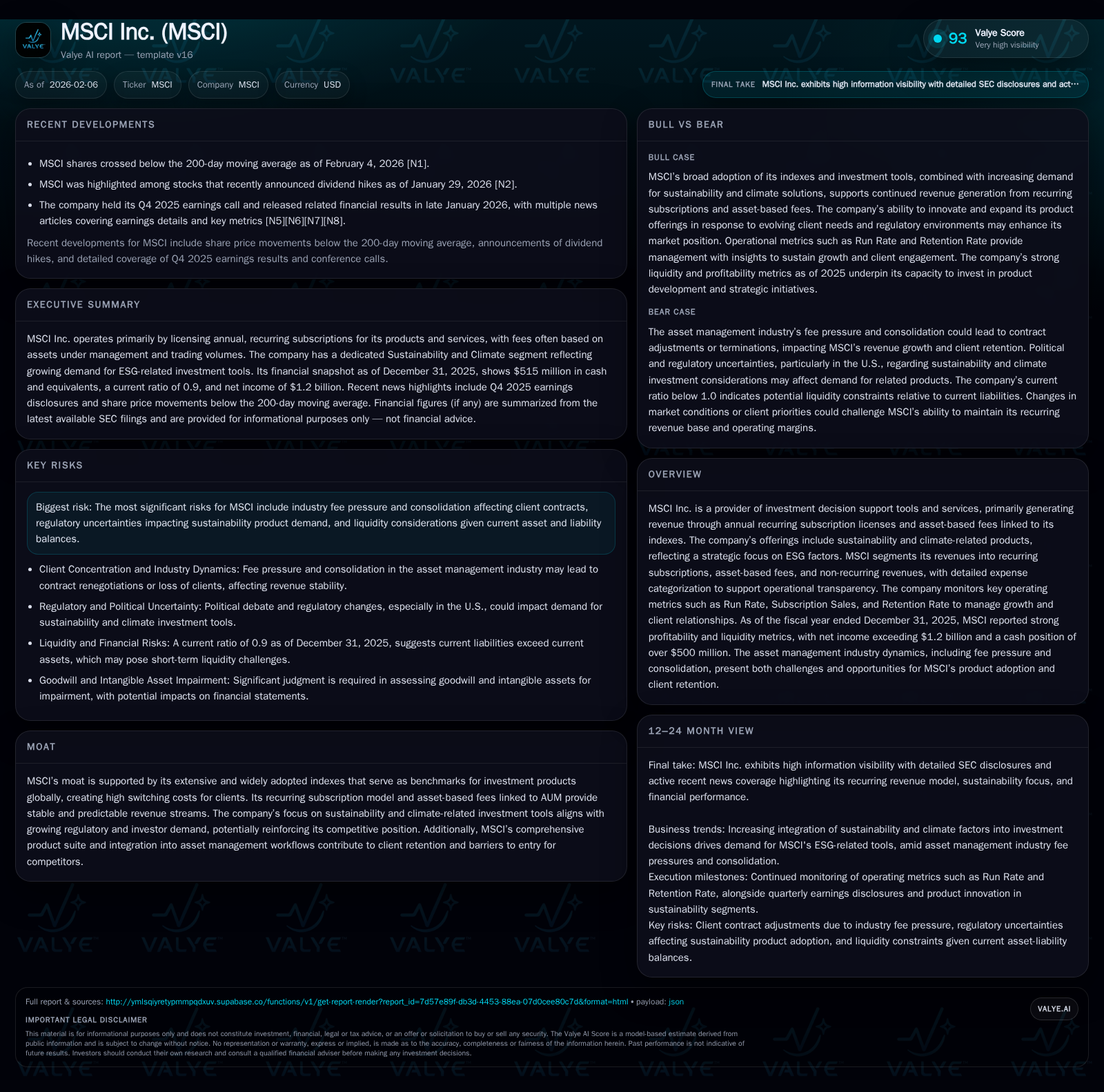
In 2025, MSCI Inc. demonstrated strong profitability with net income surpassing $1.2 billion, anchored by its subscription licensing and asset-based fee revenues. While its dominant position in global indexing creates significant switching costs fostering client retention, the company faces ongoing industry fee pressures and mixed regulatory environments impacting its sustainability offerings. Management's focus on key operating metrics and strategic product innovation underscores an adaptive stance as MSCI balances stable fundamentals against external headwinds.
MSCI’s Revenue Engines: Recurring Models and Asset-Based Fees
MSCI’s business model capitalizes on a dual-engine revenue structure: predictable recurring subscription fees complemented by variable asset-based fees linked to assets under management (AUM). According to the 2025 10-K filing, recurring subscription revenues stem chiefly from renewable contracts recognized ratably over license periods, typically prepaid before service commencement [S1]. This front-loaded billing approach contributes not only to cash flow stability but also enhances visibility into future earnings.
Asset-based fees—primarily derived from AUM linked to MSCI’s benchmark indexes—introduce a growth lever that scales with market expansions or contractions. These fees also include volumes linked to futures and options on MSCI indexes, reflecting trading activity dynamics. Non-recurring revenues remain a smaller, more volatile component consisting of one-time licenses, implementation services, or data sales [S1]. Despite some variability here, it is the combination of subscription fees plus asset-based fees that profoundly sustains MSCI’s top-line resilience.
This segmentation enables MSCI to weather market cycles better than firms relying solely on transactional revenues. The linkage between asset-based fees and AUM introduces sensitivity to market fluctuations; however, coupled with steady subscription income, it tempers revenue swings effectively [F1]. Consequently, MSCI enjoys a revenue composition favoring longevity over volatility.
The Moat in Indexing: Switching Costs and Market Entrenchment
MSCI’s entrenched index franchise represents perhaps the most formidable barrier to client churn within asset servicing providers. Its benchmarks are deeply embedded within financial products globally—index mutual funds, ETFs, structured products—all rely on MSCI indexes as underpinnings for valuation and performance measurement [valye_report_excerpt].
This extensive integration creates significant switching costs for clients: transitioning index providers entails operational disruption, re-calibration of models, regulatory re-approvals, data migration challenges, plus potential investor confusion. Such friction ensures strong client stickiness even amidst competitive bids.
Moreover, recurring revenues from subscription licensing naturally benefit from this ‘stickiness.’ The licenses cover access to index data sets vital for portfolio construction, risk analytics, and compliance monitoring. Losing an established client would not only cut recurring licensing fees but also risk undermining deeper ecosystem relationships cultivated across analytics platforms.
These dynamics reinforce MSCI’s moat by aligning multiple layers of reliance—from data usage to derivative products—all fostering comprehensive ecosystem lock-in [S1]. This ingrained market entrenchment reduces pricing elasticity to an extent but cements long-term contractual engagement.
Sustainability and Climate Products: Growth Amid Regulatory Crosswinds
In recognition of ESG’s rising prominence within investment paradigms, MSCI rebranded its “ESG and Climate” segment in early 2025 as “Sustainability and Climate” broadening its scope beyond traditional environmental factors [S1]. This suite spans tools assessing climate risks, social governance factors, carbon footprints, and other sustainable metrics increasingly demanded by both institutional investors and regulators.
However, regulatory landscapes present uneven crosswinds. Europe continues strengthening ESG disclosure mandates driving robust demand for sophisticated assessment tools [S1]. Contrastingly, U.S. political debates have injected regulatory uncertainty around sustainable investing principles which could reduce near-term uptake in certain segments.
While this fragmented backdrop complicates forecasting adoption rates precisely, MSCI projects that long-term trends favor embedding financially material sustainability factors into investment decisions globally. This secular shift aligns well with MSCI’s broadening product portfolio designed for integrated risk management rather than siloed compliance snapshots [valye_report_excerpt].
Such positioning offers strategic upside but also calls for agility—balancing expansion in receptive markets against cautious navigation where regulatory skepticism prevails.
Industry Fee Pressure and Consolidation: The Balancing Act
The asset management sector—a core client base for MSCI—faces pronounced fee compression due to investor demands for lower-cost solutions alongside ongoing industry consolidation that consolidates vendor relationships [valye_report_excerpt]. These conditions exert downward pricing pressure on data licensing and analytics services.
From one angle, this environment threatens MSCI through contract renegotiations or terminations as clients prioritize cost containment. Conversely, the intensifying sophistication of investment processes compels firms toward richer toolsets spanning multiple asset classes—a domain where MSCI’s comprehensive offerings gain relevance.
Management acknowledges this duality; while clients may cull vendors for cost reasons amid consolidation waves, overall demand for advanced index-linked analytics remains intact or even grows as strategies diversify [S1]. Hence the challenge resides in balancing pricing discipline with value demonstration sufficiently compelling to maintain or increase wallet share.
The eventual impact hinges on clients’ pace of fee-driven consolidation relative to their appetite for augmenting analytical sophistication—a dynamic MSCI continually monitors closely.
Key Operating Metrics as Growth Barometers
MSCI employs several internal operating metrics that illuminate financial momentum beyond headline figures: Run Rate signals annualized revenue from existing contracts assuming no new business; Subscription Sales capture expansion through newly booked licenses; Retention Rate measures sustained client commitment reflected in contract renewals [S1][N1].
During the Q4 2025 earnings call, executives highlighted these metrics’ importance in dissecting growth drivers amid shifting macro factors [N1]. Notably incomplete retention or diminished renewal values could presage vulnerability given the predominance of subscription revenues. Conversely, healthy Subscription Sales signal client appetite for new or expanded services implying underlying business vitality.
Tracking these measures over time offers nuanced insight into how successfully MSCI counters fee pressures with contract wins or extensions. Moreover, retention attests to network effects embedded within their ecosystems where integrated tool usage discourages defection.
Profitability and Liquidity: Assessing Financial Resilience
Fiscal 2025 closed with net income exceeding $1.2 billion—a testament to operational efficiency combined with favorable revenue mix [F1]. Margins reflect disciplined cost control across categories including cost of revenues (primarily technology infrastructure), R&D investments supporting product innovation, plus marketing expenses targeting client acquisition [S1].
MSCI maintains substantial liquidity with over $500 million in cash equivalents at year-end alongside a current ratio near 0.9 reflecting sufficient near-term coverage amid sizeable current liabilities [F1]. While below idealized thresholds above 1.0 may prompt vigilance regarding working capital management, this position remains manageable given predictable recurring revenues.
Strong financial health supports continued organic investment in sustainability expanding capabilities as well as potential bolt-on acquisitions should opportunities arise despite prevailing industry headwinds.
Client Retention and Contract Dynamics in a Competitive Landscape
Retention benefits materially from embedded switching costs leveraged via entrenched indexing frameworks paired with increasingly integrated analytics suites tailored toward diverse investment strategies [valye_report_excerpt][S1]. However, intensified fee scrutiny among consolidated asset managers can pressure contract terms with requests for concessions or scope reductions.
Msci's response leverages breadth — cross-selling sustainability tools alongside traditional benchmark licenses deepens client engagement anchoring longer-term agreements despite unit price pressures [N1]. The balance remains delicate since abrupt contract terminations or significant scope downsizing could materially disrupt revenue streams; hence proactive relationship management is pivotal.
Industry consolidation tends also toward vendor rationalization creating both threat through elimination as well as opportunity via aggregate expanded mandate should MSCI remain a preferred partner through demonstrated value-addition [valye_report_excerpt].
Risks on the Horizon: Regulation, Fee Compression, and Liquidity
Key risks crystallize principally around three vectors: regulatory uncertainty surrounding ESG investing which could dampen demand volatility; persistent fee pressure necessitating pricing vigilance; liquidity considerations given current ratio slightly below one combined with sizeable current liabilities necessitating continuous cash flow monitoring [valye_report_excerpt][S1][S2].
Shifts in political climates or unforeseen changes in disclosure mandates risk dislocating growth trajectories particularly within Europe vs US markets where regulation varies markedly. Concurrently fee compression feeds tension between sustaining investment levels in innovation versus margin preservation potentially constraining nimbleness.[S2]
Liquidity risk remains manageable but underscores importance of prudent capital deployment especially if unforeseen macroeconomic disruptions challenge market valuations affecting asset-based fees reliant on AUM level stability.
Investors should weigh these uncertainties overlaying an otherwise structurally advantaged business serving diverse end markets worldwide.
Forecasting MSCI’s Strategic Trajectory Through 2026
Looking ahead into 2026 prospects depend heavily on MSCI’s ability to harmonize its entrenched index footprint with evolving product innovations centered on sustainability while navigating broader external pressures.[valye_report_excerpt][N2][N14]
The recent Q4 earnings beat reflected operational strength despite some softness in net income margins highlighting ongoing margin management challenges [N2][N14]. Share price crossing below technical moving averages signals market apprehension amid macroeconomic uncertainties though fundamentals remain intact.[N9]
Strategically emphasis likely shifts toward deepening client penetration via horizontally integrated solutions encompassing ESG analytics aligned to shifting mandates; concurrently optimizing pricing models counteracting fee erosion yet justifying premium through demonstrable efficacy proves crucial.[valye_report_excerpt]
In sum MSCI stands at a juncture where its historic operational predictability must combine with forward-looking adaptability maintaining competitive moats while responsive to fluid industry structures—a balance essential in sustaining its leadership through uncertain landscapes.
This analysis is intended solely for informational purposes based on publicly available data as of early 2026. It does not constitute investment advice or recommendations.
Disclaimer: This is research-only, informational analysis and not investment advice. It may include AI-generated interpretation and general industry context. Always verify important details using primary sources.

Comments