
MicroVision Advances Lidar Platform Through Strategic Acquisitions While Managing Capital and Commercialization Risks
Latest quarter reveals continued operating losses amid technology integration and market development efforts.
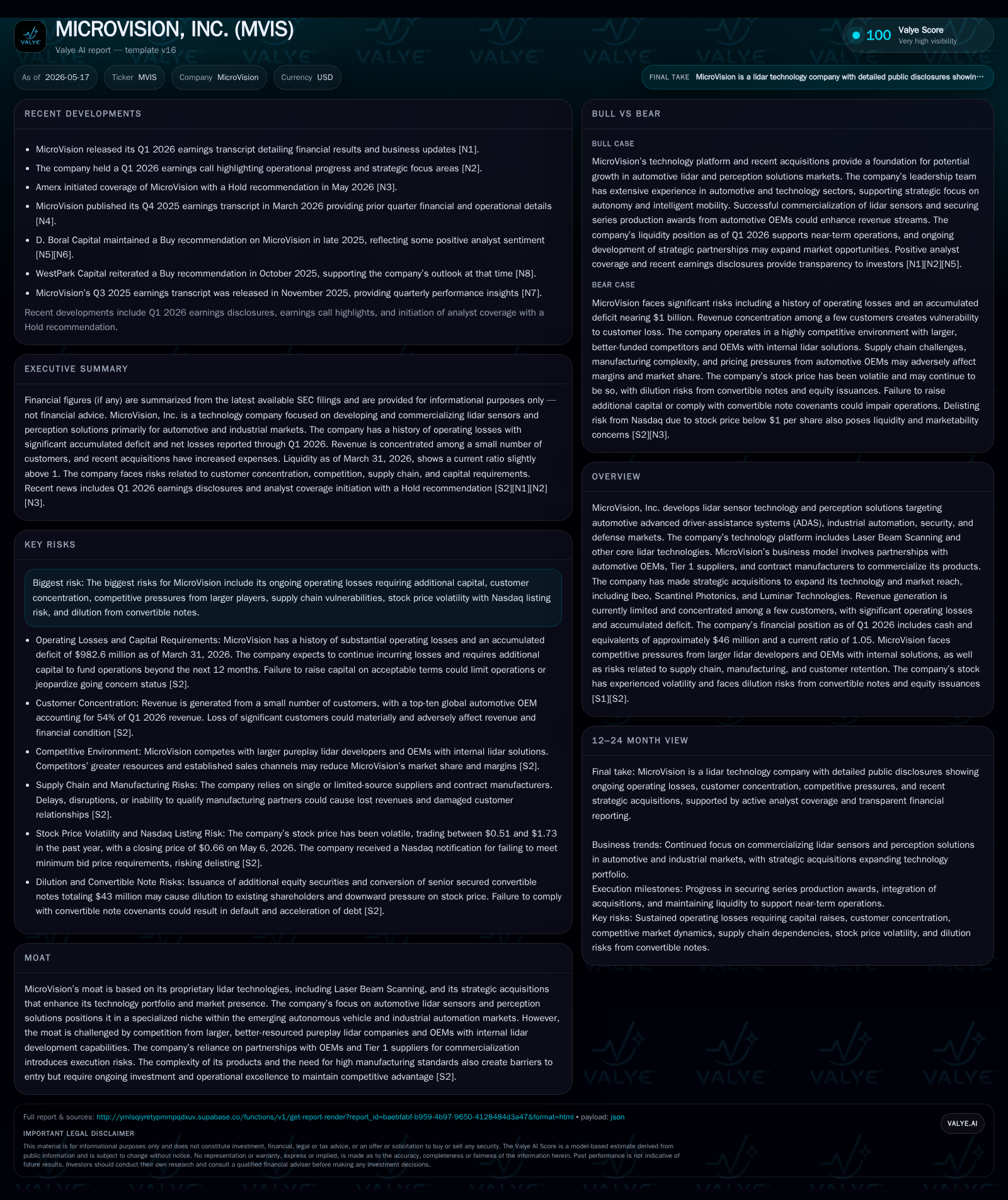
MicroVision, Inc.'s Q1 2026 filings highlight ongoing heavy investment in expanding its lidar sensor technology portfolio, including the recent acquisition of Luminar Technologies’ assets. The company remains focused on commercializing advanced lidar solutions for automotive ADAS and industrial markets, relying heavily on partnerships with OEMs and Tier 1 suppliers. Despite strategic acquisitions bolstering its technology base, MicroVision continues to operate at a loss, faces significant capital requirements, and navigates competitive pressures from larger players. Near-term growth hinges on successful product commercialization and securing additional capital under constrained liquidity conditions.
Recent Operating Update
MicroVision’s latest quarterly filing dated May 15, 2026 [S2] confirms ongoing operational challenges typical for deep-technology developers transitioning toward commercialization. The company reported a net loss of $25.3 million for Q1 2026 amid investments in integrating recent acquisitions and advancing its lidar sensor technology platform [S2]. As of quarter-end March 31, 2026, MicroVision held approximately $46.1 million in cash equivalents against total debt near $40.1 million, reflecting a narrow liquidity cushion expressed by a current ratio of just above 1.0 [F1]. The firm explicitly expects to require capital infusions beyond the next year to continue executing its business plan [S8].
A material development underpinning this quarter was the completed acquisition of Luminar Technologies’ lidar sensor assets for $33 million in February 2026 [S3], enhancing MicroVision’s product offering within the automotive lidar space—a central strategic priority. Combined with earlier deals—such as Ibeo (2023) and Scantinel Photonics (January 2026)—these acquisitions expand both the technical reach (combining Laser Beam Scanning with complementary photonic technologies) and market access.
The company disclosed that despite these additions, revenue opportunities remain limited with significant customer concentration; commercial adoption is progressing but faces inherent uncertainties of emerging sensor markets [S2][S8]. Execution risks persist given dependence on OEMs and Tier 1 suppliers to integrate MicroVision’s lidar modules into broader automated driving systems.
Business Model Analysis
MicroVision generates revenue primarily through licensing its proprietary lidar technologies—most notably Laser Beam Scanning—and providing perception solutions tailored for automotive Advanced Driver-Assistance Systems (ADAS), as well as industrial automation, security, and defense applications [S1]. The firm does not typically sell end-user products directly but leverages partnership arrangements with automotive OEMs and component suppliers who embed MicroVision technologies into their sensor suites.
Revenue mechanics hinge on three key levers: development fees during integration phases, royalties or sales-based payments tied to module volumes post-commercial launch, and licensing or contractual arrangements that may include hardware supply components. Pricing power depends on differentiation—MicroVision claims superior cost-structure potential via Laser Beam Scanning technology compared to traditional mechanical or solid-state lidars—but ultimate volume expansion is subject to OEM adoption cycles that can be lengthy.
Operating margins have been negative historically due to high R&D intensity combined with overhead burdens from acquisitions and infrastructure expansion [F1]. The company currently operates at a loss while scaling capabilities necessary to support industrial-grade manufacturing quality required in automotive applications.
Customer behavior indicates conservatism; automakers prefer tested suppliers or internally developed sensor stacks limiting rapid volume ramp-ups. This dynamic enforces a lengthy commercialization timeline that impacts cash flow generation.
Industry Structure and Competitive Position
MicroVision occupies a specialized niche within the fragmented lidar supplier ecosystem for autonomous vehicles and industrial monitoring systems. Its core asset is the proprietary Laser Beam Scanning lidar platform designed to offer performance benefits such as high resolution, longer range, and potentially lower cost over competitive scanning methods.
Competitors include pureplay lidar companies with scale advantages—such as Velodyne Lidar or Innoviz—as well as integrated automotive Tier 1 suppliers developing in-house offerings aligned closely with OEM roadmaps. Additionally, large automotive manufacturers are increasingly investing internally in perception technologies which could bypass traditional third-party vendors.
The industry is characterized by rapid innovation cycles coupled with significant capital intensity needed for production scale-up compliant with ISO automotive standards. Barriers to entry exist but are mitigated by aggressive patent portfolios held by competitors and rapid technological obsolescence risks.
MicroVision's moat is anchored in its strategic acquisitions to augment intellectual property breadth (Ibeo for automotive-grade perception software; Scantinel for complementary photonics) along with aggressive IP development around scanning-based lidars [S2]. However, the execution risk related to integrating multiple technology bases while maintaining agile innovation translates into operational complexity.
Growth Drivers
- Strategic Acquisitions: Recent asset purchases (Luminar in particular) broaden the company’s technological capabilities enabling entry into broader market segments such as higher-performance automotive L4/5 autonomy sensors.
- Emerging Market Expansion: Increasing penetration of ADAS features globally heightens demand for reliable perimeter sensing solutions; MicroVision targets these evolving requirements across geographies.
- Industrial Automation & Security Applications: Beyond automotive use-cases, adoption of lidar for industrial robotics navigation, facility security perimeter detection, and defense surveillance provides diversified revenue avenues.
- Partnership Development: Establishing deeper collaboration agreements with Tier 1 suppliers can accelerate product validation cycles and volume commitments which are vital milestones toward stable revenue streams.
- Technology Differentiation: Leveraging laser beam scanning enables potential cost reduction per unit sensor while meeting stringent performance benchmarks demanded by OEMs.
Risks and Constraints
- Capital Intensity & Cash Burn: Operating losses persist driven by R&D spending, acquisition integration costs, compensation expenses linked to executive incentives focused on growth metrics rather than near-term profit [S2][S8]. Required financing rounds pose dilution risk to existing shareholders.
- Customer Concentration: Revenue base remains small concentrated among few customers; delays or cancellations from key partners could significantly reduce anticipated cash inflows.
- Competitive Pressure: Larger well-financed rivals may out-invest or come to market faster; internal development by OEMs may displace third-party suppliers entirely.
- Supply Chain Vulnerabilities: Reliance on advanced photonics components sourced globally exposes MicroVision to geopolitical trade frictions or supplier bottlenecks impacting production schedules.
- Regulatory Compliance & Litigation Exposure: Complex patent environment poses risk of costly legal challenges around core intellectual property that could restrict commercialization or increase licensing expenditure [S26].
- Macroeconomic and Geopolitical Uncertainty: Global economic slowdowns affecting vehicle production rates or industrial capital projects could delay market adoption timelines.
What To Watch Next
Key upcoming milestones include:
- Progress updates on integrating Luminar asset technologies into coherent product lines targeting series production qualification [N1][N2].
- Announcements regarding new partnership agreements with Tier 1 suppliers or automakers indicating volume commitments or pilot programs implementation.
- Liquidity status updates addressing funding sufficiency beyond the next twelve months given burn rate versus capital raising success [S8].
- Regulatory filings validating intellectual property holdings or disclosing ongoing litigation trends impacting risk profile [S26].
- Market acceptance signals reflected through backlog growth metrics or royalty accrual disclosures tied to commercial deployments.
Financial Profile Summary
As of March 31, 2026, MicroVision held approximately $46.1 million in cash versus total debt near $40.1 million producing a marginal net cash position (~$6.0 million) and a current ratio of about 1.05, indicating tight short-term liquidity coverage amid ongoing losses exceeding $25 million per quarter recently reported [F1][S2]
The company’s high R&D expenditure rate combined with increased headcount following multiple acquisitions has elevated operating costs significantly [S8]. Revenue remains modest relative to expenses given nascent commercialization stage; therefore profitability visibility is limited in near term.
Disclaimer: This analysis is provided solely for informational purposes based on disclosed filings as of May 17, 2026. It does not constitute investment advice or a research view regarding MicroVision securities. Readers should conduct independent due diligence before taking any action related to this company.
Disclaimer: This is research-only, informational analysis and not investment advice. It may include AI-generated interpretation and general industry context. Always verify important details using primary sources.

Comments