
First Western Financial Balances Personalized Growth Model with Regional Concentration Risks
First Western Financial’s integrated private trust banking approach drives solid growth, but cash flow challenges and geographic concentration pose distinct tradeoffs.
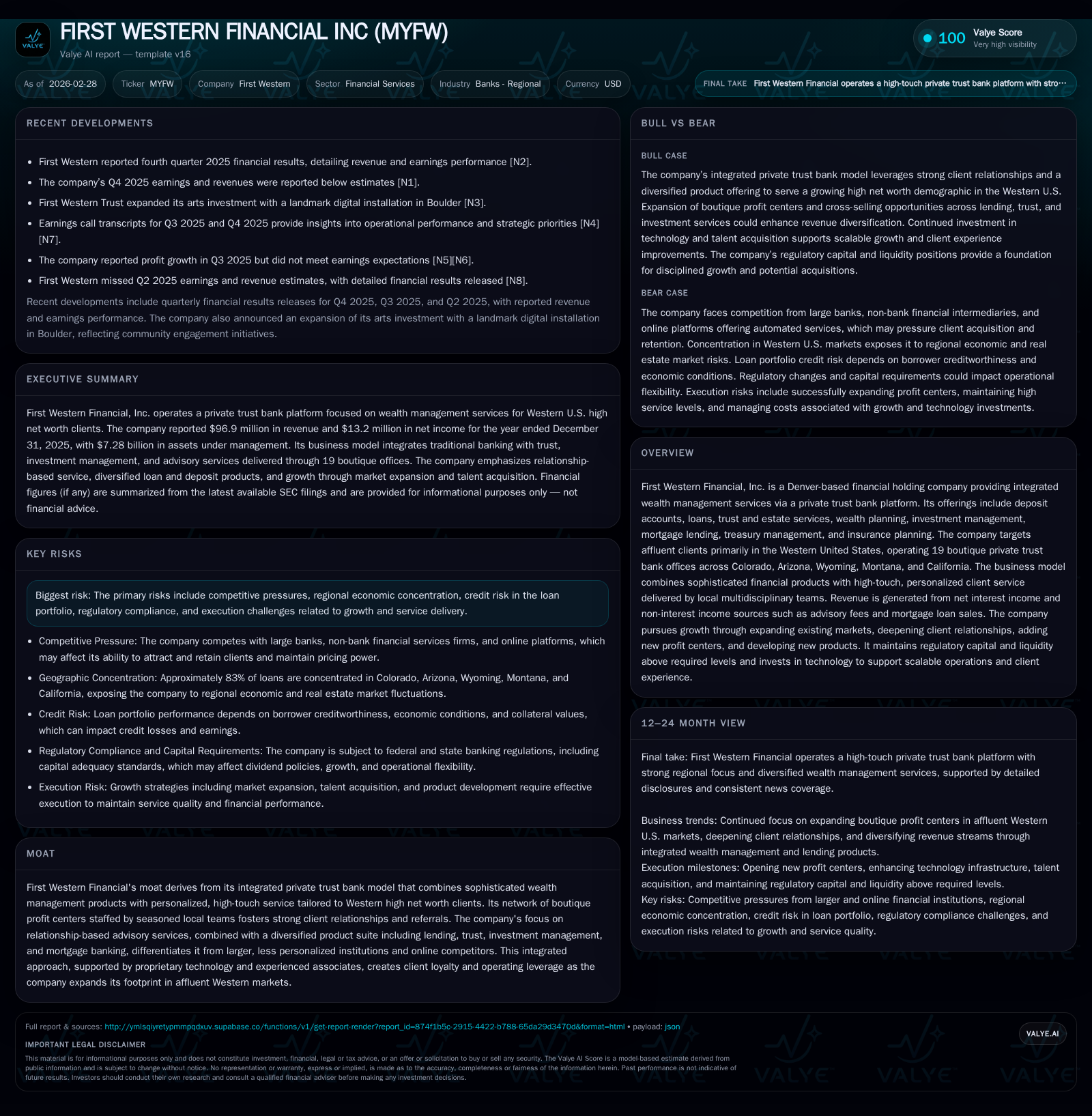
First Western Financial Inc. (MYFW) has demonstrated steady revenue growth over recent years, fueled by its high-touch wealth management and private trust bank model targeted at affluent Western U.S. clients. Despite top-line expansion, the firm saw a notable decline in operating cash flow and negative free cash flow in fiscal 2025, alongside moderate profitability with a roughly 5% return on equity. Going forward, the company plans to deepen market penetration through boutique expansion and relationship-driven client service while managing risks tied to regional economic exposure and credit underwriting. Capital allocation remains disciplined with modest share repurchases and controlled capital expenditures, but close monitoring of credit quality and regulatory compliance will be crucial amid evolving industry dynamics.
Historical Performance
First Western Financial Inc., headquartered in Denver, operates a distinctive private trust bank platform providing an integrated suite of wealth management products targeting high net worth individuals primarily across the Western United States (Colorado, Arizona, Wyoming, Montana, California). The company has emphasized personalized service through a network of nineteen boutique profit centers staffed by seasoned local multidisciplinary teams [S1].
Over the last four fiscal years through December 31, 2025, First Western’s revenues exhibited fluctuations reflective of varying economic conditions and business initiatives:
Historical performance (annual)
| FY | Rev ($mm) | Net ($mm) | CFO ($mm) | Capex ($mm) | Rev YoY | Net YoY |
|---|---|---|---|---|---|---|
| 2025 | 97 | 13 | -2 | 4 | +7.6% | +55.6% |
| 2024 | 90 | 8 | -1 | 1 | +8.9% | +62.2% |
| 2023 | 83 | 5 | 22 | 2 | -23.4% | -75.9% |
| 2022 | 108 | 22 | 48 | 3 |
Source: SEC companyfacts cache [F1].
Capital returns and efficiency (annual)
| FY | Buybacks ($) | FCF ($mm) | ROE% |
|---|---|---|---|
| 2025 | 784000 | -6 | 5.0 |
| 2024 | 89000 | -2 | 3.4 |
| 2023 | 20 | 2.2 | |
| 2022 | 45 | 9.0 |
Source: SEC companyfacts cache [F1].
First Western experienced peak revenue and earnings in FY2022 followed by contraction in FY2023 coincident with macroeconomic headwinds impacting financial services broadly; since then revenues have rebounded with steady double-digit net income growth from FY2023 lows noted through FY2025 [F1]. This volatility underscores both sensitivity to economic cycles affecting client asset values and mortgage origination volumes.
Operating cash flow on the other hand deteriorated sharply despite earnings recovery—turning negative both years ending FY24 and FY25—reflecting working capital shifts or timing impacts related to core banking operations or mortgage pipelines [F1]. Capex surged in FY25 driven likely by technology investments vital for digital service delivery enhancements highlighted in SEC filings [S12], more than offsetting operating liquidity gains.
Equity shows healthy organic growth supportive of business expansion initiatives with First Western maintaining regulatory capital prudence under Basel III-related guidelines applicable to its scale [S16][S24].
Business Model & Competitive Moat
The company’s moat centers on marrying sophisticated banking and wealth management services typically seen at large institutions with localized high-touch advisory customized to entrepreneurial clients’ unique needs—a blend not easily replicated by mass-market banks or fintechs focused more on scale or commoditized offerings .[S12]
Its multi-disciplinary local teams cultivate strong trust-based client relationships supported by proprietary technology platforms facilitating comprehensive planning and investment management solutions including loan products collateralized variously by real estate or marketable securities [S6][S10]. The embedded referral engine amplifies client acquisition sustainably without aggressive marketing spend.
This 'boutique profit center' approach supports operating leverage by centralizing product expertise while field teams handle direct relationship building—a critical operational design given its target affluent western markets which remain fragmented geographically but densely networked socially and commercially.
Future Growth Prospects
According to company disclosures and analyst materials released early 2026 (N3), First Western intends to drive growth chiefly through:
- Expanding existing markets via additional 'spoke' offices clustered strategically around affluent sub-markets (e.g., recent Denver hub build-out)
- Deepening penetration within client households through cross-selling wealth planning, trust services, mortgage lending bundled under unified advisory relationships
- Targeted entry into new geographies with similar high net worth demographics found across Western states identified via proprietary demographic analysis[S23]
- Organic deposit base growth through enhanced treasury management offerings catering both to private banking clients and commercial segments
- Leveraging scalable tech investments underpinning omni-channel client engagement enhancements outlined in investor communications such as the January 2026 digital installation event supporting brand presence locally[N3]
However, growth is constrained by several factors:
- Regional concentration exposes the loan portfolio materially to localized economic downturns especially real estate cycles given that ~83% of loans are regionally concentrated across five states[S6][S7][S19].
- Credit risk intrinsic in commercial real estate construction loans (~7% of loan portfolio) necessitates rigorous ongoing risk monitoring such that aggressive lending expansion is moderated[S6][S13].[F1]
- Competition from national banks offering broader scale economies as well as fintech entrants eroding some market share for less complex wealth management segments.
- Regulatory demands intensifying on cybersecurity resilient architectures and consumer protection compliance heighten costs related to growth[S15][S17]
Overall growth depends heavily on effective execution of client-centric service delivery combined with managed loan portfolio quality amidst evolving macroeconomic uncertainties.
Forecasts and Milestones
While the company has not provided explicit forward guidance per filings available as of February 28, 2026[S3], milestones to track include:
- Expansion pace of boutique profit centers: new office openings planned within existing hubs like Denver or Phoenix would signal accelerating footprint coverage[S23]
- Trends in assets under management (AUM), which slightly declined by ~0.6% at end-2025 indicating sensitivity to market valuations despite stable client counts[S12]
- Mortgage originations volume shift toward conforming loans sold vs held portfolios impacting non-interest income stability[S12]
- Regulatory capital ratios remaining comfortably above Basel III targets ensuring no constraints on dividends or share repurchase activity[S14][S16]
- Progress on digital platform deployments enhancing client experience as showcased through cultural events like Boulder’s art installation (Jan ‘26)[N3]
Analysts should monitor quarterly trends post Q4 ’25 earnings which fell short of estimates per public disclosures[N1], focusing particularly on loan loss provisions reflecting credit quality evolution.
Returns and Capital Allocation
Using latest annual data:
- Return on Equity approximates near ~5%, calculated from annual net income of $13.2 million over $265 million equity as of Dec ’25[F1], indicating moderate profitability relative to peers who often target double-digit ROEs in regional banking.
- Operating cash flows were negative (-$1.8 million) after capital expenditures rose substantially ($4 million), producing a negative free cash flow estimated near -$5.8 million[F1], pointing toward reinvestment-heavy phase rather than immediate cash return focus.
- Dividends are not prominently disclosed; however, share repurchases were modest but rising ($784k in FY25 compared to $89k prior year), suggesting cautious capital return balanced against liquidity preservation[S9][F1].
- Equity growth trends consistent but conservative, aligning with regulatory expectations for well-capitalized status maintained throughout reporting periods[S14][S16].
The firm’s disciplined capital approach reflects regulatory constraints typical for regional banks aiming for prudent risk posture considering credit portfolio concentrations.
Risks Summary
Key risks identified include:
- Cyclicality inherent due to concentrated geography particularly real estate exposures across specific Southwestern states may amplify losses if economic shocks occur[S6][S7].
- Credit risk managed but persists notably within construction loans segment emphasizing need for vigilant underwriting standards[S13][S18].
- Increasing regulatory scrutiny adds complexity around consumer compliance especially residential mortgages affecting operational flexibility[S15][S20].
- Cybersecurity threats remain active area requiring ongoing investment directed by dedicated ISO linked directly into board-level audit oversight mitigating potential reputational damage[S15].
- Competitive pressure from larger peer institutions leveraging scale as well as emerging digital advisory platforms necessitates constant innovation amid talent acquisition challenges[S23].
Conclusion
First Western Financial exhibits a resilient niche within regional private trust banking servicing affluent clientele through an integrated product suite delivered via bespoke relationship models fostering loyalty uncommon among broader commercial banks. Its historical financials reveal solid revenue growth tempered by episodic earnings volatility tied partly to macro cycles impacting asset values illustrating the delicate balance between tailoring services versus scaling sustainably.
Future success hinges on judicious geographic expansion while managing credit exposures tightly amid evolving regulatory frameworks requiring investment in technology platforms that simultaneously enhance efficiency and client engagement.[N3] Capital discipline remains evident but negative free cash flow signals internal reinvestment priorities rather than immediate shareholder payout maximization.[F1]
Monitoring execution milestones related to boutique office openings, AUM dynamics amid volatile markets, credit loss provisioning trends after recent earnings misses[N1], coupled with adherence to evolving oversight standards will be critical for comprehending trajectory beyond current reporting horizons.
This report is provided solely for informational purposes based on publicly available data as of February 28, 2026, without providing any investment recommendations.
Disclaimer: This is research-only, informational analysis and not investment advice. It may include AI-generated interpretation and general industry context. Always verify important details using primary sources.

Comments