Nathan’s Famous at a Strategic Crossroads: From Coney Island Legacy to Smithfield Acquisition
A detailed look at Nathan's evolution, the pivotal Smithfield buyout, and the challenges lying ahead amidst merger uncertainties.
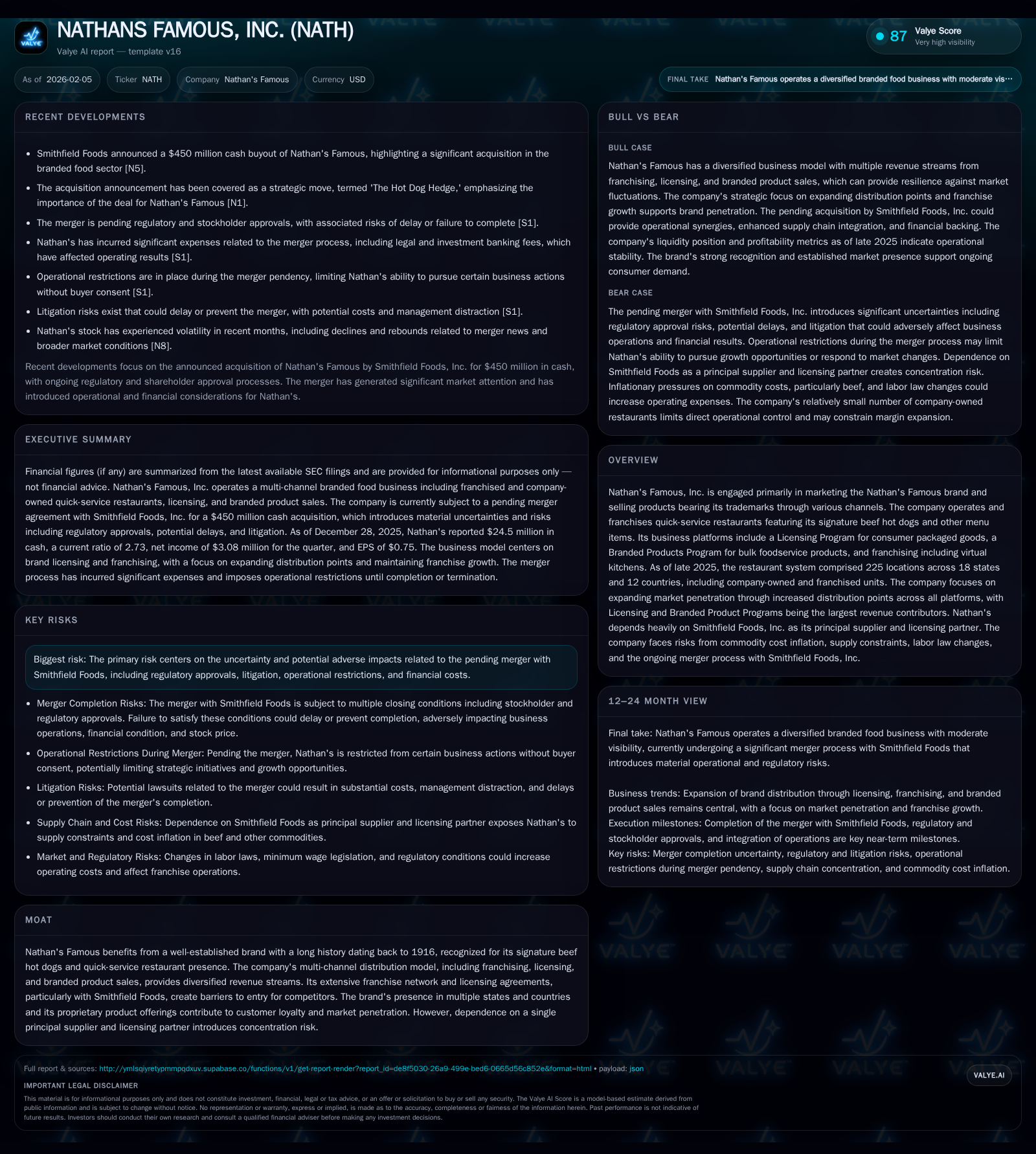
Nathan's Famous, Inc. balances its rich heritage with complex modern realities as it approaches a $450 million acquisition by supplier-turned-buyer Smithfield Foods. The company has successfully expanded beyond its iconic quick-service restaurants into licensing and branded products, generating diversified revenues. However, the pending merger highlights concentration risks and regulatory uncertainties that could impact operational stability. This analysis explores Nathan’s multi-channel strategy, financial standing, merger-related risks, and investor responses amid this critical transition phase.
From Coney Island Icon to Multi-Channel Marketer: Nathan’s Evolution
Founded more than a century ago on the bustling boardwalk of Coney Island, Nathan's Famous has grown from a single hot dog stand into a multifaceted foodservice brand recognized worldwide. Its signature beef hot dogs remain emblematic of American quick-service dining culture, but the company’s business model has evolved well beyond its original restaurant footprint. As of late 2025, Nathan’s operates and franchises approximately 225 outlets spanning 18 U.S. states and a dozen international markets, melding direct consumer engagement via brick-and-mortar locations with expansive brand licensing and product distribution channels [valye_report_excerpt][F1].
This evolution reflects a conscious strategic diversification aimed at enhancing revenue stability and broadening market reach. Core platforms now encompass not only traditional franchising of quick-service restaurants but also two high-margin non-restaurant vehicles: the Licensing Program for consumer-packaged goods bearing the Nathan’s Famous mark and the Branded Products Program that targets bulk foodservice clients with proprietary offerings. The inclusion of virtual kitchens further demonstrates an embrace of digital-enabled restaurant delivery trends.
By expanding distribution points across these multiple vehicles rather than relying solely on owned or franchised stores, Nathan’s mitigates some traditional risks associated with physical restaurant operations such as geographic saturation or single-market downturns. This trajectory situates Nathan's as a contemporary brand marketer leveraging legacy equity to penetrate diverse consumption occasions.
The Symbiotic Relationship with Smithfield Foods: Supplier and Acquirer
Few business relationships characterize interconnectedness as closely as that between Nathan's Famous and Smithfield Foods. Long-standing contractual ties designate Smithfield—an established leader in pork production—as Nathan's principal supplier and exclusive licensee for many product categories. This dependency translates to operational efficiencies but also significant concentration risk given the alignment of revenues and supply continuity [valye_report_excerpt][S2].
In January 2026, this symbiosis entered an entirely new dimension with Smithfield’s announcement of a roughly $450 million all-cash offer to acquire Nathan’s Famous outright [N1]. The proposed transaction underscores Smithfield’s strategic intent not only to secure supply chain control but to consolidate brand ownership within its portfolio, potentially streamlining margins and market positioning.
However, such overlap exposes potential conflicts and complicates future governance: becoming both principal supplier and parent company invites scrutiny over contractual fairness and post-merger integration complexities. It also raises questions about how franchisees and other stakeholders may react to increased vertical integration by a supplier historically external to operating decisions.
Decoding the $450 Million Buyout: What’s on the Table for Nathan's?
Smithfield disclosed its acquisition proposal at $450 million cash consideration—a premium reflecting both Nathan's brand goodwill and strategic value within meat product ecosystems [N1]. For shareholders of Nathan’s Famous, this represented an immediate liquidity event underpinned by tangible financial premium compared to trading levels prior to announcement.
Market commentary captures interest in how this valuation aligns with Nathan's intrinsic worth given its diverse revenue platforms versus traditional restaurant comparables [N3]. Analysts have labeled the shift metaphorically as “The Hot Dog Hedge,” denoting Smithfield's defense against market volatility by locking down a historic fast-food brand integrated within its supply chain.
Behind the scenes lie complex deal mechanics including shareholder approval requirements and regulatory review processes that will test transaction feasibility amid antitrust considerations given Smithfield’s sector prominence. Furthermore, questions linger whether this buyout strategy signals broader industry consolidation trends or simply represents an opportunistic vertical expansion by Smithfield.
Multi-Channel Growth Engines: Licensing, Franchising, and Branded Products
Nathan's financial disclosures emphasize Licensing and Branded Product Programs as primary contributors eclipsing restaurant operations in size [valye_report_excerpt][F1][S2]. Licensing agreements allow third-party manufacturers nationwide to produce packaged goods under the renowned Nathan’s banner—capitalizing on brand recognition without direct operational expenditure.
Similarly, the Branded Products initiative supplies bulk foodservice customers with proprietary formulations tailored for volume buyers such as concessions or institutional cafeterias. This segment benefits from stable institutional demand less susceptible to retail foot traffic fluctuations.
Franchising remains vital for physical presence growth; however, it faces evolving challenges including labor cost inflation, regulatory complexities around employment classifications (such as joint employer definitions), and dynamic consumer preferences toward off-premise dining modalities.
The interplay across these channels affords balance: while franchise restaurants anchor brand visibility domestically and internationally, licensing extends reach passively; branded products secure commercial contracts creating recurring revenue streams resilient to economic cycles.
Financial Snapshot and Operational Health Amidst Transition
Reviewing latest Q4 results ending December 2025 reveals net income approximating $3.08 million against solid liquidity levels characterized by cash & equivalents totaling approximately $24.5 million [F1]. Current assets stood near $43.9 million relative to $16.1 million current liabilities producing a robust current ratio near 2.73—indicative of comfortable short-term obligations coverage.
These figures reflect operational discipline despite pressures common in foodservice industries such as rising input costs (notably beef prices), wage inflation driven by minimum wage legislation in New York State where flagship operations reside, and ongoing pandemic-related supply chain disruptions captured within management discussions [S2].
Liquidity strength provides breathing room during merger deliberations allowing strategic choices without immediate financial duress. However, transaction-related fees estimated in millions along with integration transitional expenses will pose short-term earnings headwinds should the deal consummate.
Risks and Unknowns: Regulatory Hurdles and Merger Execution Challenges
Management’s recent filings outline an array of risks linked squarely to the proposed merger process [S2]. A gamut of uncertainties includes:
- Obtaining requisite stockholder approvals needed for deal ratification;
- Securing timing-sensitive regulatory clearances potentially complicated by antitrust reviews given Smithfield’s sector dominance;
- Litigation risks arising from dissatisfied shareholders or third parties contesting transaction terms or competitive concerns;
- Operational distractions diverting managerial focus away from core growth initiatives;
- Potential obligation to pay termination fees exceeding $10 million should deals falter under specified circumstances;
- Uncertain realization timelines for anticipated synergies post-merger blending.
Such factors contribute considerable execution risk; failure or delay could negatively erode stock valuations while dampening employee morale and stakeholder confidence during protracted uncertainty periods.
Broad economic variables such as inflationary pressures on meat inputs coupled with shifts in consumer eating habits additionally compound forecast volatility rendering forward-looking predictions cautious.
Investor Sentiment and Stock Price Movements in a Volatile Market
Market data chronicles notable fluctuations in Nathan’s stock price surrounding merger announcements highlighting investor ambivalence [N8][N6][N7]. After peaking amid bid reveals, shares experienced pullbacks reflective partly of overall bearish sentiment among restaurant stocks during early 2026 coinciding with broader geopolitical news events unrelated directly but influencing market psychology [N2][N4][N5].
Analysts coining phrases like “The Hot Dog Hedge” depict investors wrestling between appreciating vertical integration logic versus fearing post-merger disruption risks [N3]. Contrastingly peers like Rave Restaurant have recorded optimistic share gains prompting comparative valuation debates questioning whether Nathan's narrative sufficiently resonates on growth prospects absent ownership change [N6][N7].
Overall sentiment embodies cautious optimism tempered by reminders that transaction approval remains subject to multiple contingencies influencing near-term price dynamics while longer-term views hinge upon integration success.
Looking Ahead: Integration Synergies or Strategic Disruptions?
Projecting beyond closure involves multivariate scenarios rooted in disclosed merger frameworks [S2][valye_report_excerpt]. Potential upside lies in:
- Leveraging Smithfield’s expansive supply network enabling cost efficiencies through scale purchasing power;
- Heightened cross-selling opportunities merging manufactured product reach with branded restaurant footfall;
- Streamlined innovation pipelines combining culinary development resources enhancing menu offerings;
- Expanded international market penetration facilitated by aligned global distribution capabilities.
Conversely risks include:
- Franchisee pushback fearing loss of autonomy or unfavorable contract revisions post-acquisition;
- Cultural mismatches impeding smooth integration raising employee turnover or service inconsistencies;
- Regulatory compliance burdens amplifying administrative overhead;
- Brand dilution if product uniformity increases at expense of regional flavor distinctiveness synonymous with historical appeal.
Given management commentary emphasizing cautious optimism yet acknowledging execution complexity [S2], outcomes will likely depend on measured integration strategies avoiding overreach while delivering tangible stakeholder value gains.
This analysis synthesizes publicly available information up to February 2026 without predicting future share price movements or offering investment guidance. Merger-related developments are inherently uncertain; readers should consider these alongside evolving official disclosures from Nathan's Famous and Smithfield Foods.
Disclaimer: This is research-only, informational analysis and not investment advice. It may include AI-generated interpretation and general industry context. Always verify important details using primary sources.

Comments