
Ingevity’s Strategic Simplification Tests Profitability and Cash Flow Recovery in Specialty Materials
Ingevity Corp advances a leaner portfolio focused on activated carbon and sustainable chemicals amid restructuring and litigation challenges.
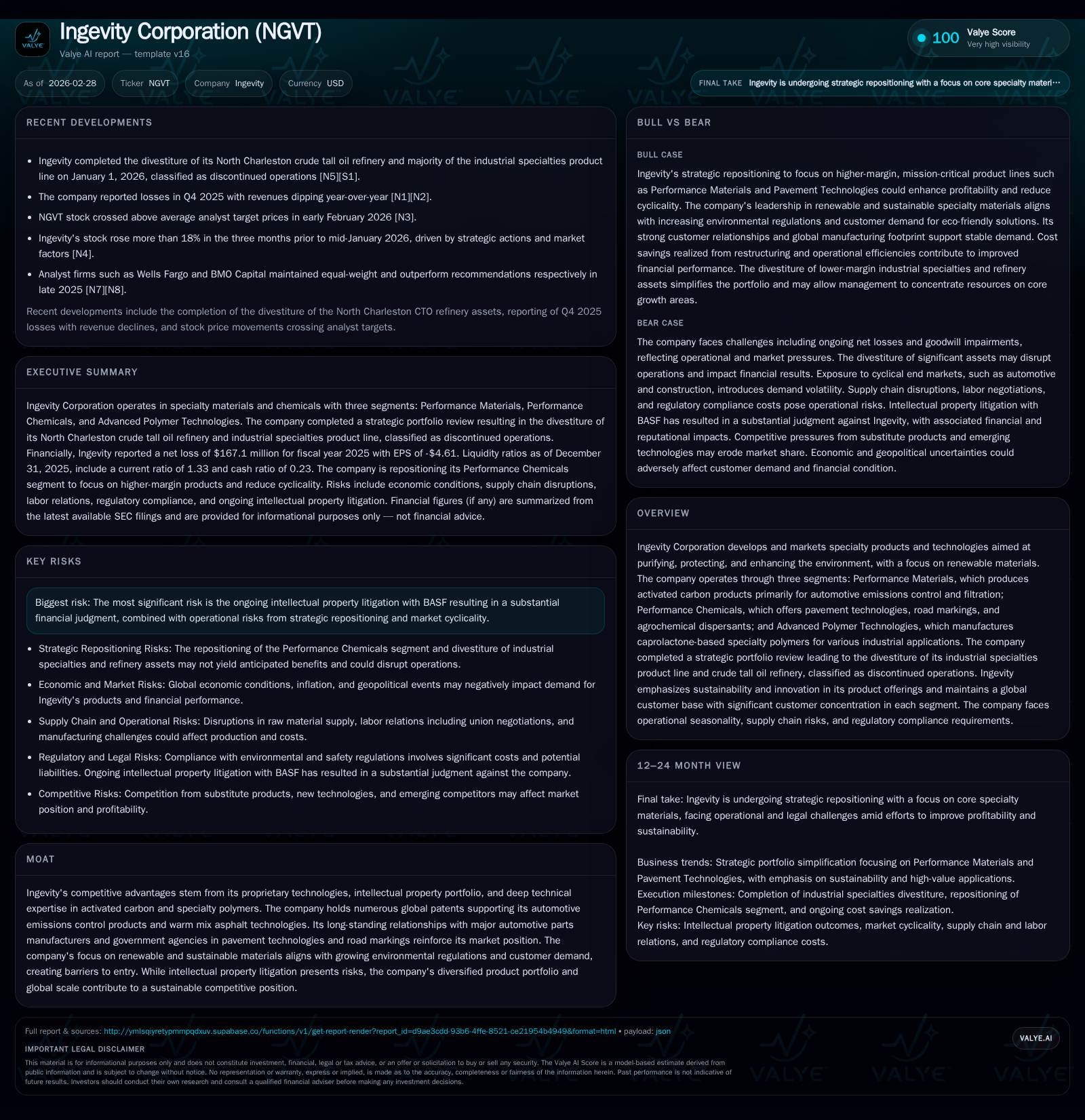
Ingevity Corporation has pursued a strategic reshaping of its business portfolio, divesting non-core industrial specialties and crude tall oil assets to concentrate on higher-margin growth areas like Performance Materials and Advanced Polymer Technologies. The company posted improved operating income in 2025 despite continuing net losses driven largely by legacy legal costs and postponed appeal outcomes. Strong cash flow generation supports ongoing share repurchases and debt repayments, while operational risks from third-party dependencies and regulatory uncertainty loom. Future growth depends on broad adoption of stricter emissions regulations worldwide and successful repositioning of its Performance Chemicals segment’s road markings and polymer businesses.
Company Overview
Ingevity Corporation operates as a global provider of specialty products aimed at purifying, protecting, and enhancing environments through renewable-based technologies focused primarily on activated carbon, pavement solutions, and specialty polymers. Its portfolio is organized into three main reportable segments: Performance Materials (activated carbons for automotive emissions controls and filtration), Performance Chemicals (markets pavement additives, road markings, agrochemical dispersants), and Advanced Polymer Technologies (caprolactone-based specialty polymers).
The firm has undergone significant transformation since separating from WestRock in 2016; most notably recently completing strategic divestitures including the sale of its North Charleston crude tall oil refinery and industrial specialties product line by early 2026. This shift underpins "New Ingevity," emphasizing higher-margin core segments aligned with sustainability trends [S1][S22].
Historical Financial Performance
Ingevity's financial trajectory shows mixed results amid structural changes and external challenges. Fiscal year 2025 delivered an operating income gain of approximately 13.5%, reaching $418.7 million compared to $369 million in 2024 [F1], reflecting improved operational efficiency post-divestiture. However, net income remained negative at -$167.1 million due largely to substantial litigation-related charges associated with ongoing disputes primarily against BASF over intellectual property infringement claims [F1][S6][S20].
Operating cash flow strengthened markedly by about 157.5% year-over-year to $331.2 million in 2025 from $128.6 million in 2024, helping generate free cash flow estimated at $249 million after capital expenditures projected between $50-$70 million annually [F1][S23]. This improvement was supported by reductions in working capital requirements and resumption of positive earnings margins post restructuring.
Share repurchases resumed with approximately $56 million executed in fiscal year 2025 following a pause during earlier restructuring phases [F1][S12]. Equity capital remains minimal at just under $30 million by end-2025—a residual effect of sustained historic losses eroding net book equity [F1].
Historical performance (annual)
| FY | Net ($mm) | CFO ($mm) | OpInc ($mm) | Net YoY |
|---|---|---|---|---|
| 2025 | -167 | 331 | 419 | +61.2% |
| 2024 | -430 | 129 | 369 | -7868.5% |
| 2023 | -5 | 205 | 397 | -102.6% |
| 2022 | 212 | 313 | 453 |
Source: SEC companyfacts cache [F1].
Capital returns and efficiency (annual)
| FY | Buybacks ($mm) | ROE% |
|---|---|---|
| 2025 | 56 | -562.6 |
| 2024 | 0 | -220.4 |
| 2023 | 92 | -0.9 |
| 2022 | 145 |
Source: SEC companyfacts cache [F1].
- Capex range per projections; exact figure not disclosed.
Segment Performance and Industry Positioning
Performance Materials
This segment leads Ingevity’s revenue base with products predominantly using hardwood sawdust-derived activated carbon chemically treated with phosphoric acid—a critical specialty input subject to fertilizer market dynamics affecting phosphoric acid supply cost [S5]. Their automotive gasoline vapor emission control applications benefit from strict regulatory environments primarily in North America (50% of segment sales) and Asia Pacific (40%), including China where regulations require durable life-of-vehicle compliance systems.
Activated carbons also find application in food/water/beverage filtration markets providing diversification beyond automotive end-users [S13]. The segment exhibits customer concentration with the top ten customers accounting for approximately 90% of sales including major automotive parts suppliers such as PHINIA Inc., A. Kayser Automotive System GmbH, MAHLE GmbH among others [S13].
Performance Chemicals
This business centers on pavement technology additives designed for asphalt construction/preservation/recycling alongside road marking paints supplying around 600 customers globally [S16]. The flagship Evotherm warm mix asphalt technology reduces production temperatures enabling extended paving seasons and incorporating recycled content; these benefits reduce emissions but face adoption variability by region relative to infrastructure spending priorities.
Road markings represent a mission-critical offering servicing prominent private contractors & government agencies across North America (~59% of line sales concentrated among top customers) amidst competitive pressures from Sherwin-Williams & PPG Industries Traffic Solutions [S16]. Despite sizable revenues near $400 million annually over recent years, repositioning efforts including divestiture plans for industrial specialties signal margin pressures reflective of cyclical end market sensitivity [S11][S19].
Advanced Polymer Technologies (APT)
APT manufactures caprolactone-based polymers utilized across diverse applications such as coatings, adhesives, bioplastics, elastomers with sustainability advantages like biodegradability features certified across multiple environments [S9]. Sales declined from ~$204 million down to about $160 million for fiscal year-end 2025.
The company has begun exploring potential strategic alternatives for APT aiming at operational improvements—but outcomes remain uncertain given market competition including players like Daicel Corporation & BASF SE vying within caprolactone chemistry spaces [S9][S19].
Litigation Challenges Impacting Financials
A protracted legal battle with BASF dominates Ingevity's risk profile stemming from enforcement actions around a pivotal patent covering canister systems for gasoline vapor control. Initial patent infringement claims were dismissed while counterclaims led to a jury verdict favoring BASF awarding approximately $28.3 million trebled under antitrust statutes plus accruing interest through late-2025.
Ingevity exhausted appeals after an adverse February 2026 Federal Circuit decision choosing not to pursue further remedies—foreseeing payment obligations including additional attorneys’ fees likely requested by BASF that could increase total liabilities beyond judgment sums already accrued ($95.4 million recorded as of December 31st 2025) [S6][S18][S20]. Such rulings have imposed substantial earnings headwinds causing consecutive annual net losses despite operational gains.
Capital Allocation and Liquidity Position
Capital allocation reflects prioritization on deleveraging combined with selective return of capital via share repurchases ($56M completed in FY25), resuming after inactivity during earlier restructuring years [F1][S12]. Capital expenditures remain controlled within a modest range ($50–70M projected for FY25), focusing on maintenance plus selective growth projects prioritizing cost improvement initiatives rather than aggressive expansion [S23][F1].
Liquidity appears sound with cash balances near $78M at fiscal year-end alongside ample undrawn revolver capacity ($477M unused as of late September 2025) providing operational flexibility amidst uncertain macroeconomic backdrops including inflationary pressures and global geopolitical instability impacting key end markets like automotive manufacturing globally.[F1][S4][S7]
Operational Risks and Regulatory Environment
Third-party dependencies on utilities such as compressed air and energy provision at critical plants impose operational risk exposures especially amid co-location arrangements—for example at the Warrington UK facility where service providers have scaled down operations but retain critical service roles posing cost or disruption risks if contracts fail or third party disruptions occur [S1]. The company relies heavily on raw material inputs including hardwood sawdust sourced via diversified vendors mitigating supply disruptions though exposure remains present.
Environmental compliance costs might escalate amid tightening laws such as OSHA Process Safety Management code for chemical hazards or TSCA & REACH regulations governing chemical usage across U.S., EU & UK jurisdictions requiring continual investment maintaining operational licenses without material adverse effects currently anticipated but risk persists given evolving landscape particularly related to certain raw material chemicals [S15][S17].
Growth Outlook Analysis
Future growth drivers depend largely upon:
- Continued tightening worldwide air quality standards mandating advanced onboard gasoline vapor emission controls driving Performance Materials demand; any delays or relaxations globally may hinder growth materially given automotive exposure[S17][S19];
- Successful repositioning or monetization of APT segment alongside road markings product line improving margin profiles;
- Potential geographic expansion especially where emerging markets begin adopting stricter environmental norms;
- Innovation pipeline leveraging intellectual property portfolio enabling next-gen activated carbon products beyond automotive fields into filtration or energy storage sectors;
- Scaling pavement additive technologies emphasizing sustainability attributes complementing infrastructure investment cycles influenced by government spending.
Key milestones include completion of ongoing sales transactions finalized by early calendar year 2026 positioning New Ingevity structure clearly; monitoring BASF settlement payments anticipated Q2 2026 impacting cash flows; progress updates on strategic review outcomes relating to APT/road markings segments will be pertinent financial catalysts.
Summary Observation
Ingevity’s strategic narrowing toward core competency areas backed by progressive environmental regulation positions it well within specialty materials tied closely to sustainability megatrends while legacy litigation burdens materially depress net profitability metrics currently evident across recent reporting periods.[F1][S6][S20] Robust operating cash flow generation sustains liquidity enabling deleveraging via debt repayment paired with shareholder returns notwithstanding ongoing repositioning execution risk.[S12][S23][F1] Nonetheless persistent industry cyclicality coupled with complex third-party plant dependencies suggests continued vigilance necessary managing operational continuity amid evolving global economic conditions.[S1][S17]
Investors should continue tracking regulatory developments affecting emissions standards adoption globally alongside management's ability to execute segment divestitures/improvements slated under New Ingevity strategy.
This analysis is based solely on cited factual public disclosures without any form of investment recommendation or valuation perspective.
Disclaimer: This is research-only, informational analysis and not investment advice. It may include AI-generated interpretation and general industry context. Always verify important details using primary sources.

Comments