
How Neptune’s Proprietary Technology is Reshaping Flood Insurance Economics
Neptune leverages AI-powered underwriting and policy management platforms to achieve unrivaled underwriting performance and scalable growth in the private flood insurance market.
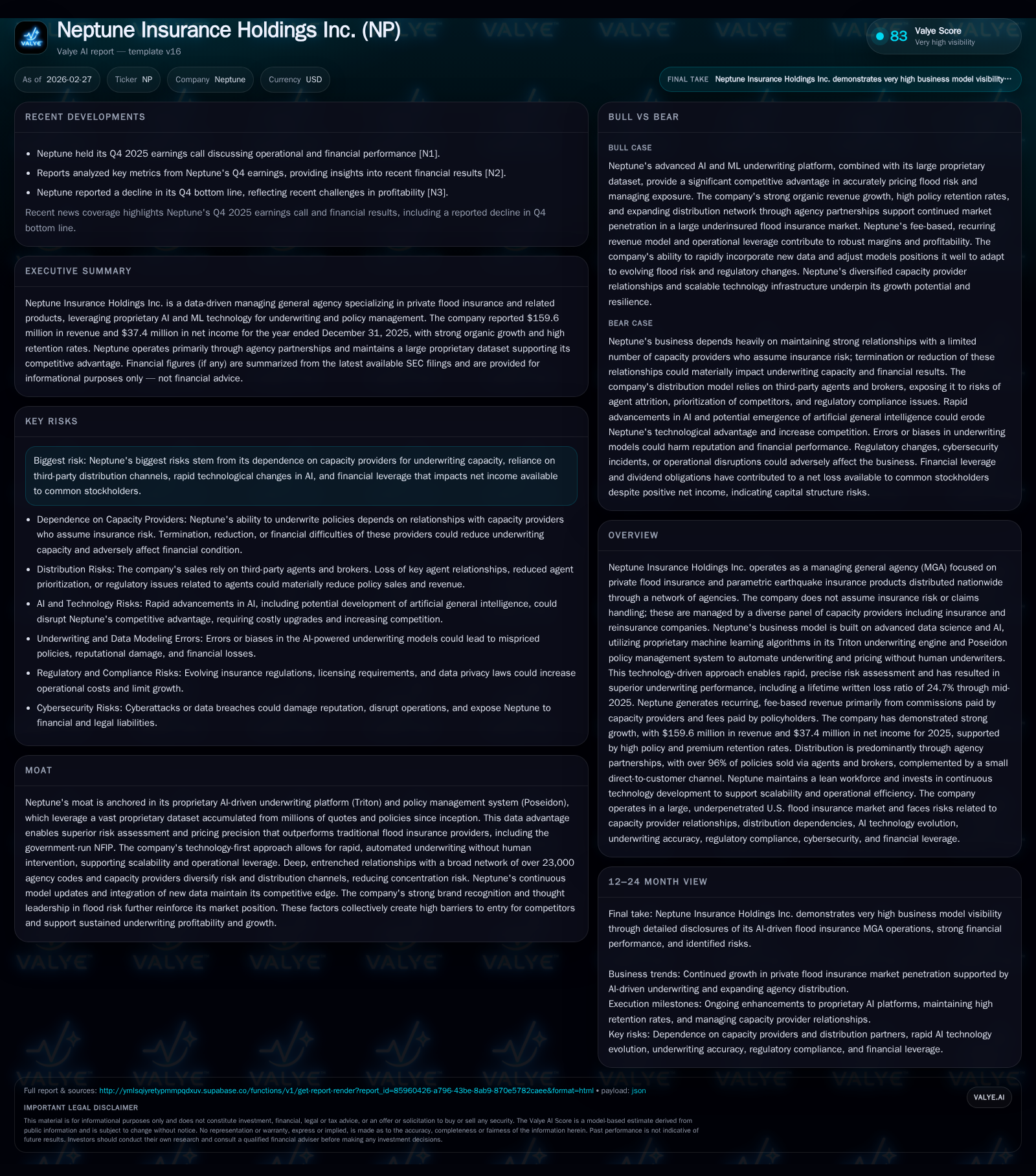
Neptune Insurance Holdings, a managing general agency specializing in private flood and parametric earthquake insurance, has built a technology-driven model anchored by proprietary machine learning underwriting (Triton) and policy management (Poseidon) systems. This innovation has delivered superior loss ratios and robust organic revenue growth of 33.7% in 2025. The company’s unique blend of a vast proprietary dataset, broad capacity provider relationships, and agent network creates a durable competitive moat amid evolving regulatory shifts impacting government flood insurance programs. However, financial leverage, dependency on capacity providers, and rapid AI evolution remain material risks to monitor.
AI Backbone: Triton & Poseidon Power Growth
Neptune Insurance Holdings stands apart in the flood insurance space through the deployment of its cornerstone technology platforms: the Triton underwriting engine and the Poseidon policy management system. At its core, Triton applies advanced machine learning (ML) algorithms trained on a proprietary dataset accrued from millions of quotes and policies since Neptune’s inception. This depth of data input enables granular, risk-adjusted pricing that surpasses traditional actuarial methods with nimble adaptability—a critical feature given the high variability of flood risk.
Poseidon complements Triton by automating the entire policy lifecycle without human underwriters, dramatically reducing processing times while improving accuracy and operational leverage. The integration ensures end-to-end underwriting throughput that scales effectively across a national agency distribution network exceeding 23,000 codes. The ML models continuously ingest claims outcomes and exposure data to calibrate loss predictions dynamically—in other words, Neptune's AI-driven ecosystem sustains its own competitive edge through self-improving analytics embedded into daily operations [S1].
Parametric earthquake products further extend Neptune's technological prowess by leveraging predefined indices for rapid claim settlements, illustrating platform flexibility beyond traditional indemnity flood lines.
Historical Performance & Revenue Drivers Through 2025
Neptune reported strong top-line momentum fueled by both new sales growth and enhanced renewal rates attributable to data-driven model optimizations. In fiscal 2025 revenue reached $159.6 million, up 33.7% year-over-year predominantly from commissions which grew 35.4% alongside fee income gains of 28.6%. These increases track with rising written premium volume reflecting both organic portfolio expansion and renewed market demand [S1][F1].
Operating expenses surged by 74.2%, primarily owing to agent commissions closely correlated with policy count growth plus substantial escalation in share-based compensation following the late-2025 IPO. General administrative expenses also climbed due to expanded infrastructure supporting scale [S1]. Despite these cost headwinds operating income rose modestly to $71 million—an indicator of margin resilience despite upfront investments.
The company achieved net income of $37.4 million for the year with a net margin of approximately 23.4%, underscoring profitable scaling even with intensifying operating expense investment [F1].
Historical performance (annual)
| FY |
|---|
| 2025 |
Source: SEC companyfacts cache [F1].
Revenue growth chiefly driven by increased policies in force; agent commissions proportionally increased maintaining consistent commission rates.
Evolving Private Flood Market Dynamics and Competitive Moat
The U.S. private flood insurance market remains nascent but rapidly evolving due to regulatory reforms affecting the National Flood Insurance Program (NFIP), notably FEMA’s Risk Rating 2.0 initiative which introduced risk-reflective pricing aligned closer with actual exposure rather than historical subsidies . This creates a viability window where private insurers like Neptune can compete on accuracy, service speed, product flexibility, and tailored coverage.
Neptune’s moat consolidates three pillars: its AI-first underwriting platform leveraging extensive proprietary datasets; a diversified panel of capacity providers who carry the insurance risk thus minimizing balance sheet volatility; and a deeply entrenched distribution network exceeding 23,000 agency codes which mitigates concentration risk prevalent among smaller MGAs or direct-to-consumer models [S1]. The technology not only yields superior predictive loss ratios (written loss ratio lifetime at just 24.7%) but also enables ongoing model refinement keeping pace with emergent climate patterns and claims trends.
Additionally, Neptune’s ability to offer bundled indemnity flood, excess flood layers supplementing NFIP coverage, and parametric earthquake products broadens its addressable segments mitigating single peril dependence [S22]. These multi-product capabilities elevate Neptune beyond straightforward private flood insurers ultimately enhancing resilience.
Growth Prospects Amid Regulatory and Market Shifts
Looking forward, Neptune identifies significant runway as flood insurance remains underpenetrated with over 100 million residential/commercial buildings exposed nationally lacking adequate coverage . The company aims to deepen penetration via expansion of agency partner networks, enhancements in underlying ML renewal algorithms driving elevated acceptance rates (renewal retention reached over 91%), and continuous innovation in product features including deeper parametric earthquake offerings [N1][S1][N2].
Regulatory developments remain double-edged: while Risk Rating 2.0 dismantles certain subsidy barriers favoring private write-ups, any future government strategies lowering NFIP premiums or expanding subsidies could constrain margin or volumes respectively [S26]. Success will depend on balancing agility in AI model updates with sustained capacity relationships that expand underwriting limits without concentration risks.
Innovation cadence is crucial; disruptive entrants deploying new forms of AI might intensify competitive dynamics or require Neptune to accelerate R&D investment cycle times [S2][valye_report_excerpt.risks]. Strategic monitoring of regulatory filings at state levels affecting MGA licensing is also essential for maintaining distribution breadth.
Capital Structure: Leverage, Liquidity, and Covenants
Neptune refinanced its credit facilities multiple times during recent years culminating in a $260 million revolving credit facility as amended November 2025 providing enhanced liquidity flexibility [S5][S15]. After repaying term loans using proceeds drawn under this revolver, total debt outstanding sits heavily concentrated on this revolver line which bore interest at variable SOFR plus margins dependent on total net leverage ratios.
Covenants require maintaining net leverage below tightening thresholds—from an adjusted max of 5x in most recent quarters toward eventual limits of around 4x starting late-2026—and an interest coverage ratio minimum above 2x [S4][S6]. As of Q4 end-2025 compliance status was maintained with about $240 million drawn leaving $20 million undrawn availability providing working capital cushion [S5][F1].
Liquidity stands sound with cash & equivalents totaling approximately $8 million supplemented by fiduciary cash balances representing premiums awaiting remittance [S6][F1]. Operating cash flow generation was robust at $51.7 million for full-year ‘25 underpinning debt servicing capability despite substantial non-cash charges such as accelerated share-based compensation accounting post-IPO.
Capital Allocation Strategy - Shareholder Returns & Investments
The company does not currently pay dividends nor engage in share repurchases reflecting reinvestment priorities in scaling technology platforms particularly accelerating software development capital expenditures estimated around $4 million annually focused on product functionality expansions [S25][F1].
Return on equity has been negative near -16%, reflective largely of equity dilution effects related to IPO transaction costs rather than operating loss generation per se [F1][S27][S29]. Share-based compensation expenses surged notably from under $0.3 million in ’24 to over $11 million in ’25 consistent with public company transitions incentivizing management retention but pressuring short-term earnings metrics.
As Neptune achieves greater scale effects combined with margin improvement opportunities via operating leverage from automated processing flows, incremental profitability enhancements should gradually arise though clarity on explicit dividend or capital return policy is absent thus far.
Key Risks in Capacity Provider and Distribution Dependence
Capacity concentration remains a material vulnerability given that Neptune does not retain insurance risk itself but depends entirely on diverse reinsurers acting as capacity providers who assume claims liabilities [S2]. Terminations or reductions in these relationships could materially impair premium writing ability or shift cost structures unfavorably.
Similarly strong reliance on third-party agents/brokers demands sustained relationships supported by competitive commissions amid a crowded private flood market featuring governmental competitors with legacy advantages such as subsidized program recognition featuring prominently as challenges mentioned in company disclosures [S11][valye_report_excerpt.risks].
Rapid progressions in broader AI technologies encompassing artificial general intelligence (AGI) paradigms threaten to disrupt Neptune's existing ML model advantages if competitors access similar or superior algorithmic capabilities faster or if regulatory constraints impose additional operational overheads around algorithmic transparency [S2][valye_report_excerpt.risks].
Financial leverage also introduces earnings volatility risks especially given floating rate debt interests—adverse rate environments or refinancing constraints could constrain discretionary investments or necessitate deleveraging actions impacting growth strategies.
Cybersecurity risks linked to centralized data assets govern operational continuity importance as insurance underwriting depends heavily on safeguarding sensitive information streams against breaches which could undermine trust among policyholders and partners alike [S12][S18].
Analyst Upgrades and Market Expectations
Recent broker activity illustrates growing investor enthusiasm tempered by attention toward execution post-IPO milestones including continuous subscription volume growth alongside cautious scrutiny of bottom-line fluctuations largely attributed to transient transaction costs or share-based comp spikes rather than core underwriting deficiencies [N3][N4][N6][N1][N2].
Mizuho Capital emphasized the sustainable competitive moat generated through ML sophistication distinguishing Neptune from peers while appreciating expanded credit facilities enhancing financial flexibility enabling acceleration of customer acquisition initiatives [N3]. Similarly BMO Capital highlighted superior retention improvements facilitated by tech-enabled renewals optimization techniques amid favorable regulatory trends elevating private market adoption prospects yet flagged ongoing dependence on capacity diversification as a watch item [N6].
Keefe Bruyette & Woods reiterated confidence citing quarterly figures above expectations for operating metrics despite net income dips hinting at improving operational efficiency trajectories balanced against an evolving macroeconomic backdrop demanding prudent capital stewardship [N4]. Investors should monitor upcoming quarterly disclosures closely for indicators validating sustained modeling superiority alongside renewal lift trends essential for underpinning medium-term growth story.
Disclaimer: This analysis is intended solely for informative purposes based on publicly available information as of February 27, 2026, without offering investment advice or recommendations regarding the security discussed herein.
Disclaimer: This is research-only, informational analysis and not investment advice. It may include AI-generated interpretation and general industry context. Always verify important details using primary sources.

Comments