
Navigating Complexity: Insperity’s Integrated PEO Model Amid 2025’s Financial and Industry Challenges
Despite a solid client base and industry standing, Insperity contended with margin pressures and operational headwinds throughout 2025.
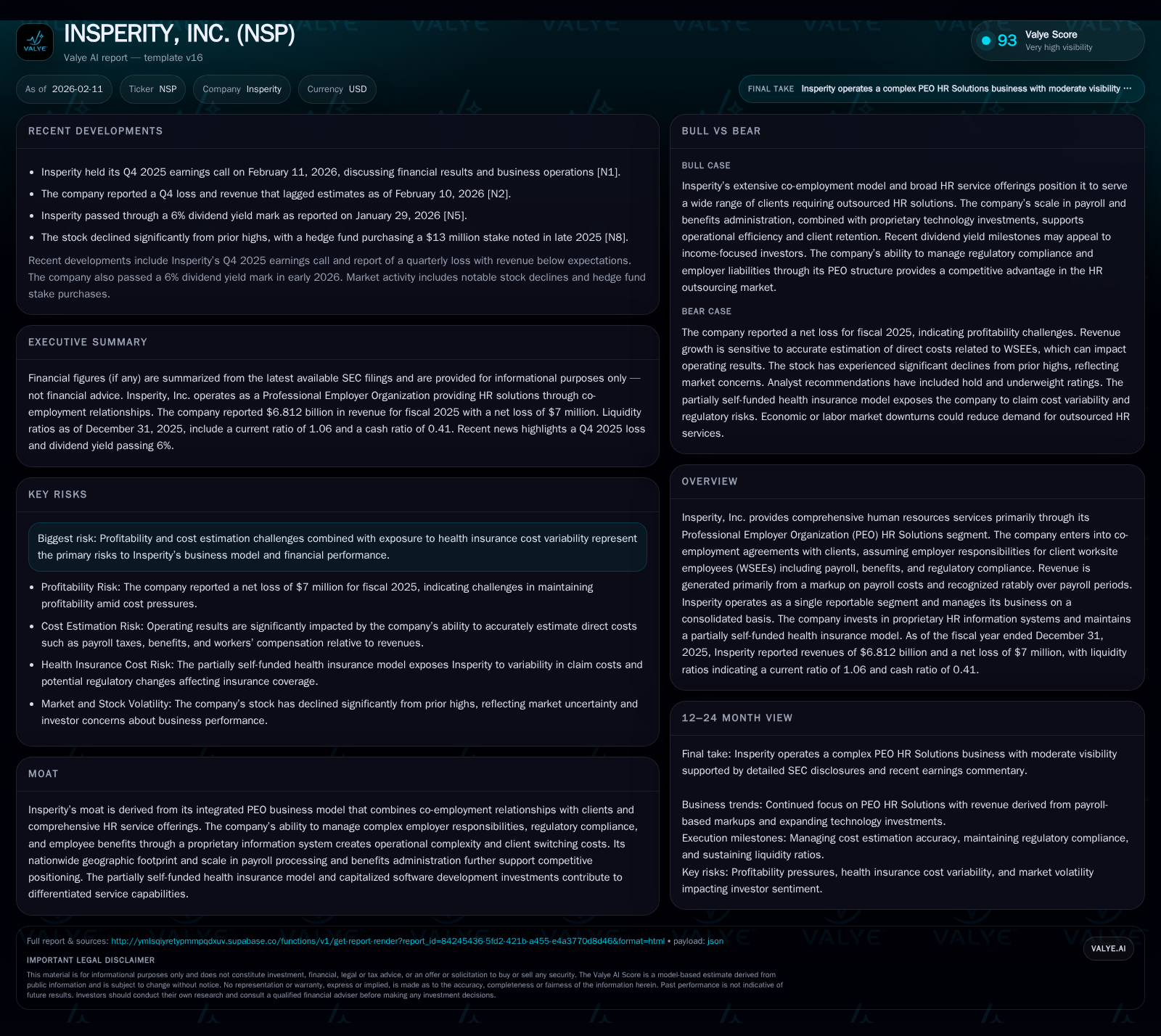
Insperity’s deeply integrated professional employer organization (PEO) model — combining co-employment services, proprietary HR tech, and partial self-funded insurance — supports meaningful client retention but also entails exposure to volatile benefits costs. In 2025, rising health insurance expenses and increased direct costs challenged profitability despite modest revenue growth and workforce expansion. The company is countering headwinds with new product innovations, notably the HR Scale solution developed with Workday, targeting middle market clients seeking advanced HR capabilities. While liquidity remains adequate for now, sustained margin compression underscores operational risks ahead as Insperity confronts evolving client needs and competitive pressures.
Insperity’s PEO Model: A Complicated Moat in HR Services
At the heart of Insperity’s operations lies a complex co-employment arrangement where the company effectively becomes the employer of record for its clients’ worksite employees (WSEEs). This structure entails assuming critical employer responsibilities including payroll administration, employee benefits provision, tax withholding, workers’ compensation insurance, and regulatory compliance [S1]. Unlike a mere outsourcing vendor, Insperity operates hand-in-hand with its SME clients through co-employment contracts that allocate employment rights and duties via a Client Service Agreement.
This arrangement inherently raises entry barriers: clients face significant switching costs since shifting the administrative burden involves disentangling integrated payroll processes, benefits plans, compliance oversight, and a proprietary human capital management platform—Insperity Premier™. The company further differentiates by operating with a partially self-funded health insurance model which leverages internal risk pools rather than relying solely on fully insured third-party carriers. Capital investments into proprietary HR information systems compound operational complexity that competitors must overcome to achieve scale on similar terms.
Together these elements form an intricate moat rooted in legal structure, technology infrastructure, and benefits delivery expertise. However, they also tether Insperity financially to variable cost exposures—particularly in healthcare services—which can amplify margin swings in volatile economic environments.
Breaking Down 2025 Financials: From Revenue Growth to Profitability Erosion
The fiscal year ending December 31, 2025 showcased a nuanced performance story. Total revenues rose approximately 4% year-on-year to $6.812 billion primarily propelled by a slight expansion (1%) in average paid WSEEs along with a modest pricing increase achieving 3% higher revenue per WSEE [S1]. At first glance this signals steady client engagement.
Yet beneath headline growth lurked deteriorating unit economics. Gross profit declined sharply by 14%, dropping to about $900 million — this stemmed mainly from a notable 15% decrease in gross profit per WSEE offsetting volume gains. Delving deeper reveals direct cost per WSEE rose nearly 6%, primarily driven by escalating benefit costs which surged 9% per participant.
These cost pressures sucked margin out from under operations amid relentless insurance inflation that outpaced price pass-throughs. Adjusted EBITDA suffered a steep halving (-51%) down to $131 million highlighting acute profitability stress [S1]. Net income swung into loss territory at negative $7 million (versus prior profits), reflecting near flat revenue but increasing burden from elevated direct expenses.
On labor metrics the average workforce size edged up marginally by approximately 1%, yet efficiency measured as operating expense per WSEE improved slightly due to concerted expense control efforts reducing professional services fees, travel, events, salaries & wages — albeit not enough to offset degraded gross margins [S1]. This financial dichotomy underscores how top-line durability masks emerging core profitability erosion threatening sustainable cash flow.
Cost Pressures and Health Insurance Volatility: The Achilles’ Heel
Insperity’s partial self-funding approach to health insurance embodies both strength and fragility. While avoiding premium markups inherent in fully insured plans affords some control over cost structures during benign periods, it lays bare the company’s P&L when claims escalate unexpectedly or trend upward structurally.
Management has repeatedly flagged these cost estimate challenges as primary risk factors in filings dating back through FY2025 [S1],[S2]. Even amidst proactive pricing adjustments — including a reported average contract price hike around 3% — the surge of nearly twice that rate (9%) for benefits costs per participant created disproportionate financial strain.
Estimation volatility handicaps precise forecasting rendering budgeting efforts complex while introducing potential gaps between accruals and actual claim experience. Margins compress further where contractual obligations limit immediate reimbursement pass-through or delay price resets. This dynamic acts as an Achilles’ heel creating liquidity pressures during periods of sustained healthcare inflation intensified by economic headwinds affecting clients’ business continuity.
Administratively too, managing these risks demands high expertise embedded within Insperity's HR professionals combined with proprietary data analytics—a costly endeavor supporting their moat but weighing on operational leverage.
New Product Innovations and Tech Partnerships: HR Scale with Workday
Amidst margin compression challenges, Insperity is doubling down on innovation as a strategic lever. Key among initiatives is the introduction of HR Scale — a flagship product developed jointly with HR software leader Workday Inc., intending to serve larger or scaling middle market firms needing advanced human capital management solutions [S1].
Scheduled for initial rollout early in 2026, HR Scale integrates Workday’s sophisticated cloud HCM platform with Insperity’s core HR service expertise. Positioned at a premium price point relative to their traditional HR 360 offerings, this suite targets growth-oriented customers requiring agility alongside comprehensive compliance support.
Beyond broadening product portfolio breadth this move aims at capturing emerging demand for tech-enabled workforce management capable of handling complexities beyond basic payroll or benefits administration. By addressing scalability challenges faced by mid-tier enterprises navigating regulatory landscapes and talent acquisition cycles more dynamically, Insperity hopes to diversify revenue sources away from heavily commoditized segments while restoring margin resilience.
In analytical terms, this shift denotes recognition that legacy PEO models alone may prove insufficient long term; embedding next-generation software capabilities could lower client churn risks by expanding ‘stickiness’ through enhanced service sophistication.[S1]
Middle Market & SME Client Dynamics Amid Economic Uncertainty
Insperity serves an expansive client base concentrated largely among small and medium-sized enterprises (SMEs). Notably about one-quarter (26%) of worksite employees stem from middle market accounts defined as companies employing between roughly 150–5,000 [S1]. This group often embodies businesses undergoing organizational growth or transformation phases demanding flexible yet compliant HR frameworks.
However, contracting conditions characterized by cancellable agreements with typically short notice periods foster ongoing client retention uncertainty especially during economic downturns or sector-specific shocks impacting SMEs disproportionately.[S1]
Furthermore, broader macroeconomic uncertainties including inflationary pressures and tighter labor markets can reverberate unevenly at the SME level influencing workforce size fluctuations or willingness to invest in bundled HR services despite their demonstrated value proposition.
The mixed picture of slight average WSEE count growth set against decreasing profitability metrics illuminates underlying tension between stable client engagement volumes but eroding incremental profitability possibly driven by pricing constraints imposed by competition or client budgetary limitations amidst inflationary environments.
Liquidity and Capital Structure: Navigating Margins and Operating Costs
Financially Insperity maintains positive working capital positioning ($102 million at year-end) supported by current assets ($1.722 billion) exceeding current liabilities ($1.620 billion), yielding a current ratio just above unity at approximately 1.06 [F1],[S1]. Cash holdings remain robust at $642 million underpinning short term liquidity cushions necessary given fluctuating earnings trends.
Operating expense discipline emerged as a bright spot where total expenses fell approximately 3% even amid revenue headwinds,[S1] indicative of operational rigor attempting to preserve cash flow amid difficult conditions.
Despite incremental efficiency gains on operating expense per WSEE basis (decreasing from $253 to $245), intensive benefit-related direct costs dominate the margin equation limiting free cash generation potential absent structural shifts or accelerated pricing power.[S1]
In this context sustaining positive liquidity requires balancing investments in technology innovation like HR Scale alongside mitigating escalating healthcare claims exposure—both costly undertakings essential for medium-term competitiveness but challenging against compressed earnings baselines.
Competitor Landscape: How Insperity Measures Up Against Industry Peers
Placing Insperity’s performance in sector context reveals heterogeneous peer outcomes signaling wider human capital management space grappling with cost containment hurdles alongside varying success at monetizing technological advances.
For example, ManpowerGroup surpassed quarterly earnings estimates recently reflecting perhaps broader scale advantages or better cost pass-through capabilities while Kforce missed expectations hinting at persistent margin headwinds plaguing staffing-centric models [N3],[N4].
Such disparities underscore that although sector fundamentals remain attractive given persistent SMB demand for integrated HR services, execution quality around controlling health-related benefits costs particularly distinguishes leaders versus laggards.
Insperity’s entrenched co-employment framework offers unique client lock-in features not easily replicated but sustained profitability depends increasingly on innovating beyond traditional PEO footprints while deftly managing variable cost components comparatively better than its peers.[N4]
Strategic Risks and Forward-Looking Executions for 2026 and Beyond
Looking ahead management commentary from late-2025 earnings dialog candidly acknowledged enduring cost pressures stemming largely from health insurance volatility even as they continue investing heavily into rolling out the Workday-backed HR Scale solution aiming to expand addressable markets [N1],[S2].
Regulatory environments remain fluid adding compliance complexity within co-employment models exposing them legally albeit no new material contingencies surfaced recently [S2]. Macroeconomic uncertainty spanning labor availability challenges complemented by inflation trends could exacerbate client retention difficulties given cancellable contracts posing tangible downside risks.[N1]
Thus Insperity faces delicate dual mandates: stabilizing fragile margins through prudent cost management while simultaneously accelerating innovative service delivery enhancements necessary for future-proofing relevance among growing enterprise customers demanding integrated digital-human capital architectures.[N1]
Prudent observers will weigh management optimism cautiously against recent financial realities but cannot discount strategic moves positioning Insperity potentially well if product-market fit around HR Scale matures as forecasted alongside continued professionalization of SME human resource needs nationally.[N1]
This analysis synthesizes publicly available information up to February 11th, 2026 without forecasting future stock performance or providing investment recommendations. Readers should consider broader market dynamics along with company disclosures when forming perspectives on Insperity's evolving business landscape.
Disclaimer: This is research-only, informational analysis and not investment advice. It may include AI-generated interpretation and general industry context. Always verify important details using primary sources.

Comments