
NovelStem International Leverages Licensing Rights Amid Operational Shutdown
Following NewStem's liquidation and NetCo divestiture, NovelStem shifts to a licensing-centric model amid severe liquidity constraints.
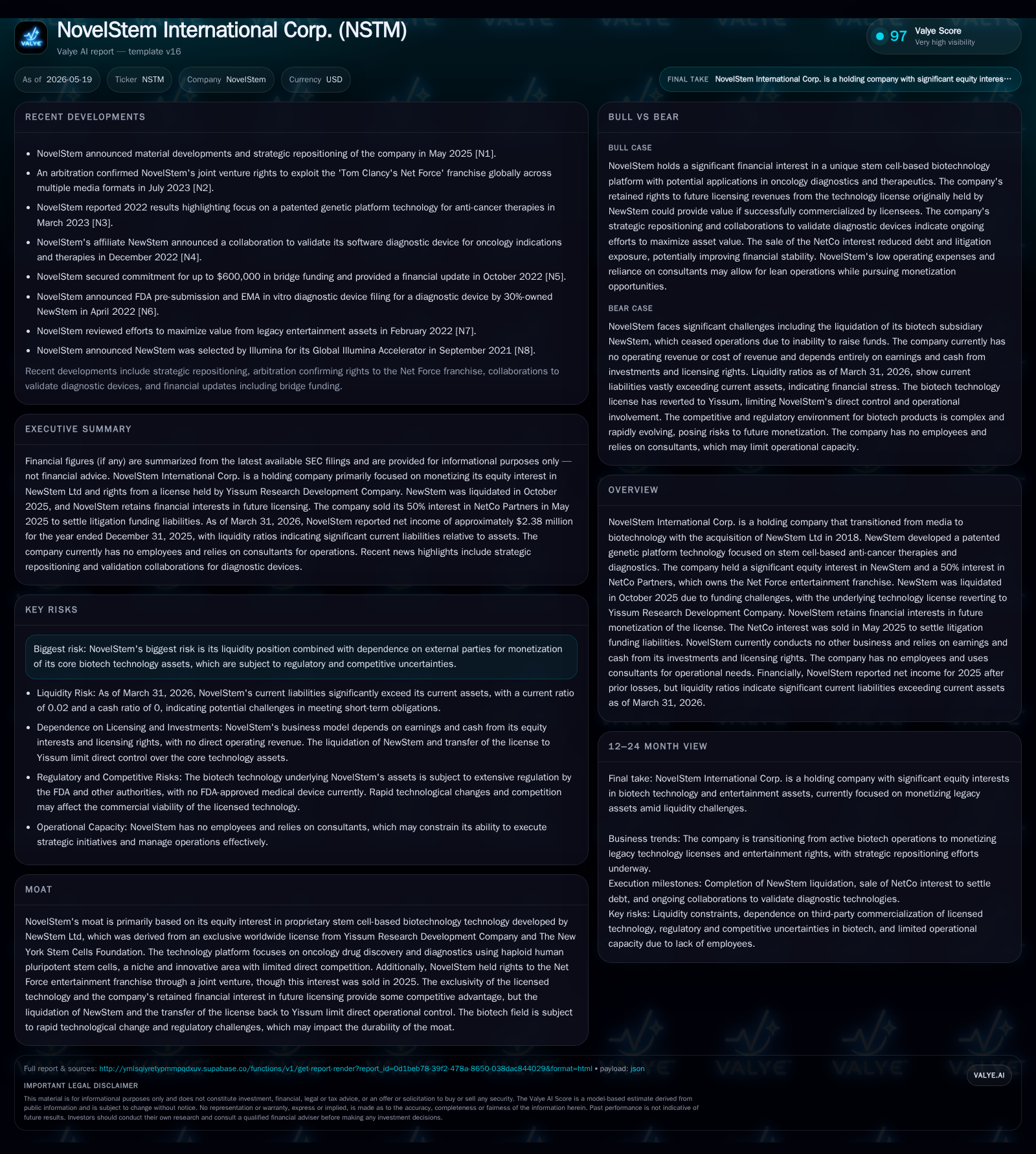
NovelStem International has completed the liquidation of its biotech subsidiary NewStem and sold its entertainment joint venture interest in NetCo, marking a strategic pivot from active operations to monetizing licensing rights inherited from these entities. The latest quarterly filing underscores the company's transition to a holding structure with no employees, relying solely on residual licensing revenues managed externally by Yissum Research Development Company. Despite retaining rights to potential future licensing proceeds up to $3.75 million, NovelStem faces critical liquidity challenges and depends heavily on third-party commercialization success. The company’s growth prospects hinge on external licensing agreements, while operationally it remains passive with mounting working capital pressures.
Latest Quarterly Update: Defining Turning Points
NovelStem International's most recent quarterly filing (10-Q dated May 15, 2026) crystallizes its transformation from an operational biotech holding company into a self-described holding entity without employees or active subsidiaries [S2]. This shift follows NewStem Ltd's liquidation completed in October 2025 — the Israeli biotech subsidiary through which NovelStem held rights to a proprietary stem cell-based anti-cancer technology platform licensed exclusively via Yissum Research Development Company [S1], [S8]. Earlier, in May 2025, NovelStem sold off its 50% joint venture interest in NetCo Partners (owner of the Net Force entertainment franchise) to settle significant litigation funding liabilities [S5], [S16].
Post-liquidation, NovelStem retains only financial interests tied to the licensed technology and no longer directly manages research or development activities. The latest disclosures reveal acute liquidity pressure with current assets approximating $100,000 contrasted against current liabilities well above $2 million as of December 31, 2025 [F1]. Cash balances are negligible (near $1,100 last known mid-2025), underscoring an urgent need for capital infusion or licensing revenue realization [F1], [S2]. The company also extended an interim bridge loan from its Executive Chairman through mid-2026 to maintain basic operations [S3], highlighting the fragility of its financial footing.
Evolving Business Model: From Operating Subsidiaries to Licensing Interests
Historically, NovelStem's business centered on equity ownership controlling influential stakes in NewStem and NetCo — entities engaged in active biotech R&D and media publishing respectively [S1], [S12]. Through NewStem, NovelStem was positioned as a development stage biotech firm focused on pioneering haploid human pluripotent stem cell (hPSC) technology aimed at advancing oncology drug discovery and diagnostics. Management exerted considerable operational influence over NewStem, with the Executive Chairman serving dual roles across both companies [S8].
However, due to persistent funding shortfalls culminating in failed acquisition attempts and inability to secure further financing during 2024-2025, NewStem ceased operations and entered liquidation [S8]. As a result, direct operational control and internal R&D capability dissipated; the exclusive intellectual property license automatically reverted to Yissum — Hebrew University’s tech transfer subsidiary — while NovelStem retained a financially contingent interest in future monetization efforts capped at $3.75 million [S5], [S12].
The sale of NetCo ended that legacy media exposure concurrently settling debt obligations—this divestiture removed an additional operational asset stream yet reduced balance sheet liabilities [S16]. Currently, NovelStem functions primarily as a holding company that relies not on internally generated revenues but on external parties' ability — particularly Yissum's licensees — to commercialize formerly proprietary biotech assets. This model inherently shifts revenue risk externally, making NovelStem’s cash flow dependent on licensing milestones or fee collections rather than product sales or service contracts.
Competitive Context and Industry Dynamics of Stem Cell Biotechnology
NovelStem’s erstwhile core asset was a patented genetic platform focusing on stem cell-based diagnostic technologies using haploid human pluripotent stem cells (hPSCs) for oncology applications. Such technology occupies a niche segment within regenerative medicine and cancer drug resistance prediction arenas where direct competition remains limited due to technological complexity and novelty.
Nevertheless, commercialization within biotechnology—especially diagnostics incorporating stem cell-derived platforms—faces protracted regulatory scrutiny. For instance, NewStem had secured CE marking under EU regulations as an "other" IVD device but did not obtain FDA approval for its medical device offering [S12]. Marketing authorization across jurisdictions varies widely with stringent requirements impacting timing and cost burdens significantly—a factor dampening swift adoption.
Moreover, pricing power for early-stage biotech licenses often remains modest until clear clinical validation occurs; this constrains near-term margin expansion potential absent successful partner investment. Adoption curves reflect typical caution by oncologists integrating new diagnostic tools pending robust evidence demonstrating patient outcome improvement. Thus, while exclusivity over core technology confers a moat against incumbents replicating similar approaches directly, eventual market penetration depends heavily on downstream collaborators’ execution capabilities.
Growth Opportunities Rooted in Licensing Monetization
Given NovelStem’s relinquished direct operations post-NewStem liquidation, future growth prospects rest entirely on licensing monetization under agreements coordinated by Yissum Research Development Company [S5],. Potential value recovery is currently estimated up to $3.75 million contingent on successful exploitation of the underlying biotechnology platform and associated intellectual property.
Such monetization strategies typically involve sublicensing deals with pharmaceutical developers or diagnostic firms seeking proprietary genomic tools for anticancer therapy resistance detection. The ability of these third parties to expand product offerings responsive to shifting customer needs shapes potential revenue inflows back to NovelStem [S1]. These arrangements could generate initial upfront payments followed by ongoing royalties tied to licensing milestones or net sales volumes.
However, realization hinges critically on several exogenous factors including regulatory approvals in major markets like the U.S. and EU—each subject to unpredictable timelines—and competitive innovations emerging from other biotech entities. Without internal capability or resources allocated to product advancement or market development, NovelStem's upside derives exclusively from external commercialization success alongside effective intellectual property enforcement.
Key Risks and Constraints Facing NovelStem’s Future
A prominent risk factor is the company’s precarious liquidity position characterized by minimal working capital sufficiency: reported current assets around $100k versus liabilities exceeding $2 million impose severe operational restrictions [F1]
Further risks include dependence on Yissum’s effectiveness in securing viable licensees who can navigate complicated regulatory pathways typical of advanced biotechnology products targeted at oncology diagnostics. Failure by these parties or unfavorable market reception would impede any value realization for NovelStem.
Additionally, given that NovelStem now lacks internal employees or direct engagement in R&D activities—relying solely on consultants—the absence of operational muscle increases execution risk related to maintaining investor confidence and managing contractual obligations effectively [S12]. Regulatory changes impacting IVD classifications or reimbursement policies could also materially constrain commercial viability.
Milestones and Watchpoints on the Path Ahead
Critical milestones for NovelStem revolve around lucid reporting from Yissum regarding new or existing license agreements tied to the former NewStem technology platform. Updates about sublicensing negotiations, contract signings, upfront payments received, royalties accrued over time—or regulatory progress such as FDA submissions—will be paramount indicators signaling potential cash flow inflection points [S1], [S5].
Moreover, shareholder communications detailing capital raising efforts or bridge loan extensions will provide insight into NovelsTem's trajectory toward sustainable financing solutions given its constrained balance sheet positioning. Management commentary during quarterly disclosures will be vital for monitoring remediation strategies regarding internal controls noted as materially weak due to resource constraints faced during reporting periods [S24].
Lastly, any shifts in patent status or competitive technological breakthroughs reshaping demand dynamics warrant investor attention since they directly influence the license value proposition embedded within NovelStem's residual asset portfolio.
Financial Snapshot: Liquidity Pressures and Capital Needs
As elucidated in the latest filings with supporting companyfacts data: as of March 31, 2026, current assets stand at approximately $100,912 contrasted with current liabilities exceeding $5.3 million—an imbalance indicative of significant working capital deficits likely sustained into subsequent periods absent refinancing actions or material licensing revenue inflows [F1], [S2]. Cash equivalents were roughly $1,106 mid-2025 revealing tight day-to-day liquidity management requirements.
The Company carries convertible debt and notes payable extended by related parties including an interim bridge loan extended by the Executive Chairman maturing June 30, 2026 accruing interest at 10% per annum reflecting ongoing reliance on insider financing support [S3]. Total net debt was estimated near $124,000 end-2023 indicating modest leverage though offset substantially by minimal cash reserves implying fragile solvency.
Management explicitly states dependency on shareholder support combined with successful commercialization efforts by Yissum for company continuity beyond one year forecast horizons—a reliance underscored by disclosed going concern qualifications within annual filings emphasizing acute financial vulnerability until successful asset monetization transpires [S1], [S23].
This analysis synthesizes publicly filed data exclusively without forecasting outcomes not explicitly supported by available statements. It aims solely to clarify NovelStem International Corp.'s current operational posture and strategic implications given recent structural transformations amid challenging financial conditions.
Disclaimer: This is research-only, informational analysis and not investment advice. It may include AI-generated interpretation and general industry context. Always verify important details using primary sources.

Comments