
NeOnc Technologies Weighs Early-Stage Oncology Focus Against Liquidity Pressure
NeOnc ramped up equity financings in early 2026 while continuing to develop its monoterpene-based oncology pipeline.
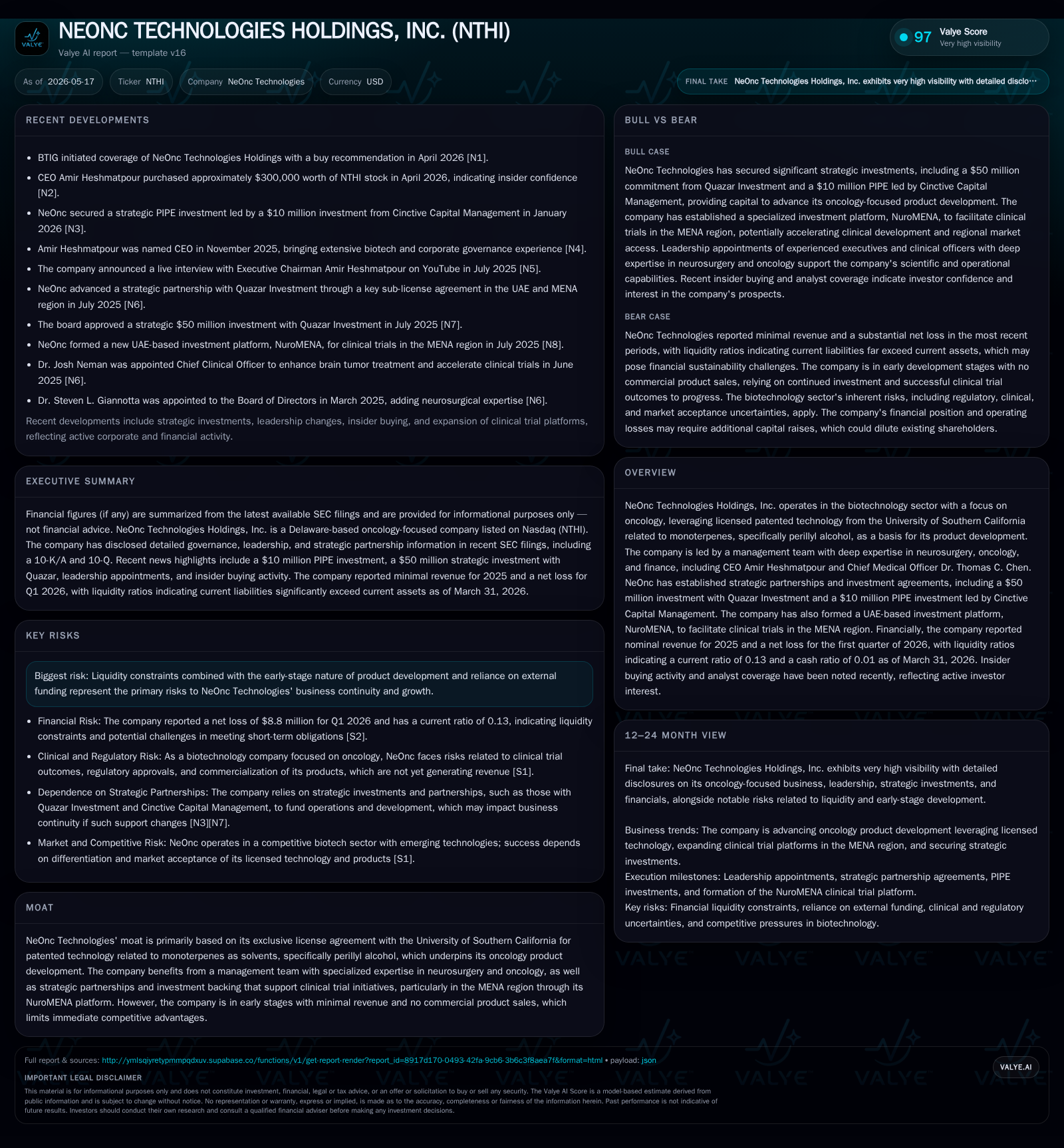
NeOnc Technologies Holdings, Inc. remains in the development phase with exclusive technology licensed for oncology treatments centered on perillyl alcohol. Its latest quarter filing confirms no material changes to risk factors and highlights ongoing capital raises through securities purchase agreements and an ATM offering. The company’s lack of revenue and limited liquidity underline structural risks, while strategic partnerships and a specialized management team support its clinical ambitions, particularly in the MENA region. Near-term growth hinges on successful trial progression and access to continued funding.
Recent Operating Update
The latest quarterly report filed on May 15, 2026 [S2] reaffirms NeOnc Technologies Holdings' position as an early-stage biotechnology company with ongoing operational losses and no changes to previously disclosed risk factors. Despite nominal revenue recorded at $39,990 for full-year 2025 [F1], the company’s net loss continues to scale significantly into tens of millions. As of March 31, 2026, NeOnc's cash balance was roughly $138K against total current liabilities exceeding $16 million, underscoring a precarious liquidity position with a current ratio calculated at approximately 0.13 [F1].
To offset these pressures, NeOnc has actively pursued multiple financing rounds. In early 2026, the company executed four successive Securities Purchase Agreements culminating in several million dollars of proceeds at roughly $7.20 per share plus accompanying warrants exercisable at $9.00 [S3][S8]. Complementing these private placements is an 'at the market' (ATM) equity program initiated in April aimed at raising up to $75 million through sales managed by BTIG LLC and A.G.P./Alliance Global Partners [S17][S19]. This capital influx is explicitly earmarked for advancing preclinical trials such as NEO216 and sustaining broad clinical development efforts.
These developments imply that while NeOnc faces short-term liquidity strains without commercial products or sustained revenues, it is leveraging equity capital markets continuously as its principal financial sustenance.
Business Model
NeOnc's business model revolves around developing novel oncology therapeutics based on an exclusive license from the University of Southern California granted in 2009 [S1]. This license centers on patented technology involving monoterpenes employed as solvents—specifically perillyl alcohol—which serves as the foundation for its product candidates. The company's approach targets cancers with high unmet medical needs, emphasizing mechanistic innovation rather than traditional chemotherapeutics.
Revenue generation will ultimately depend on successful drug commercialization following regulatory approval cycles. Currently, NeOnc operates without any marketed drugs or established sales channels; all revenue recognized is nominal and likely related to non-recurring sources or minimal milestone events [F1].
Its cost structure is dominated by research and development outlays—including collaboration costs paid to USC—and general administrative expenses heavily weighted toward compensation for its specialized management team [S1][S15].
Customer adoption dynamics are indirect at this stage: investors fund ongoing trials anticipating future FDA (or analogous foreign authority) approvals needed to unlock commercial royalties (expected at approximately 2% of net sales under USC licensing terms) [S1]. Success will rest on meticulously executed clinical trial design, regulatory compliance, and eventual market access strategies.
The issuance of warrants alongside common shares as part of financing rounds introduces potential dilution but also aligns incentives for investors betting on long-term pipeline maturation.
Industry Structure and Competitive Position
NeOnc exists within the highly competitive and capital-intensive biotechnology sector specializing in oncology drug development—an arena characterized by high R&D costs, extended timelines, regulatory complexity, and significant scientific risk. Its niche focus on monoterpene-based therapeutics distinguishes it scientifically but does not confer immediate competitive barriers until clinical efficacy can be demonstrated.
Competitors include diversified pharmaceutical companies with robust oncology pipelines alongside smaller biotech firms focusing similarly on novel molecular entities or delivery mechanisms targeting cancer indications.
The company's moat arises primarily from exclusive intellectual property rights granted by USC along with strategic alliances such as its investment platform NuroMENA designed to expedite clinical trials specifically within Middle East and North Africa regions—a somewhat differentiated geographic focus [S1].
Management team's neurosurgical/oncology expertise provides domain-relevant insight critical for navigating early-stage product development hurdles and signaling credibility to investors.
Nonetheless, the absence of commercial-stage assets limits bargaining power vis-à-vis partners or payers currently.
Growth Drivers
Key growth catalysts for NeOnc include:
- Progression of Clinical Trials: Advancement from preclinical studies into human trials represents fundamental validation steps toward potential approval and commercialization milestones.
- Successful Capital Raises: The ability to continuously secure financings—evidenced by multiple securities purchase agreements since late 2025—directly enables expanding research capabilities and operational runway.
- Regional Market Expansion via NuroMENA: Establishing footholds within emerging MENA clinical trial hubs may reduce time/costs relative to more conventional markets and open differentiated patient recruitment channels.
- Technology Licensing Arrangements: Leveraging patented monoterpene technology ensures control over foundational IP which underpins future royalty streams.
- Management’s Industry Expertise: Leadership savvy drives efficient allocation of limited resources toward promising targets and investor confidence.
These markers provide tangible signs tracing risk-reward balance shifts over time.
Financial Profile Highlights (Latest Quarter)
Latest financial snapshot
| Metric | Value | Period |
|---|---|---|
| Cash & equivalents | $138,601 | |
| 2026-03-31 | ||
| Total debt | $320,000 | |
| 2026-03-31 | ||
| Net debt | $181,399 | |
| 2026-03-31 | ||
| Current assets | $2,095,163 | |
| 2026-03-31 | ||
| Current liabilities | $16,287,621 | |
| 2026-03-31 | ||
| Current ratio | 0.13 | |
| 2026-03-31 |
Source: SEC companyfacts cache [F1].
Operating losses remain substantial nearing $58 million annually with net loss roughly $62 million recorded for calendar year 2025 [F1]. The heavy imbalance between current liabilities relative to liquid assets signals urgent capital requirements routinely addressed through equity issuance [S3][S8][S17]. This financial leverage scenario exemplifies typical early biotech risk profiles where burn rate vastly exceeds minimal income until product approvals commence revenue recognition cycles.
Disclaimer: This analysis is based solely on publicly available regulatory filings through May 17, 2026. It presents a qualitative assessment without investment advice or price forecasts.
Disclaimer: This is research-only, informational analysis and not investment advice. It may include AI-generated interpretation and general industry context. Always verify important details using primary sources.

Comments