
Navigating AI and Geopolitics: An In-Depth Analysis of NVIDIA’s Semiconductor Leadership
NVIDIA remains at the forefront of AI-driven semiconductor innovation amid geopolitical headwinds and supply chain complexities.
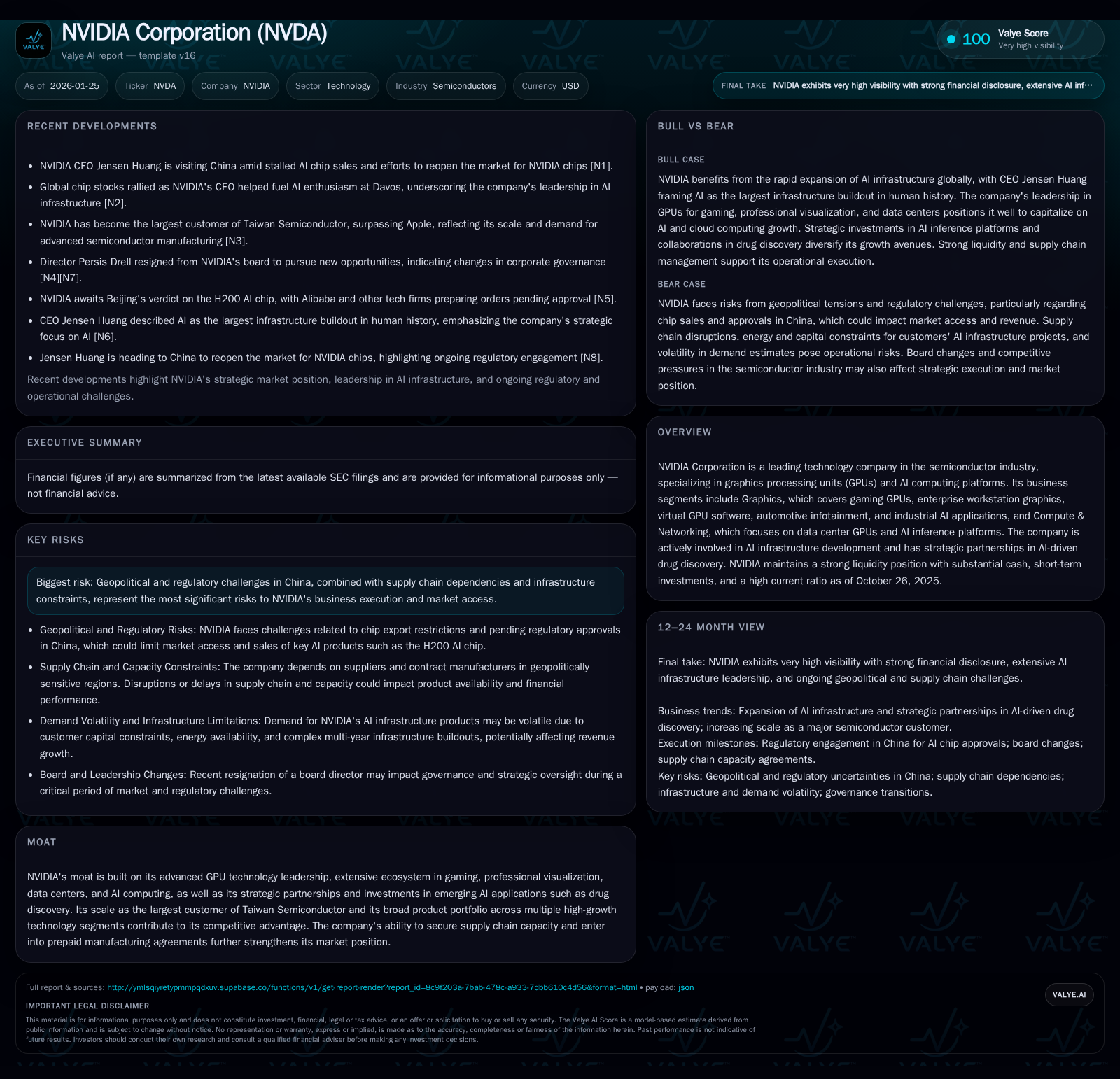
NVIDIA continues to solidify its market leadership through cutting-edge GPU technology and strategic AI platform development, driving robust revenue growth across gaming, data center, and emerging AI applications. Recent advancements include a $20 billion GPU deal and ongoing efforts to resolve China market access amid U.S. export controls. The company’s business model leverages a broad product portfolio, strong customer concentration in Compute & Networking, and a tightly managed supply chain primarily reliant on Taiwan Semiconductor. However, sustained global memory shortages and regulatory challenges pose notable risks. Understanding NVIDIA requires dissecting its integrated system of innovation, ecosystem partnerships, and geopolitical navigation in a rapidly evolving semiconductor landscape.
What Changed Recently
In the last 45 days, NVIDIA has demonstrated both its market strength and the geopolitical hurdles it faces. The company signed a substantial $20 billion GPU deal with Groq, a key AI accelerator partner, reflecting the surging demand for AI compute platforms essential for generative AI and inference workloads [N5]. This deal reinforces NVIDIA’s dominant position in AI infrastructure, supporting its expanding ecosystem beyond traditional GPU markets.
Simultaneously, CEO Jensen Huang's presence at the World Economic Forum in Davos helped fuel an AI frenzy across global chip stocks, underscoring NVIDIA's influence in the sector [N2]. Huang's subsequent visit to China signals a strategic push to navigate U.S. export controls limiting AI chip sales in one of the world's largest markets [N8][N10]. These export restrictions, particularly on NVIDIA's H200 chip, have materially impacted revenue, prompting a $4.5 billion inventory charge tied to excess H200 stock due to diminished demand in China [S22].
Supply-side challenges persist as Micron forecasts a memory shortage extending beyond 2026, which directly affects NVIDIA’s ability to scale production of memory-intensive GPU products [N6]. Despite these headwinds, leading investment banks like JPMorgan and Goldman Sachs have reiterated NVIDIA among their favorite chip stocks, reflecting confidence in its AI compute ecosystem leadership and financial strength [N1][N7].
Business Model as a System
NVIDIA operates a multifaceted business segmented primarily into Graphics and Compute & Networking, which together form a synergistic ecosystem to serve high-growth technology markets [S1]. The Graphics segment includes gaming GPUs, professional visualization for enterprise workstations, automotive infotainment systems, and industrial AI applications. This segment generated approximately $20 billion in revenue, with gaming alone contributing over $4 billion, showcasing the enduring strength of NVIDIA’s core GPU technology in consumer and professional spaces [S3][S6].
Compute & Networking focuses on data center GPUs, AI inference platforms, and networking solutions. This segment accounts for a significant portion of NVIDIA's revenues and includes large customers concentrated in the United States and Europe, with four customers each representing more than 10% of total revenue in the last reported quarter, emphasizing customer concentration risks [S7].
NVIDIA’s business model depends on a continuous innovation cycle—designing advanced GPUs and AI platform software while securing manufacturing capacity primarily through Taiwan Semiconductor Manufacturing Company (TSMC), its largest supplier. The company’s scale with TSMC affords it preferential access to cutting-edge process nodes essential for AI workloads, a critical moat given the capital intensity and complexity of semiconductor fabrication [valye_report_excerpt].
The company also invests heavily in R&D, operating leverage, and ecosystem partnerships, including strategic moves into AI-driven drug discovery and virtual GPU software, broadening its addressable markets. Revenue recognition follows a product and service mix, including OEM sales, direct to customers, and licensing of virtualized GPU software [S1][S2].
Industry Map & Competitive Battlefield
NVIDIA sits at the nexus of the semiconductor and AI infrastructure industries. Its primary competitors span several segments: AMD and Intel challenge NVIDIA in gaming and professional GPUs; Google, Amazon, and specialized AI chip startups like Groq compete in AI inference and data center accelerators. However, NVIDIA’s comprehensive product portfolio and ecosystem integration—encompassing hardware, software frameworks like CUDA, and AI model acceleration—create significant barriers to entry.
The semiconductor industry remains highly cyclical and capital intensive, with supply chain access, wafer fabrication capacity, and memory availability as critical limiting factors. Taiwan Semiconductor’s dominance in advanced nodes and NVIDIA’s status as a major customer provide a strategic advantage but also create geographic concentration risk amid U.S.-China tensions.
Global geopolitical dynamics, especially U.S. export controls aimed at limiting Chinese access to cutting-edge AI chips, shape the competitive landscape. NVIDIA’s ability to license products selectively to China, under evolving regulations, and to engage diplomatically through Huang’s recent visit, will impact its market penetration and growth trajectory [N8][N10][S22].
Where the Economics Become Real
NVIDIA generates revenues exceeding $57 billion annually, with net income over $31 billion, reflecting robust profitability and operating leverage [S2]. Gross margins hover around 70%, driven by high-value GPU products and software solutions. Operating income benefits from scale economies but faces pressures from inventory write-downs related to export restrictions and supply chain constraints [S4][S11][S22].
The company maintains a strong liquidity position, with $11.5 billion in cash and equivalents and a current ratio near 4.5, enabling flexibility for capital expenditures, R&D, and strategic investments [S13][S20]. Capital intensity is significant, with ongoing investments in chip design, AI software platforms, and ecosystem expansion.
Unit economics depend heavily on securing advanced node capacity from TSMC and managing memory availability amid industry shortages forecasted to extend beyond 2026 [N6]. Pricing power is supported by technological leadership and the critical role of NVIDIA’s GPUs in AI workloads, but regulatory controls and supply bottlenecks temper growth.
Customer concentration is concentrated in the Compute & Networking segment, with a handful of customers representing a substantial portion of revenue, underscoring the importance of maintaining key enterprise relationships [S7].
Diligence Questions / Disconfirming Signals
- How effectively can NVIDIA navigate evolving U.S. export regulations and geopolitical tensions to regain and expand access to the Chinese market?
- What is the sustainable impact of the $4.5 billion charge related to H200 inventory, and how might future regulatory changes affect product demand and licensing fees?
- To what extent will the prolonged global memory shortage constrain NVIDIA’s production and margin profiles?
- How diversified is NVIDIA’s customer base beyond a few large enterprise accounts, and what risks does customer concentration pose amid shifting demand?
- How resilient is NVIDIA’s supply chain, particularly its reliance on TSMC, in the face of geopolitical risks and potential manufacturing disruptions?
- What is the pace and success rate of NVIDIA’s investments in emerging AI applications, such as drug discovery, and how do these ventures contribute to long-term growth?
- How sustainable are NVIDIA’s operating margins in balancing aggressive R&D spending, supply chain costs, and pricing pressures?
Understanding NVIDIA’s trajectory requires ongoing monitoring of geopolitical developments, supply chain dynamics, and AI industry adoption rates. The company’s integrated business model, combining hardware leadership with software ecosystems and strategic partnerships, positions it uniquely within a complex and rapidly evolving landscape.
Disclaimer: This analysis is based on publicly available information and does not constitute investment advice. Financial figures are derived from the latest SEC filings and news reports as cited. The future performance of NVIDIA Corporation involves risks and uncertainties that are not fully predictable.
Disclaimer: This is research-only, informational analysis and not investment advice. It may include AI-generated interpretation and general industry context. Always verify important details using primary sources.

Comments