
NVIDIA Corporation: Navigating AI Leadership Amid Regulatory and Supply Chain Complexities
NVIDIA remains a dominant force in AI and GPU markets, balancing strong demand and innovation against geopolitical and supply challenges.
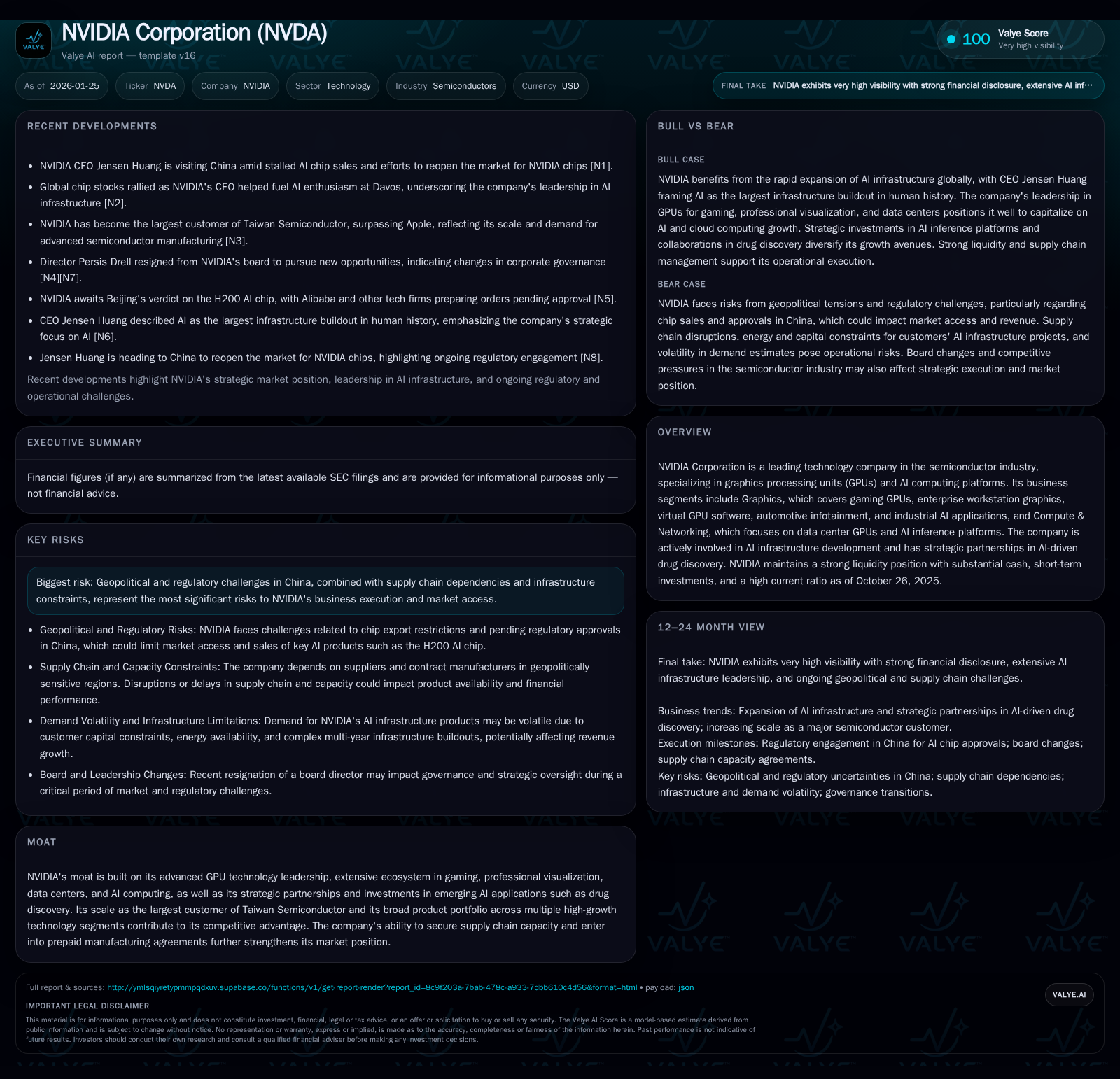
NVIDIA continues to solidify its leadership in AI computing platforms and GPUs, underpinning its strong financial results and strategic market positioning. Recent developments highlight robust demand driven by AI infrastructure expansion and new large-scale contracts, although regulatory constraints in China and memory supply shortages pose tangible risks. The company's integrated business model leverages a broad product portfolio across gaming, data center, automotive, and professional visualization, supported by a strong liquidity position and supply chain partnerships. Vigilance around geopolitical developments and manufacturing bottlenecks will be critical to sustaining growth dynamics.
What Changed Recently
NVIDIA’s momentum in AI and semiconductor markets has been reinforced by several notable developments in the past 45 days. The company announced a $20 billion deal with Groq, a specialized AI hardware provider, indicating an expanding ecosystem and demand for scalable AI inference solutions beyond NVIDIA’s core GPU products [N5]. This agreement reflects NVIDIA’s strategy to partner with complementary technology vendors to broaden AI infrastructure adoption.
CEO Jensen Huang’s high-profile visit to China amid stalled AI chip sales signals the company's active management of geopolitical headwinds, particularly U.S. export controls restricting shipments of advanced AI chips like the H200 to Chinese customers [N8][N10][N12]. While limited licenses have been granted, revenue from these remains minimal relative to potential demand, and U.S. officials have floated measures such as revenue-sharing with the government, though no formal regulation has been codified yet [S26]. The visit underscores the criticality of China as a market and the complexities of operating under evolving regulatory regimes.
Supply chain pressures persist, with key suppliers like Micron projecting memory shortages well beyond 2026 [N6]. This bottleneck impacts NVIDIA’s production costs and capacity, necessitating prepaid manufacturing agreements and advanced planning. The semiconductor industry rally around NVIDIA at the Davos forum, fueled by Huang’s framing of AI as the largest infrastructure buildout in human history, has boosted investor sentiment and chip sector valuations [N2][N9].
Business Model as a System
NVIDIA operates through two primary segments: Graphics and Compute & Networking. The Graphics segment encompasses gaming GPUs, enterprise workstation graphics, virtual GPU software, automotive infotainment systems, and industrial AI applications. Compute & Networking focuses on data center GPUs, AI inference platforms, and networking solutions. As of the latest quarter ending October 26, 2025, NVIDIA reported $57 billion in revenue with substantial contributions from both segments—Gaming generated approximately $20.4 billion, and Compute & Networking over $27.6 billion [S2][S3].
The company’s product suite is technologically differentiated by advanced GPU architectures optimized for parallel processing, enabling AI training and inference workloads. NVIDIA’s business model integrates hardware sales with software ecosystems such as CUDA and AI SDKs, creating high switching costs and fostering customer lock-in. A handful of large customers dominate Compute & Networking revenue, with four direct customers accounting for over 60% of that segment’s sales [S7]. This concentration amplifies NVIDIA’s leverage but also raises customer dependency risks.
NVIDIA outsources fabrication primarily to Taiwan Semiconductor Manufacturing Company (TSMC), leveraging its leading-edge process technologies. This relationship grants NVIDIA scale advantages but also creates supply chain dependencies. The company strategically enters prepaid manufacturing agreements to secure capacity and manage cost volatility [Valye overview].
Financially, NVIDIA maintains a strong liquidity profile with $11.5 billion in cash and equivalents and a current ratio of 4.47, providing operational flexibility to invest in R&D and navigate supply chain challenges [S13][S20]. Operating income for the period reached nearly $58 billion, reflecting efficient margin management despite inventory write-offs related to export restrictions [S11][S26].
Industry Map & Competitive Battlefield
NVIDIA sits at the apex of the semiconductor industry’s AI and GPU markets, where competition is fierce and innovation cycles rapid. Its primary competitors include AMD and Intel in GPUs, along with emerging AI-specific chip providers such as Groq and Graphcore. NVIDIA’s broad portfolio across gaming, professional visualization, data centers, and automotive differentiates it from peers that may focus on narrower segments.
The AI infrastructure space is increasingly strategic, with cloud providers like AWS, Microsoft Azure, and Google Cloud representing key customers and partners. NVIDIA’s ecosystem approach—combining hardware, software, and developer tools—creates barriers to entry for new competitors.
However, geopolitical and regulatory factors present a unique battleground. U.S. export controls constrain NVIDIA’s ability to supply AI chips to China, the world’s largest semiconductor market, complicating growth prospects and forcing the company to engage diplomatically at the highest levels [N8][N10][N12]. Supply chain constraints, especially in memory, also create competitive tension, as shortages affect pricing and delivery timelines industry-wide [N6].
Where the Economics Become Real
At the unit economics level, NVIDIA’s revenue generation is driven by high ASPs (average selling prices) of its advanced GPUs and AI inference chips. The gross margin, consistently around 70%, reflects the premium pricing power derived from technological leadership and ecosystem stickiness [S11].
Cost of revenue approximates 25-30%, influenced by component costs, wafer pricing from TSMC, and logistics. Inventory management remains critical, especially given geopolitical restrictions that led to a $4.5 billion charge related to excess H20 inventory due to diminished demand under export controls [S26]. This highlights the risk of rapid regulatory shifts translating into financial impairments.
Operating leverage is evident, with operating income approximating $58 billion on revenues of $57 billion, demonstrating strong scalability of fixed costs such as R&D, which is pivotal for sustaining competitive advantage [S11][S18]. Capital expenditures are focused on design and software development rather than manufacturing, given NVIDIA’s fabless model.
Customer concentration in the Compute & Networking segment—where a small number of customers represent a large share of revenue—can impact pricing power and negotiating leverage. Additionally, supply shortages in memory and other components constrain production volumes and may pressure margins if cost inflation cannot be passed through [N6][Valye overview].
Diligence Questions / Disconfirming Signals
- How sustainable is NVIDIA’s ability to secure advanced node manufacturing capacity at TSMC amid ongoing global supply chain constraints and geopolitical tensions?
- What are the concrete terms and timelines of U.S. government licensing requirements for sales of AI chips to China, and how might revenue-sharing or other obligations affect profitability?
- How is the $20B deal with Groq structured in terms of revenue recognition, margin contribution, and strategic alignment with NVIDIA’s core GPU business?
- Given the concentration of revenue in a few large data center customers, how diversified and secure is NVIDIA’s customer base against potential shifts in enterprise procurement?
- What impact could prolonged memory shortages have on NVIDIA’s product roadmap, cost structure, and ability to meet customer demand?
- How effective are NVIDIA’s risk mitigation strategies around inventory management, given prior write-downs related to regulatory-driven demand loss?
- What are the implications of NVIDIA’s positioning in emerging AI applications such as drug discovery in terms of competitive moat and revenue diversification?
Understanding these factors will be essential to assessing NVIDIA’s capacity to maintain its market leadership amid a complex and evolving operating environment.
This analysis synthesizes publicly available information and recent news without offering investment recommendations. Financial metrics are derived from the latest SEC filings and industry reports for informational purposes.
Disclaimer: This is research-only, informational analysis and not investment advice. It may include AI-generated interpretation and general industry context. Always verify important details using primary sources.

Comments