
NVIDIA’s Strategic Position Amid AI Boom and Geopolitical Headwinds in Semiconductor Industry
NVIDIA navigates accelerating AI demand, supply constraints, and regulatory challenges while leveraging its GPU leadership and ecosystem scale.
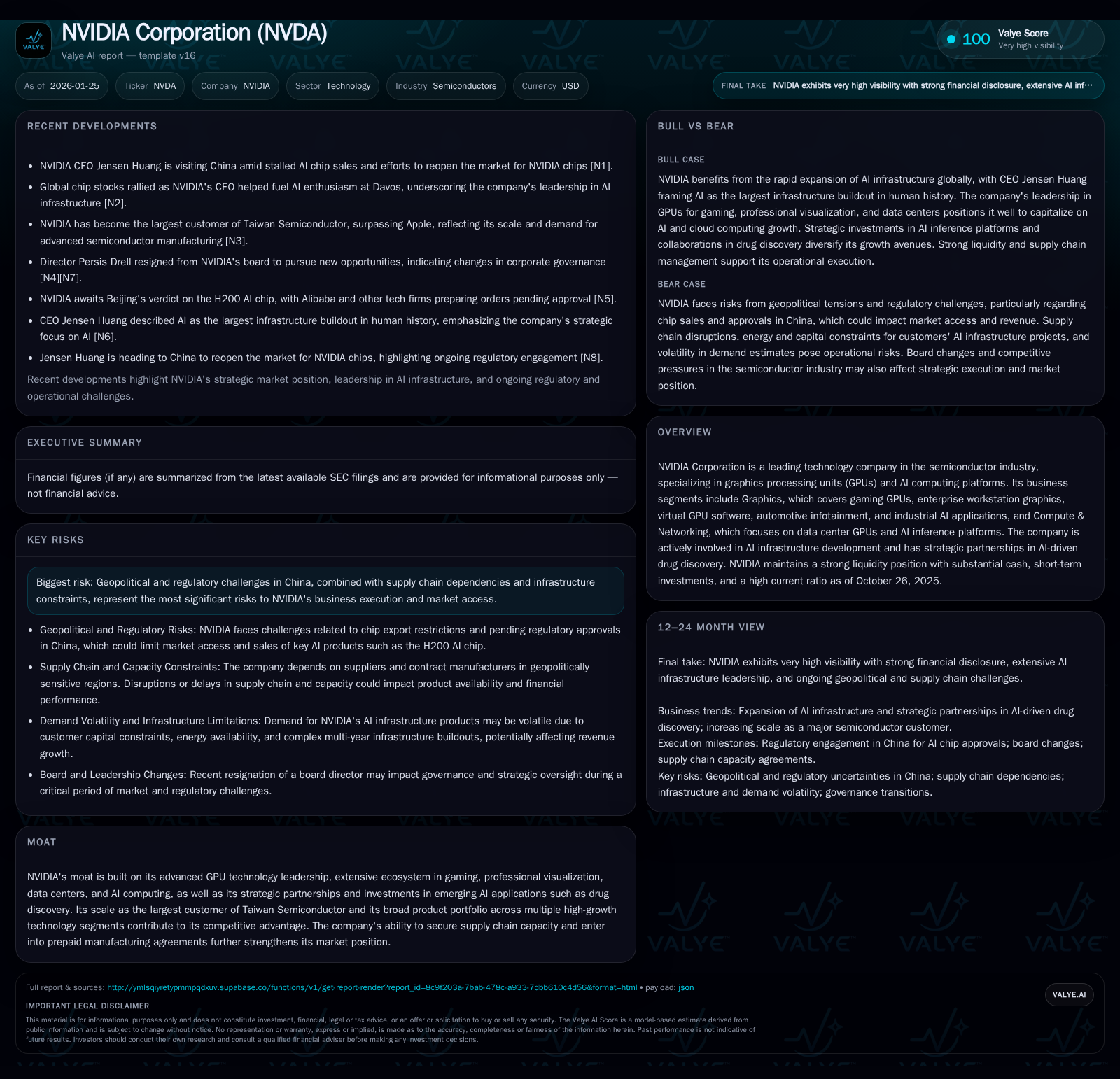
NVIDIA remains a dominant semiconductor player, driven by its advanced GPUs powering AI, gaming, and data center applications. Recent developments include a major $20 billion GPU deal and CEO Jensen Huang’s efforts to reopen the China market amid stalled AI chip sales. The company’s business model integrates high-margin hardware with a broad software and platform ecosystem, supported by strategic supply agreements. However, persistent memory shortages and geopolitical risks, especially U.S.-China export controls, present execution and market access challenges. NVIDIA’s competitive moat is reinforced by technology leadership, ecosystem depth, and scale advantages, but future growth depends on navigating regulatory environments and supply bottlenecks.
What Changed Recently
NVIDIA has been at the center of the AI hardware boom, with CEO Jensen Huang actively shaping market sentiment and industry focus. In the past 45 days, the company announced a substantial $20 billion GPU deal with Groq, signaling robust demand for AI compute infrastructure [N5]. This deal underscores NVIDIA’s central role in powering next-generation AI workloads. Concurrently, Huang’s visit to China marks a critical effort to navigate U.S. export restrictions that have effectively stalled NVIDIA's AI chip sales in the region [N8][N10][N12]. These restrictions have resulted in a $4.5 billion inventory charge related to the H20 GPU product line, reflecting diminished demand under the new licensing regime [S26].
The geopolitical backdrop is complex: while the U.S. government rescinded some stringent export rules (AI Diffusion IFR), ambiguity remains over revenue sharing requirements for licensed sales in China [S26]. Meanwhile, NVIDIA’s share price and chip stocks broadly rallied amid optimism about AI infrastructure growth, partly fueled by Huang’s messaging at the Davos forum [N2]. However, supply chain constraints, particularly in memory, persist as a bottleneck, with Micron projecting shortages extending beyond 2026 [N6].
Business Model as a System
NVIDIA operates at the intersection of semiconductor hardware and AI software ecosystems. Its core revenue streams derive from two segments:
Graphics: Dominated by gaming GPUs, professional visualization, automotive infotainment, and industrial AI applications. Gaming continues to generate substantial revenue (~$4.3 billion recently), but growth increasingly comes from AI-driven workloads and virtual GPU software deployments [S3].
Compute & Networking: Focused on data center GPUs for AI training and inference, high-performance computing, and networking silicon. This segment drives the majority of revenue and profitability, supported by a concentrated customer base including hyperscalers and cloud providers [S7].
NVIDIA’s product architecture integrates silicon design with proprietary software stacks, such as CUDA and AI frameworks, creating high switching costs and ecosystem lock-in. The company’s strategic partnerships extend to AI-driven drug discovery initiatives, signaling a push beyond traditional compute into verticalized AI applications [Valye overview].
Financially, NVIDIA maintains a strong liquidity position with over $11 billion in cash and equivalents and a high current ratio (4.47), enabling substantial R&D investments and supply chain prepayments [S13][S20]. The company preemptively secures advanced manufacturing capacity with Taiwan Semiconductor, ensuring access to leading process nodes vital for performance leadership [Valye overview].
Revenue concentration is notable, with four large customers in the Compute & Networking segment each contributing more than 10% of total revenue. This concentration underscores reliance on a select group of hyperscale and enterprise customers but also reflects the scale of demand from these AI infrastructure leaders [S7].
Industry Map & Competitive Battlefield
The semiconductor industry is bifurcated between commodity silicon suppliers and those specializing in high-performance compute hardware. NVIDIA's GPUs have evolved from gaming accelerators to AI-centric engines, situating the company as a pivotal player in the AI compute stack.
Key competitors include AMD and Intel in GPUs, with emerging AI-specific chip startups like Groq and Graphcore aiming to challenge NVIDIA’s dominance. However, NVIDIA’s entrenched ecosystem, software compatibility, and scale supply chain relationships create high barriers to entry.
The AI boom is intensifying demand for GPUs across cloud providers, enterprises deploying AI models, and automotive applications. NVIDIA’s ability to bundle hardware with AI-optimized software and leverage its CUDA ecosystem remains a significant moat.
Geopolitics complicate the battlefield: U.S.-China trade tensions and export controls limit NVIDIA’s addressable market and introduce regulatory risks. Competitors with less exposure to U.S. sanctions, or those developing indigenous Chinese AI chips, pose long-term threats.
Supply chain complexity is another critical dimension. Memory shortages reported by Micron and foundries capacity constraints could limit NVIDIA’s ability to ramp production and meet market demand [N6]. The company’s proactive capacity reservation with Taiwan Semiconductor is a strategic hedge here.
Where the Economics Become Real
NVIDIA’s unit economics hinge on product mix, wafer costs, and pricing power. High-end AI GPUs command premium ASPs due to their complexity and performance differentiation.
Gross margins historically range in the high 60%-70% area, reflecting a premium semiconductor product with significant R&D amortization and fixed costs spread over volume [S4]. Operating income margins are robust ($57.9 billion operating income on $111 billion revenue in fiscal 2026 scale) indicating strong operating leverage [S11].
The company’s supply chain model requires upfront capital commitments to foundries and memory suppliers, with lead times spanning months. Inventory write-downs due to export restrictions reveal vulnerability to regulatory shifts impacting sales channels [S26].
Software and platform revenue, such as virtual GPU licensing and AI application partnerships, augment hardware sales and improve overall profitability through recurring revenue components.
Customer concentration in the Compute & Networking segment creates a dual-edged dynamic: large customers provide stable volume and pricing power but also increase negotiation leverage. NVIDIA balances this by innovating rapidly to stay indispensable.
Diligence Questions / Disconfirming Signals
To what extent can NVIDIA mitigate the ongoing U.S.-China export restrictions to regain meaningful revenue share in the critical Chinese AI market? Huang’s visit suggests high-level negotiations, but regulatory outcomes remain uncertain [N8][N10][N12].
How will the persistent memory shortages and supply chain constraints impact NVIDIA’s ability to fulfill large AI infrastructure orders, and what contingency plans exist beyond Taiwan Semiconductor capacity reservation [N6]?
Does the revenue concentration in a few Compute & Networking customers pose risk from customer-specific slowdowns or renegotiation pressures?
How sustainable is NVIDIA’s technological leadership given increasing competition from AMD, Intel, and AI-specialist chipmakers, especially in light of the industry’s rapid innovation cycle?
What are the implications of U.S. government expectations of revenue sharing from licensed China sales, and how might potential new regulations affect NVIDIA’s margin profile and compliance costs [S26]?
Are there emerging vertical applications beyond gaming and cloud AI (e.g., automotive, industrial AI, drug discovery) that could materially diversify revenue and reduce concentration risk?
How will NVIDIA’s investments in software ecosystems and AI frameworks translate into defensible competitive advantage against both established semiconductor players and nimble startups?
This analysis is based on publicly available information as of January 2026 and does not constitute investment advice. It aims to provide a comprehensive view of NVIDIA’s business dynamics, industry context, and key risks to inform further due diligence.
Disclaimer: This is research-only, informational analysis and not investment advice. It may include AI-generated interpretation and general industry context. Always verify important details using primary sources.

Comments