
Northwest Bancshares Bolsters Earnings with Strategic Loan Growth and Operational Efficiency
Focused expansion in commercial lending and disciplined operational execution underpinned Northwest Bancshares’ notable profit rebound in 2025.
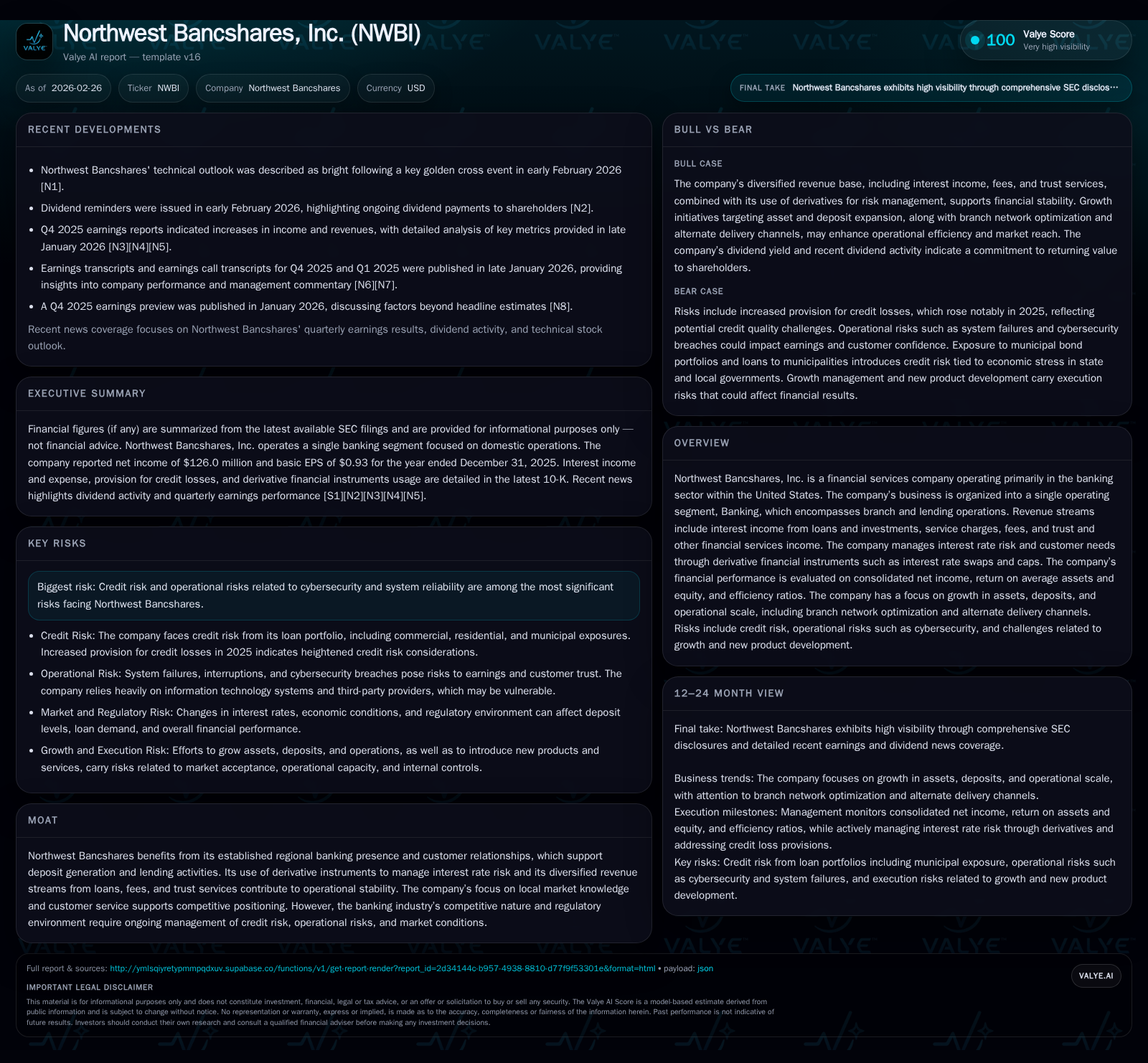
Northwest Bancshares demonstrated a robust 25.7% increase in net income for fiscal 2025, driven largely by accelerating commercial loan growth and enhanced fee income. This earnings improvement unfolded alongside meticulous interest rate risk management using derivatives, supporting stable net interest margins amid a challenging rate environment. Nonetheless, the bank faces intensified regulatory scrutiny due to its high commercial real estate loan concentration exceeding 340% of bank capital, raising potential credit risk concerns. Capital allocation balanced growth investment—with a capex surge supporting branch optimization—and steady dividend payouts, while shareholders’ returns remained solid through controlled capital deployment. Investors should monitor evolving loan quality metrics and regulatory developments as pivotal factors shaping Northwest's earnings trajectory going forward.
Strong Historical Growth Anchored by Commercial Lending Expansion
Northwest Bancshares’ financial trajectory experienced notable acceleration in fiscal year 2025, underscoring the strategic emphasis placed on augmenting its commercial lending footprint. Net income for the year reached $126.0 million, marking a substantial 25.7% increase from $100.3 million recorded in 2024 [F1]. This rebound largely originated from the bank’s deliberate expansion of its commercial loan portfolio—a sector inherently nuanced by higher underwriting complexity given larger credit exposures per borrower and dependence on ongoing business cash flows rather than solely collateral values [S1].
Interest income climbed approximately 11.9% to roughly $749.7 million in 2025 from $669.2 million the prior year [S4]. Alongside this core driver were incremental gains in service charges and fees totaling $65.1 million and trust-related income of $32.3 million—both reflecting a diversified revenue mix supportive of operational stability beyond pure lending yields [S4]. The amalgamation of rising interest and noninterest income streams indicates robust client engagement through multiple touchpoints including deposit products, specialized lending arrangements, and fiduciary services.
However, this growth has not been without caveats. The revenue uplift is shadowed by an elevated concentration risk profile stemming from heavy exposure to commercial real estate loans—which at the end of 2025 represented an outsized 342% of total bank capital [S1]. Such concentration demands vigilant risk assessment practices due to volatility inherent in underlying markets and regulatory expectations designed to cap investor exposures [S1]. The company’s underwriting discipline faces tests related to collateral valuation challenges as well as elongated foreclosure timelines unique to non-residential property assets.
Historical performance (annual)
| FY | Net ($mm) | CFO ($mm) | Capex ($mm) | Net YoY |
|---|---|---|---|---|
| 2025 | 126 | 153 | 12 | +25.7% |
| 2024 | 100 | 128 | 2 | -25.7% |
| 2023 | 135 | 93 | 9 | +1.0% |
| 2022 | 134 | 175 | 4 |
Source: SEC companyfacts cache [F1].
Capital returns and efficiency (annual)
| FY | Div ($mm) | Buybacks | FCF ($mm) |
|---|---|---|---|
| 2025 | 110 | 142 | |
| 2024 | 102 | 125 | |
| 2023 | 102 | 0 | 84 |
| 2022 | 101 | 0 | 171 |
Source: SEC companyfacts cache [F1].
Profitability Drivers Amid a Challenging Rate Environment
Profitability gains at Northwest Bancshares have been buttressed by sophisticated interest rate risk mitigation strategies leveraging derivative instruments—including interest rate swaps and caps—as detailed in the company's disclosures [S1]. These tools allow the bank to manage fluctuations in benchmark rates that could otherwise compress net interest margin (NIM), thereby stabilizing earnings amidst heightened market volatility.
The effectiveness of these hedging activities contributed materially to the operating cash flow outperformance observed in fiscal 2025: operating cash flow rose by over 20%, reaching approximately $153.4 million versus $127.7 million a year earlier [F1]. This efficiency infusion coincides with prudent expense management initiatives and scale benefits tied to branch network optimization and adoption of alternative delivery channels such as digital banking platforms [S4]. Improving efficiency ratios reflect tighter control over payroll and operational overhead relative to revenue growth.
Operationally, Northwest’s ability to combine derivative-led interest rate protection aligns with sector best practices applicable for regional banks facing a reset rate environment following extended low-rate cycles. This measured approach tempers income volatility while preserving flexibility in loan repricing and funding cost adjustments.
Risks Loom Large: Credit Exposure and Regulatory Scrutiny on CRE Concentrations
Credit risk presents a pronounced challenge for Northwest Bancshares given its increasing reliance on commercial loans secured by real estate collateral. The commercial segment inherently carries greater default risk than residential mortgages because repayment depends primarily on borrower business viability as opposed to stable household income flows [S1]. Moreover, collateral such as inventory or accounts receivable poses secondary valuation difficulties relative to traditional real estate assets.
Regulatory scrutiny has intensified accordingly under established guidance from federal agencies aimed at banks with concentrated CRE exposures surpassing defined thresholds—in this case notably when such loans exceed threefold the institution's capital base [S1]. As Northwest’s CRE loans constitute about 342% of total capital, board-level oversight mandates have escalated alongside requirements for comprehensive risk assessments, monitoring protocols, and strategic contingency planning.
Operational risks also compound these credit vulnerabilities; cybersecurity threats have become especially salient against a backdrop of legislative tightening around data privacy protections and systemic resilience demands [S1], [S9]. Potential breaches or technology failures pose threats not only financially but also reputationally.
Capital Allocation Strategy: Dividends, Capex Surge, and Shareholders’ Returns
From a capital deployment standpoint, Northwest Bancshares demonstrates a calibrated balance between reinvestment for growth and consistent shareholder distributions. In fiscal 2025, dividends paid amounted to approximately $109.9 million—showing slight incremental growth over $101.9 million distributed in the previous year—signaling consistency in returning cash while maintaining capital buffers [F1].
Capital expenditures underwent a remarkable surge—approximately a fourfold increase rising to $11.6 million compared with just $2.3 million in 2024 [F1]. Management attributed this jump primarily to investments targeting branch network optimization efforts alongside enhancement of digital delivery infrastructures that align with the company’s stated focus on scaling operations effectively across alternative channels.
Return on equity stood near an estimated 6.7%, calculated using latest net income against year-end equity levels ($126 million net income over $1.89 billion equity) [F1]. While modest relative to some peers, this reflects conservative leverage combined with strategic buffer maintenance given elevated credit exposures noted earlier.
Notably absent from recent years are share repurchases; zero buybacks were recorded post-2022 after more active buyback episodes prior [F1]. This restraint suggests prioritization of organic asset growth initiatives and bolstering operational capabilities above opportunistic capital returns through market transactions.
Operational Efficiency and Asset Quality Metrics to Watch
Internal efficiency metrics referenced during segment disclosures indicate that management systematically benchmarks expense structures—particularly payroll costs—against revenue streams within its single banking segment framework [S4]. Such monitoring facilitates dynamic adjustments responsive to evolving volume trends across deposits, loans, and fee-generating segments.
Allowance for credit losses requires close observation as portfolio shifts toward higher-risk commercial loans unfold; provisions remain key leading indicators for asset quality trajectory amidst economic cycles impacting borrower repayment capacity [S4]. The provision coverage ratio will warrant attention alongside delinquency patterns within multifamily residential versus commercial property loans.
Maintaining adequate allowance levels ensures preparedness against latent impairments especially when asset composition tilts toward sectors sensitive to macroeconomic shifts such as CRE development projects or municipal bond stresses discussed below.
Forward Outlook: Monitoring Loan Quality, Regulatory Changes, and Earnings Trajectory
Looking ahead, investors should track several critical dimensions shaping Northwest Bancshares' performance landscape:
- Loan delinquency rates particularly within commercial real estate subsets will serve as bellwethers for credit deterioration or stabilization following recent expansions [N1], [N3].
- Net interest margin movements influenced by ongoing derivative hedge effectiveness coupled with market rate shifts remain pivotal to sustained profitability [N2], [N3].
- Regulatory developments under CRE Lending Guidance will likely drive enhanced disclosure requirements plus intensified supervisory reviews potentially impacting capital planning norms [S9].
- Municipal bond portfolio stress stemming from worsening state/local government finances could trigger mark-to-market losses or liquidity constraints affecting investment returns or funding costs [S5].
- Cybersecurity-related legislative actions may necessitate incremental compliance expenses or technology upgrades implicating cost structures over medium term horizons [S1], [S9].
Overall earnings trajectory hinges delicately on maintaining credit quality within rapidly growing commercial exposures while balancing measured capital allocation towards technology-enabled operational scaling—a complex equation typical for well-established regional banks navigating post-pandemic economic recalibrations.
This analysis is based solely on publicly available information up through February 26, 2026 ([F1], SEC filings S1-S9; news N1-N3). It does not constitute investment advice but aims to provide an informed perspective on Northwest Bancshares' financial performance dynamics.
Disclaimer: This is research-only, informational analysis and not investment advice. It may include AI-generated interpretation and general industry context. Always verify important details using primary sources.

Comments