
Northwest Biotherapeutics Advances DCVax Platform with Advent Acquisition, Faces Liquidity Challenges
The company's acquisition of Advent BioServices Ltd. bolsters its manufacturing capabilities for personalized immune therapies amid tight liquidity and a heavy debt load.
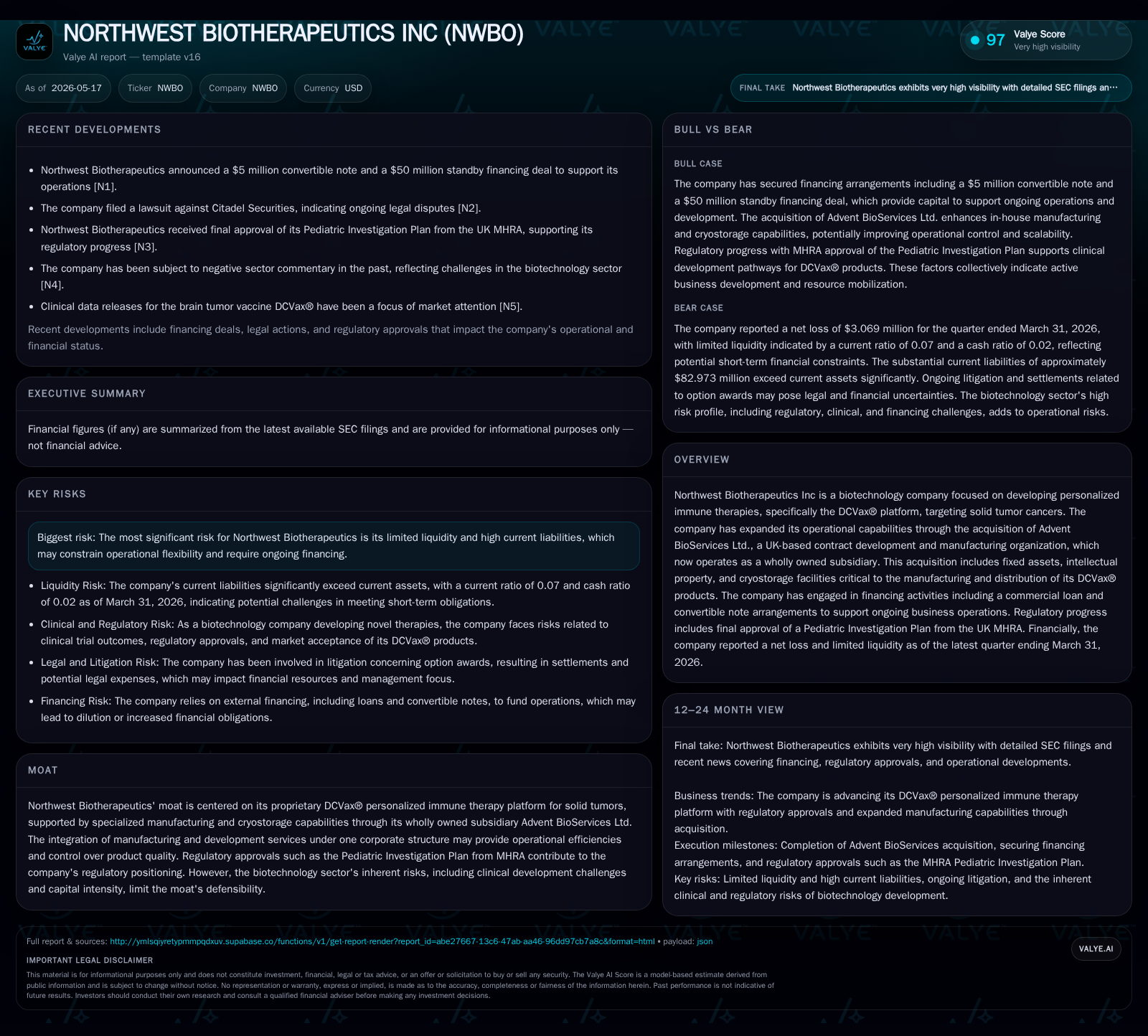
Northwest Biotherapeutics Inc has recently completed the acquisition of Advent BioServices Ltd., a UK-based CDMO, integrating critical manufacturing assets and intellectual property to support its DCVax® platform targeting solid tumors. This strategic move consolidates development, production, and cryostorage under one subsidiary, potentially improving operational control and cost structure. However, as of Q1 2026, the company faces severe liquidity constraints with a current ratio of approximately 0.07 and a net debt position exceeding $57 million. Growth prospects hinge on regulatory approvals and successful commercialization of DCVax®, yet significant risks include capital intensity, clinical development hurdles, and financial leverage.
Recent Operating Update
Northwest Biotherapeutics (NWBO) disclosed its latest quarterly results in the 10-Q filed May 15, 2026 [S2], which confirmed ongoing operational focus on advancing its DCVax® personalized immune therapy platform aimed at solid tumors alongside integrating newly acquired manufacturing capabilities from Advent BioServices Ltd. The acquisition closed in October 2025 [S3][S8], adding a UK-based contract development and manufacturing organization (CDMO) as a wholly owned subsidiary that provides fixed assets including cryostorage facilities and intellectual property essential to the manufacturing and distribution of DCVax® products.
This transaction represented a related party deal since NWBO’s Chairperson and CEO Linda Powers controls both sides [S14]. The structure entailed no new NWBO shares issued; instead, shares (12 million) and stock options (5.5 million) previously granted to Advent were returned and cancelled, effectively consolidating ownership [S9][S14]. The agreed acquisition price was approximately £1.4 million upfront with additional installment payments paced over two years tied to regulatory milestones such as approval of the DCVax®-L product [S8].
From a financial perspective, the company’s cash position remains critically low at $1.8 million as of March 31, 2026 compared with total debt of about $59.4 million and current liabilities exceeding $82.9 million [F1]. This results in an extremely weak current ratio near 0.07 reflecting acute short-term liquidity stress [F1]. Alongside this backdrop, Northwest Biotherapeutics entered into an unsecured commercial loan agreement for $5.5 million in late October 2025 carrying an effective interest cost exceeding 8% and deferred repayment until mid-2026 [S18]. These financing actions underscore constrained operating flexibility amid uncertain cash flows.
Business Model
Northwest Biotherapeutics’ value proposition centers on its proprietary DCVax® platform—personalized dendritic cell vaccines customized from each patient's tumor antigen profile intended to stimulate an immune response against solid tumor cancers [S1]. This immunotherapy approach addresses a sizable unmet need given the limitations of conventional chemotherapy or checkpoint inhibitors against tumors lacking immunogenicity.
Revenue generation is currently non-recurring service-related income coupled with milestone-dependent payments rather than product sales given the developmental stage [F1][S1]. The Advent acquisition integrates manufacturing development services critical for producing these complex autologous cell therapies—an industry niche marked by technical complexity involving cryopreservation logistics and batch-specific quality controls.
Operationally, customers consist primarily of internal clinical programs with ongoing efforts toward rolling out pivotal Phase III trials (e.g., DCVax®-L). Contract research arrangements historically existed between Advent and NWBO prior to acquisition but are now internalized allowing potential cost efficiencies and tighter quality oversight [S8][S9].
Margins remain negative due to high R&D burn rates associated with expensive clinical programs combined with substantial corporate overheads typical for pre-commercial biotech players [F1]. The fixed-cost manufacturing infrastructure inherited via Advent should help improve gross margin scalability once commercial production ramps.
Industry Structure and Competitive Position
The personalized cancer immunotherapy sector is characterized by intensive R&D investment requirements, extended clinical validation timelines often spanning multiple years, complex regulatory landscapes across jurisdictions, and competitive pressure from both large pharma incumbents developing checkpoint inhibitors/bispecifics as well as emergent cell/gene therapy startups.
NWBO competes principally through differentiation by personalized dendritic cell vaccines tailored individually versus off-the-shelf immune modulators employed by peers such as Bristol-Myers Squibb or Moderna's mRNA-based oncology vaccines (emerging). The integration of CDMO capabilities via Advent gives NWBO vertical control uncommon among similar mid-tier biotechs reliant on third-party manufacturers with potential benefits in supply reliability during scale-up stages.
However, NWBO’s relatively small organizational scale compared to global pharmaceutical companies poses challenges in marketing reach and funding depth necessary for broad Phase III trial completion or global launch campaigns.
Furthermore, regulatory approval pathways remain complex amidst evolving guidelines around autologous cell therapies requiring robust safety/efficacy data from large randomized studies [S1]. Approval delays or additional monitoring requirements could impose material timing risks on bringing DCVax® products to market.
Growth Drivers
Growth is structurally driven by:
- Successful advancement through late-stage clinical trials validating efficacy/safety profile versus standard-of-care for various solid tumor indications.
- Regulatory approvals including FDA clearance beyond orphan designations along with EU MHRA acceptance demonstrated by the Pediatric Investigation Plan completion which paves way for pediatric oncology applications [S1].
- Monetization potential expanding through direct commercialization or forming partnerships/licensing deals leveraging exclusivity around the proprietary DCVax® platform linked IP portfolio.
- Capacity expansion enabled by Advent’s manufacturing assets facilitating higher volume production while controlling batch costs unlike CDMOs charging external development margins.
- Milestone-triggered payments embedded in contracts accelerating revenue realization if pipeline advances progress timely.
Each growth lever is contingent upon execution risks inherent in biotechnology especially given capital constraints requiring efficient use of resources toward pivotal readouts.
Risks / Watchpoints / Growth Constraints
Key risk factors evident include:
- Severe liquidity constraints as evidenced by limited cash buffers ($1.8M) against substantial near-term liabilities ($82.9M current liabilities), suggesting dependence on additional financing or delayed obligations payments [F1].
- High leverage burden reflected by net debt approaching $57.6M restricting operational flexibility amidst volatile biotech project timelines [F1].
- Clinical development risk inherent to immunotherapy innovations where efficacy or safety signals may fall short causing setbacks or trials suspensions impacting valuation/progress.
- Regulatory risk spanning prolongations or requests for further study reducing speed-to-market.
- Related party transaction scrutiny stemming from acquisition involving CEO-controlled seller potentially raising governance concerns that could affect investor perception [S14].
- Competitive pressure from larger pharma entities deploying diverse immuno-oncology approaches challenging relevance if differentiation fails.
- Market adoption uncertainty for autologous dendritic cell vaccines requiring demonstration not only of efficacy but also cost-effectiveness relative to alternatives.
What to Watch Next
Key operational milestones within the next quarters include:
- Announcements regarding pivotal Phase III trial enrollment progress or interim efficacy data reports informing feasibility of FDA/EMA approvals.
- Updates on installment payment schedules relating to the Advent acquisition potentially linked to regulatory milestones like DCVax®-L approval triggering early payments [S8].
- Additional capital raises plans or debt refinancing initiatives necessary due to severe short-term liquidity stress identified in latest balance sheet [F1][S2].
- Progression on strategic partnerships or licensing agreements amplifying commercialization capability or providing upfront/license fees impacting cash flow visibility.
- Regulatory developments such as expanded MHRA decisions or FDA interactions clarifying path-to-market feasibility.
Monitoring these data points will be essential to assess any shifts in trajectory from developmental-stage risk toward commercial execution viability.
Financial Profile (Latest Quarter Context)
Latest financial snapshot
| Metric | Value | Period |
|---|---|---|
| Cash & equivalents | $1786000 | |
| 2026-03-31 | ||
| Total debt | $59mm | |
| 2026-03-31 | ||
| Net debt | $58mm | |
| 2026-03-31 | ||
| Current assets | $6mm | |
| 2026-03-31 | ||
| Current liabilities | $83mm | |
| 2026-03-31 | ||
| Current ratio | 0.07x | |
| 2026-03-31 |
Source: SEC companyfacts cache [F1].
Despite significant intangible asset additions from Advent demonstrating investment in operational infrastructure ([S3], [S8]), Northwest Biotherapeutics’ balance sheet reveals precarious liquidity placing pressure on management’s ability to fund ongoing operations without dilutive future financings or restructuring existing debt arrangements.
Operating income remains negative consistent with R&D stage biotech profiles focused heavily on pipeline progression rather than revenue generation [F1]. Capital raise necessity might be anticipated given limited cash runway past mid-year considering loan amortization schedules commencing June 2026 under onerous terms (~8% plus prepayment penalties) further elevating debt service burdens [S18].
This analysis is based solely on publicly filed company disclosures up to May 17, 2026 without speculation beyond documented facts. It is intended for informational purposes only and does not constitute investment advice or recommendations.
Disclaimer: This is research-only, informational analysis and not investment advice. It may include AI-generated interpretation and general industry context. Always verify important details using primary sources.

Comments