
NEXTNRG Advances Integrated Energy Solutions Despite Acute Liquidity Pressures
Latest quarterly results show NEXTNRG growing revenue via innovative energy infrastructure and mobile fuel delivery, yet facing severe liquidity constraints that press urgent capital raises.
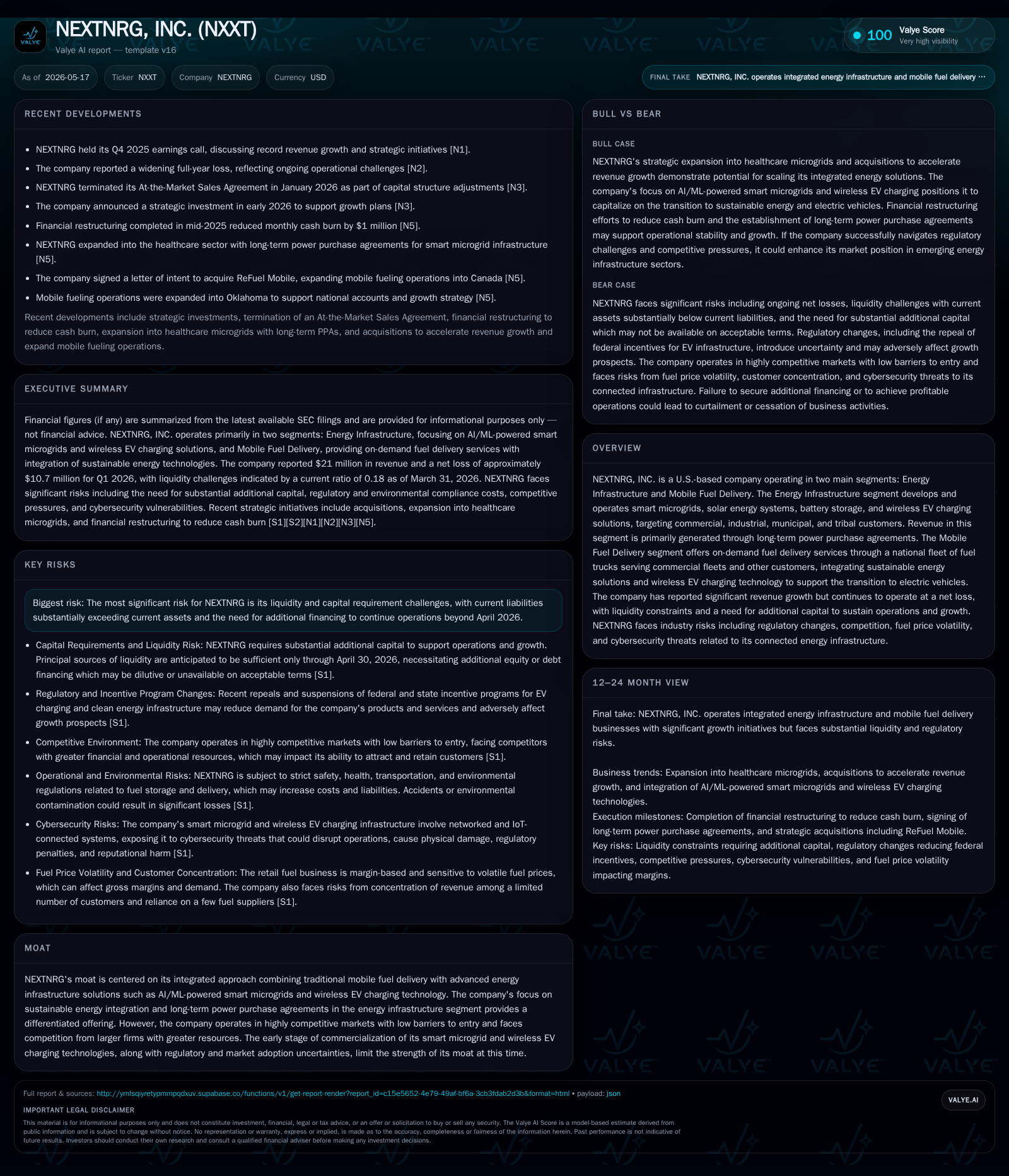
NEXTNRG reported continued revenue gains driven largely by its Energy Infrastructure segment’s smart microgrid projects and expanding Mobile Fuel Delivery operations. However, the latest 10-Q reveals a daunting liquidity picture with current liabilities vastly exceeding current assets, creating a critical financing hurdle. The company’s dual-segment model combines long-term contracted infrastructure revenues with on-demand fuel services enhanced by sustainable technologies, positioning it uniquely in evolving energy markets despite early-stage commercial risks. Near-term focus will center on securing additional capital and advancing pilot deployments of wireless EV charging to sustain growth momentum.
Latest Quarterly Update: Operating Progress Amid Financial Strains
NEXTNRG’s May 15, 2026 Form 10-Q marks continued revenue growth propelled primarily by the Energy Infrastructure segment's deployment of smart microgrid systems and expansions in its Mobile Fuel Delivery services [S2], [S3]. Despite this top-line momentum, the company’s balance sheet depicts a precarious financial stance as of March 31, 2026: current assets totaled approximately $5.54 million against daunting current liabilities near $30.5 million—a current ratio of merely 0.18 evidencing acute short-term liquidity stress [F1]. Management discloses cash resources sufficient only through April 30, 2026 absent successful capital raises [S1]. This dual narrative creates operational tension between innovative progress and existential funding risks.
Moreover, recent event filings confirm the issuance of press releases accompanying these disclosures, underscoring proactive communications around financial condition and performance metrics [S3]. NEXTNRG’s liquidity challenges imply an imperative for immediate strategic financing actions to avoid operational curtailment.
Dual-Segment Business Model: Energy Infrastructure and Mobile Fuel Delivery
NEXTNRG operates through two principal segments addressing complementary aspects of the evolving energy ecosystem [S1]. The Energy Infrastructure division focuses on developing AI/ML-powered smart microgrids incorporating solar energy systems, battery storage, and innovative wireless EV charging solutions designed for commercial, industrial, municipal, and tribal clients. Revenue in this unit principally derives from long-term power purchase agreements (PPAs), leases, and technology licensing arrangements that provide recurring income streams anchored to contract longevity [S1]. These projects range from utility-scale installations to community energy systems integrating distributed energy resources.
In parallel, the Mobile Fuel Delivery segment offers an alternative to traditional fueling by deploying an expanding national fleet of fuel trucks serving commercial fleets plus other customers seeking flexible service access. This segment integrates sustainable energy applications, including wireless EV charging technologies intended to facilitate client transitions toward electric vehicles while enhancing operational efficiency [S1]. The mobile fueling model is transactional but benefits from increased utilization driven by sustainability preferences and electrification adoption trends.
Revenue mechanics therefore differ between stable contracted flows in infrastructure versus volume- and usage-driven sales in mobile delivery. Customer diversity spans private commercial entities, municipalities, tribal groups, with contracts often involving multi-year terms underpinning Energy Infrastructure cash flow stability.
Technological Differentiation: Smart Microgrids, Battery Storage & Wireless EV Charging
Central to NEXTNRG’s strategic positioning is its integrated technology suite blending AI/ML-enabled smart microgrids with cutting-edge battery storage platforms and pioneering wireless EV charging capabilities targeting fleet applications [S1]. These elements collectively aim to enhance grid resiliency, optimize energy consumption patterns through intelligent analytics, reduce total costs of energy ownership, and improve sustainable access.
While innovative in concept—particularly the deployment of wireless fleet charging which seeks to overcome infrastructure complexity barriers—the company acknowledges these technologies remain at relatively early commercialization stages [S1]. This yields uncertainty around broader market adoption timing and associated unit economics.
Nevertheless, the blend of AI-driven resource optimization combined with physical asset deployment differentiates NEXTNRG within an industry where many peers offer discrete solutions lacking full-stack integration. This positions NEXTNRG as a potential consolidator of future-ready energy solutions capable of capturing emerging demand patterns related to electrification rollouts.
Industry Positioning: Competitive Market Dynamics and Peer Context
The markets in which NEXTNRG competes are characterized by intense competition alongside varying structural dynamics across segments. The Mobile Fuel Delivery sector features relatively low barriers to entry; various local players operate fuel truck fleets but often lack integrated clean-energy enhancements or scale [S1]. Conversely, Energy Infrastructure demands technical innovation combined with regulatory navigation related to renewable project deployment—this segment experiences competition from large established utilities as well as emerging distributed energy resource (DER) specialists.
NEXTNRG appears relatively small compared with larger incumbents who benefit from greater resource depth but counters this through focused innovation in smart grids and wireless vehicle charging overlays offering differentiated service propositions. Regulatory uncertainty—especially regarding tariffs on equipment imports or renewable incentives—remains a wild card that can amplify either headwinds or accelerants depending on policy shifts [S1], analysis.
Thus far, NEXTNRG's integrated approach offers a tangible moat relative to peers operating solely in traditional mobile fueling or single-solution renewables sectors; however scalability bottlenecks inherent in advanced technology commissioning currently temper structural advantages.
Growth Drivers: Power Purchase Agreements and Sustainable Fleet Expansion
Growth prospects rest principally on two pillars:
Power Purchase Agreement Backlog Expansion: The ability to secure long-duration PPAs underpins predictable recurring revenue critical for infrastructure scaling. These contracts typically involve fixed rates or escalators that enhance margin visibility once projects reach operation stages [S1]. Securing PPAs with municipal utilities or tribal organizations represents a strategic avenue given their perennial energy needs coupled with emphasis on sustainability agendas.
Fleet Electrification Adoption & Wireless Charging Pilots: The Mobile Fuel Delivery business is leveraging increasing fleet demands for electrification support by embedding wireless EV charging pilots within customer fleets [N1], [S17]. Success here depends on acceptance of wireless over wired solutions for speed and convenience benefits alongside efficient fleet operations management systems. Volume growth will naturally follow wider fleet decarbonization mandates if execution meets reliability benchmarks.
Both avenues tie closely to KPIs such as contract awards pipeline size—reflecting tangible future bookings—and pilot project rollouts validating technology efficacy which are essential milestones for investor confidence.
Key Risks: Liquidity, Capital Access, Regulatory Uncertainties, and Litigation
The most pressing risk for NEXTNRG is clearly its strained liquidity profile documented in recent SEC filings: current liabilities exceeding current assets by nearly sixfold leaves scant runway beyond April 2026 unless successful capital infusions occur imminently [F1], [S1]. Additionally:
Debt Covenants & Financing Constraints: Venture Debt agreements impose restrictive covenants limiting ability to incur further indebtedness without lender consent; violations carry heavy fees or default triggers including potential collateral seizure or acceleration clauses that could paralyze operations [S4], [S21], [S28]. These constraints limit financial flexibility during critical fundraising phases.
Operational Litigation Risk: A notable lawsuit involves allegations regarding acquisition misrepresentations tied to a solar+battery project in Florida undermined by unmet assumptions about power purchase rates and grid connection rights [S1]. Outcomes of this litigation could impair asset values or lead to additional costs impacting financial results.
Regulatory Volatility: International trade tensions elevating tariff costs along the supply chain introduce price volatility risks especially for imported equipment components crucial for infrastructure deployments [S1]. Policy unpredictability might delay project permits or affect incentive programs essential for economic feasibility.
Discounting these factors provides perspective into the fragile near-term outlook tempered by promising medium-term industry alignment.
Upcoming Catalysts: Financing Milestones and Project Development Timelines
Key upcoming de-risking events include:
Financing Rounds: Management is actively pursuing equity or conventional bank financing alternatives before cash availability lapses late April 2026; success here critical to operations continuity given restrictive venture debt ceilings [S4], [S21].
Wireless EV Charging Pilot Progress: Ongoing pilot deployments will serve as proof points quantifying operational reliability metrics essential for scaling customer adoption post-quarter end [N1], [S17].
Power Purchase Agreement Awards: Pipeline evaluations over coming quarters anticipated will reveal traction speed securing longer-duration PPAs across target commercial/municipal segments offering revenue visibility horizon extensions.
Monitoring these milestones closely will provide clarity on the sustainability of NEXTNRG’s growth trajectory amidst funding challenges.
Financial Overview: Liquidity Crunch and Debt Covenants Impact
As of the quarter ended March 31, 2026, NEXTNRG held current assets totaling $5.54 million against overwhelming current liabilities near $30.5 million yielding an alarming current ratio around 0.18—a textbook indicator of acute short-term financial strain risking insolvency absent capital injections [F1]. Most recent filings detail two high-cost loans entered earlier in Q2 2026 including a $750K loan from Cashera Private Credit priced at an approximate APR above 170%, alongside a $1 million Venture Debt loan carrying over 200% annualized interest—all secured via first-priority liens covering substantially all company assets including accounts receivable inventory equipment and intellectual property [S4], [S19], [S21].
Such onerous debt arrangements accompanied by restrictive negative covenants forbid additional borrowing without lender approvals severely constraining operational flexibility during this critical juncture; failure to comply triggers penalties potentially accelerating repayment obligations or collateral seizures further heightening risk profiles [S4], analysis.
This financial backdrop forces management’s hand toward aggressive pursuit of equity raises alongside cost restructuring measures although dilution implications pose trade-offs impacting shareholder value schemes going forward.
The information herein synthesizes publicly filed SEC documents exclusively without investment research views. The analysis highlights observable operational trends juxtaposed against stringent financial constraints reflective of NEXTNRG's position as an innovator navigating capital markets under demanding conditions. Readers should consider all disclosures comprehensively prior to forming independent views concerning company prospects or risks.
Disclaimer: This is research-only, informational analysis and not investment advice. It may include AI-generated interpretation and general industry context. Always verify important details using primary sources.

Comments