
NEXTNRG Q2 2026: Revenue Growth Amid Significant Liquidity Constraints and Financial Restructuring
NEXTNRG reported revenue growth driven by mobile fuel delivery and microgrid projects, yet faces severe liquidity constraints requiring financial restructuring.
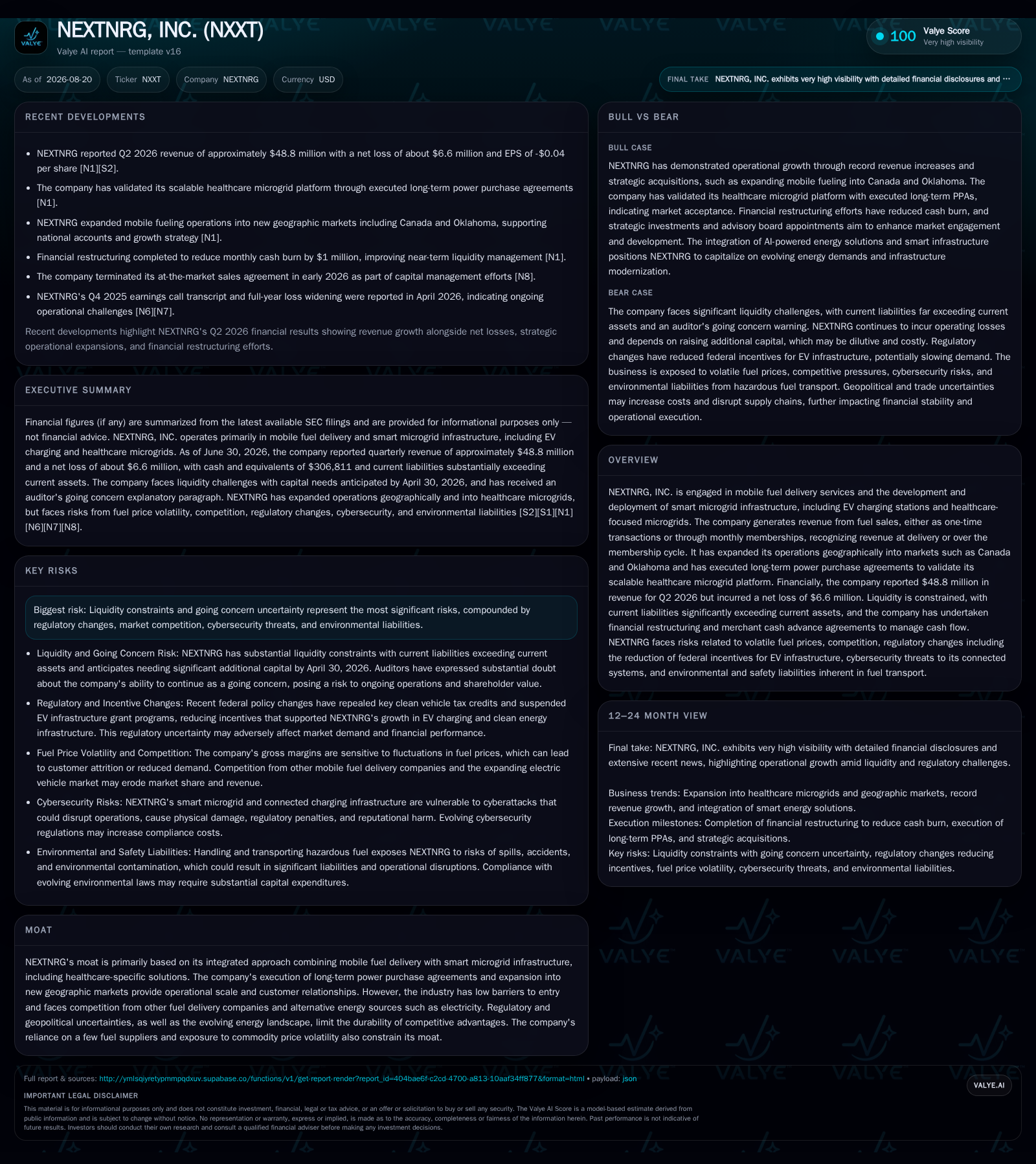
In Q2 2026, NEXTNRG, Inc. achieved $48.8 million in revenue, reflecting growth in mobile fuel delivery services and smart microgrid deployments, including healthcare-focused projects. Despite this operational expansion, the company recorded a net loss of $6.6 million and reported a current ratio of 0.18 as current liabilities of $31.3 million significantly exceeded current assets of $5.7 million. To address these liquidity challenges, NEXTNRG entered into a Securities Purchase Agreement with an institutional investor in August 2026, imposing restrictive covenants and governance arrangements. These developments highlight the tension between scaling operations and maintaining financial sustainability in a capital-intensive energy infrastructure services niche.
Q2 2026 Operating Performance and Revenue Growth
NEXTNRG, Inc. reported $48.8 million in revenue for the second quarter of 2026, reflecting growth primarily driven by its mobile fuel delivery services and deployments of smart microgrids, including projects focused on healthcare facilities [S2]. This revenue increase evidences operational expansion into new geographic markets such as Canada and Oklahoma, as well as the execution of long-term power purchase agreements (PPAs) that underpin recurring revenue streams from renewable energy infrastructure projects [S1]. Despite this top-line growth, the company recorded a net loss of $6.6 million in the quarter, indicating that operating costs and expenses continue to outpace revenues, resulting in negative operating margins [S2].
The combination of one-time fuel delivery sales and recurring membership or PPA revenues supports a diversified revenue model, which is critical in the capital-intensive energy infrastructure services sector where cash flow stability can be challenging [S1]. However, the net loss underscores ongoing operating challenges, including the impact of fuel commodity costs, project development expenses, and scale inefficiencies.
Liquidity and Financial Restructuring
As of June 30, 2026, NEXTNRG faced significant liquidity constraints, with current liabilities totaling $31.3 million vastly exceeding current assets of $5.7 million, resulting in a current ratio of just 0.18 [F1]. This working capital deficit highlights severe short-term financial stress, raising concerns about the company’s ability to meet near-term obligations without additional capital. The imbalance between assets and liabilities reflects the capital-intensive nature of the company’s operations, including investments in mobile fuel delivery infrastructure and renewable energy projects such as solar and battery energy storage systems.
To manage these liquidity challenges, NEXTNRG entered into a Securities Purchase Agreement (SPA) with an institutional investor on August 13, 2026 [S3]. The SPA imposes restrictive covenants, including limitations on issuing Series C Preferred Stock except to the investor, and provisions requiring stockholder approval for potential reverse stock splits. Additionally, a Voting, Support and Standstill Agreement was executed, aligning certain stockholders to vote in favor of proposals related to the SPA and preventing actions that could impede its approval [S3]. These arrangements indicate that the company is pursuing financial restructuring to stabilize its capital structure and secure necessary funding.
Business Model and Market Expansion
NEXTNRG operates at the intersection of mobile fuel delivery and renewable energy infrastructure development. Customers pay for on-demand fuel delivery services, which generate transactional revenue recognized at the time of delivery [S1]. Concurrently, the company develops and operates renewable energy projects, including smart microgrids and battery energy storage systems, which generate recurring revenue through long-term power purchase agreements with institutional clients.
The company’s expansion into new geographic markets such as Canada and Oklahoma, coupled with the execution of healthcare-focused microgrid projects, suggests potential scalability of its platform. These developments may indicate that NEXTNRG is leveraging its integrated energy services model to capture demand in both traditional fuel logistics and emerging clean energy infrastructure sectors [S1]. The revenue growth demonstrates that the company’s diversified business model and geographic expansion are gaining traction, potentially enabling sustainable revenue streams if scale and contract execution continue [S2]. The bull case would posit that successful capital raises, expansion of long-term PPAs, and improvements in operating margins through scale could enhance liquidity and reduce losses. Confirmation of this scenario would come from improved liquidity ratios in subsequent quarters, new contract announcements, and positive operating cash flow.
Conversely, the severe liquidity constraints and working capital deficit pose significant risks. The restrictive covenants in the SPA limit financial flexibility, and failure to raise additional capital or improve operating performance could lead to operational curtailment or restructuring. The bear case would be confirmed by further deterioration in liquidity ratios, announcements of asset sales or restructuring, and continued negative cash flow trends. Regulatory setbacks or loss of key contracts could exacerbate these risks.
Business Economics and Watchpoints
In the energy infrastructure services sector, key economic drivers include revenue growth from both transactional fuel deliveries and recurring PPA income, operating margins influenced by fuel commodity costs and capital expenditure intensity, and liquidity adequacy to fund ongoing operations and project development. NEXTNRG’s current financial profile reveals the challenges of balancing these factors amid capital-intensive growth.
Investors and analysts should closely monitor NEXTNRG’s subsequent quarterly liquidity ratios and working capital trends, announcements of new power purchase agreements or membership growth, terms and success of capital raising activities, and any improvements in operating margins or net loss reductions. Additionally, legal and regulatory developments affecting project viability remain critical watchpoints given the company’s exposure to such risks.
Disclaimer: This is research-only, informational analysis and not investment advice. It may include AI-generated interpretation and general industry context. Always verify important details using primary sources.

Comments