
Orion Energy’s Q4 Miss: Balancing Innovation and Financial Strains
Orion Energy Systems reports a Q4 earnings miss amid customer concentration pressures while strategically expanding into EV charging and electrical contracting services.
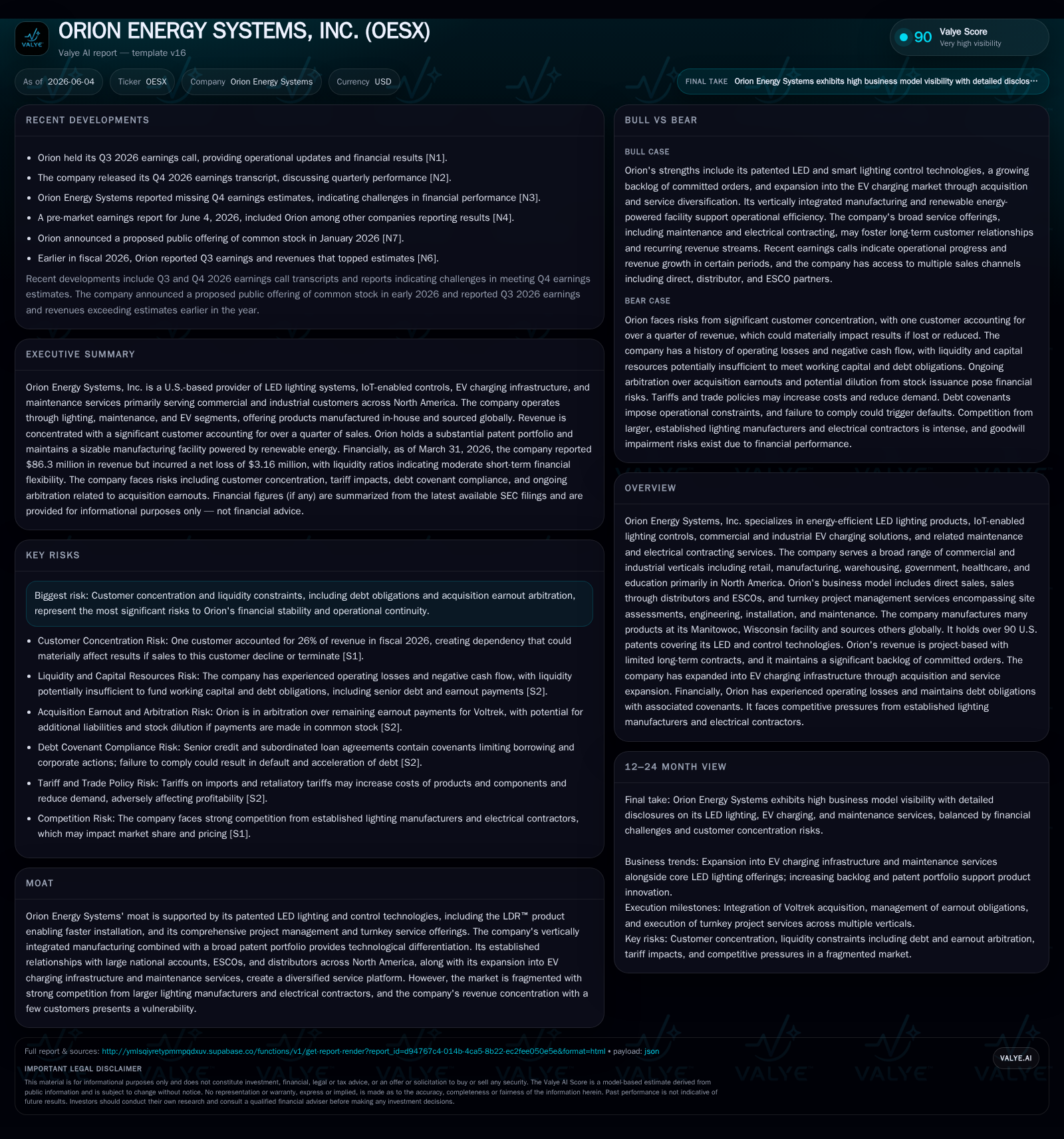
In its latest fiscal quarter ending March 31, 2026, Orion Energy Systems faced operational headwinds evidenced by a loss from operations and continuing challenges with revenue concentration tied to a few significant customers. The company is actively diversifying its business model beyond LED lighting systems by growing its electric vehicle (EV) infrastructure and electrical maintenance services, leveraging the recent Voltrek acquisition. Although backlog expanded reflecting strong project demand, liquidity constraints and debt obligations temper the near-term outlook. Orion's proprietary LED and IoT-enabled lighting technologies, combined with turnkey project execution and multi-year maintenance contracts, form a competitive base but are tested by customer concentration risks and working capital pressures.
Q4 Operating Results Signal Pressure Points
Operating expenses remain high relative to revenues; sales and marketing expenditures continue expanding alongside elevated general administrative costs, reflecting efforts to support new products and broader market reach [S5][S6]. The tight operating leverage underscores ongoing challenges in converting strong demand into sustainable profit margins.
Integrated Energy Solutions: Beyond LED Lighting
At its core, Orion’s business model combines the manufacture of energy-efficient LED lighting fixtures—many incorporating proprietary LDR™ technology designed for rapid installation—with IoT-enabled wireless control solutions enabling dynamic energy management [S1]. The company's vertically integrated approach through its Manitowoc manufacturing facility supports quality control while maintaining innovation leadership protected by over 90 US patents covering LEDs and controls technologies [S10].
Complementing product sales is Orion’s turnkey project delivery model involving site surveys, engineering design, installation, controls integration, commissioning, and maintenance services [S1][S22]. This integrated suite addresses commercial retrofit needs across retail, manufacturing, government facilities, healthcare, education, and logistics verticals predominantly in North America.
Revenue generation hinges on project-based contracts rather than long-term binding agreements except for multi-year maintenance contracts which contribute growing recurring revenue streams. This structure demands effective backlog conversion and order intake stability to smooth profitability.
Strategic Expansion into Electric Vehicle Infrastructure
The last few years have seen Orion expand its market footprint through acquisition (notably Voltrek LLC in October 2022) and organic growth initiatives targeting commercial and industrial electric vehicle charging infrastructure solutions alongside related turnkey installations and services [S1][N1]. This segment supplements core lighting operations by offering complementary electrical contracting services launched recently in fiscal 2026.
Such diversification serves two purposes: first it leverages existing project management expertise into adjacent energy solutions markets; second it introduces higher-margin recurring service revenues through ongoing maintenance contracts for both lighting systems and EV infrastructure installations—a critical margin stabilizer given project revenue cyclicality [S22]
Competitive Positioning and Industry Context
The LED retrofit market is fragmented with incumbents ranging from large multinational lighting manufacturers having scale advantages to specialized electrical contractors increasingly moving into energy management territory. Orion's moat lies in its patented product designs like LDR™, which enable faster installations translating into customer time/cost savings—a critical edge measured partly via lumens per watt efficiency that drives end-user energy savings calculations [S10]. However, scale limitations relative to industry giants cap pricing power potential.
Orion’s direct sales relationships combined with distribution through ESCOs (Energy Service Companies) fortify its access to national account customers while broadening geographic reach [S1][S2]. Still, heavy reliance on few large clients dilutes operational predictability—an endemic risk within project-driven business models exposed to capital spending fluctuations at large customers
Growth Drivers: Turnkey Services and Service Contracts
Demand catalysts include growing federal/state utility incentive programs supporting energy-efficient retrofits plus increased regulatory scrutiny driving sustainability investments across commercial sectors. Orion’s capability to conduct detailed site assessments and manage utility subsidy applications enhances competitive positioning when bidding for complex retrofit projects requiring multi-site rollouts.
The company’s expansion of maintenance contracts offers steadier revenue inflows that mitigate the lumpiness inherent in new fixture sales or one-off turnkey projects. As adherence to ESG standards grows among national accounts, the potential for cross-selling additional IoT-enabled controls or electrical contracting services expands organically from existing relationships.
Backlog growth provides a tangible KPI signaling escalating future revenue streams; conversion rates from backlog to billed projects merit monitoring as a lead indicator of operational execution efficacy [S10]. Yet variability in customer order patterns constrains visibility.
Risks: Customer Concentration and Financial Liquidity
Customer concentration persists as a primary risk factor with the loss or reduction of volume from any single significant customer poised to materially impair near-term results [S2][S12]. This structural vulnerability limits revenue predictability despite otherwise favorable market dynamics for LED retrofits and EV infrastructure deployment
Financially, Orion carries total debt near $6 million offset by roughly $3.3 million in cash equivalents as of March 31, 2026 resulting in net debt approximating $2.7 million supported by a revolving credit facility currently with around $12.6 million availability subject to borrowing base restrictions [F1][S4][S13]. Liquidity is further stressed due to ongoing earnout payment obligations tied to prior acquisitions including Voltrek—these payments constrain free cash flow flexibility amidst losses from operations.
Maintaining compliance with credit covenants remains feasible currently but could be challenged if order volatility persists or adverse macroeconomic factors increase cost pressures. Any inability to secure additional capital under acceptable terms risks forcing operational retrenchment or restructuring [S2].
Catalysts to Monitor Ahead
Critical upcoming milestones include the planned implementation of a new Enterprise Resource Planning (ERP) system targeting Q2 fiscal 2027 launch expected to enhance operational efficiency and financial reporting accuracy—a potential enabler for improved working capital management [S1]
Tracking incremental sales growth within EV infrastructure services post-Voltrek integration will provide clarity on diversification strategy success alongside quarterly changes in order intake from national account customers reflecting broader economic capital expenditure trends [N1][S2][S3]
Credit facility usage trends coupled with any amendments or covenant adjustments also constitute important liquidity markers signaling financial health outlooks.
Financial Snapshot Summary
As of March 31, 2026, Orion reported revenues totaling approximately $86.3 million accompanied by an operating loss close to $1.64 million and net loss exceeding $3 million highlighting persistent profitability challenges amid growth investments [F1]. Cash balances stood at about $3.27 million with total debt around $5.97 million equating net debt near $2.7 million while preserving a current ratio above 1.4—indicative of basic short-term liquidity adequacy but limited cushion against unforeseen stressors [F1].
Operating expenses reflect elevated general & administrative spend coupled with sustained R&D outlays focused mainly on advancing LED technologies and IoT integration capabilities necessary to sustain product differentiation in competitive retrofit markets [S5][S6]. Interest expense burden remains material given outstanding indebtedness constraining net income recovery efforts.
This analysis synthesizes material SEC filings through June 2026 including Form 8-K, 10-Qs and the latest Form 10-K alongside recent earnings call excerpts and public commentary devoid of speculative forecasts or investment research views.
Disclaimer: This is research-only, informational analysis and not investment advice. It may include AI-generated interpretation and general industry context. Always verify important details using primary sources.

Comments