
Omega Healthcare Investors’ Resilient Income Strategy Amid Healthcare REIT Dynamics
Omega Healthcare Investors’ specialization in healthcare real estate facilitates stable dividends despite tenant and regulatory challenges.
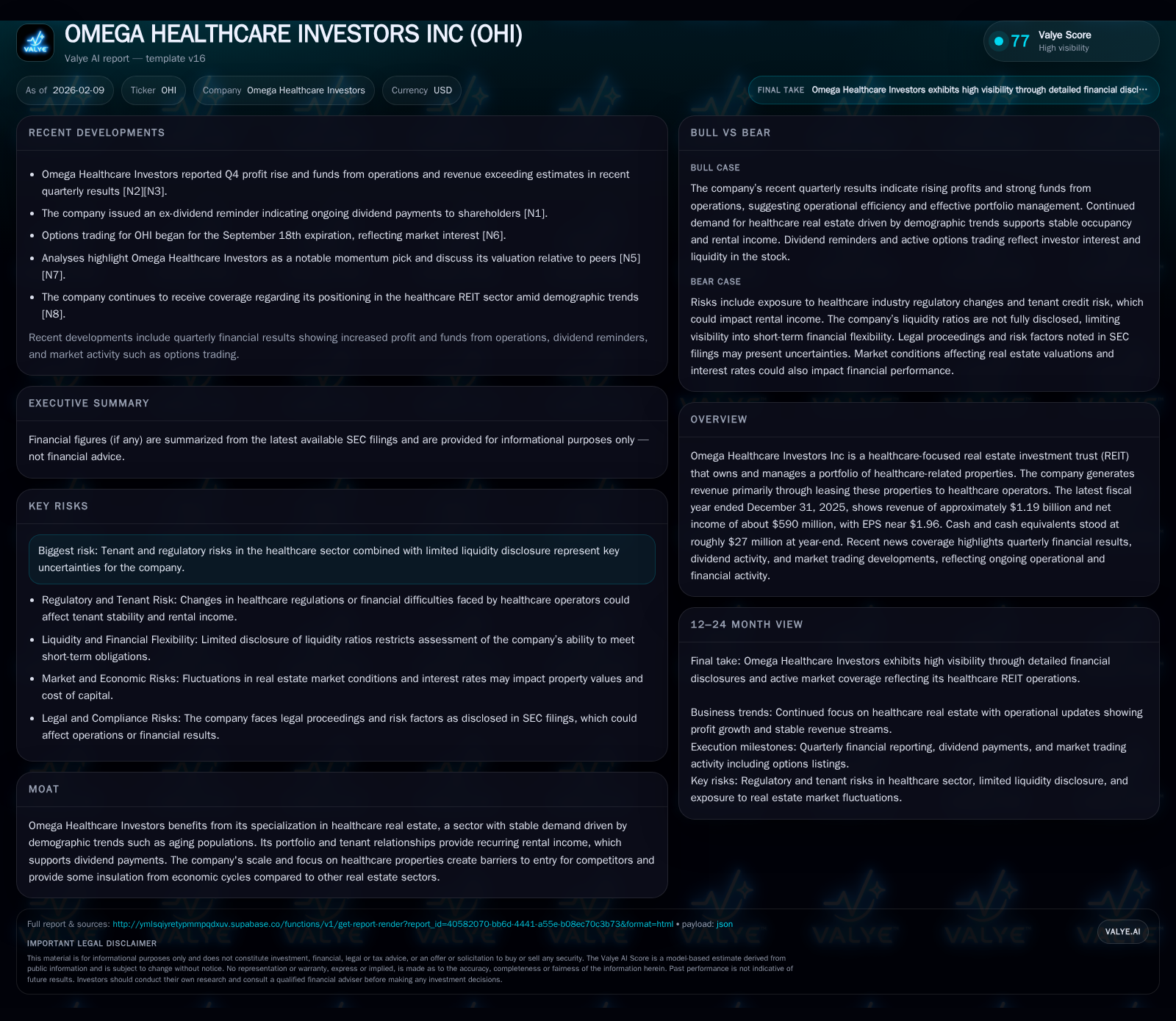
Omega Healthcare Investors Inc (OHI) recently surpassed Q4 revenue and FFO estimates, bolstering confidence in its sustainable dividend track record. The company’s focused investment in healthcare properties leverages demographic tailwinds, creating a durable moat that supports recurring rental income even through economic fluctuations. However, sector-specific risks like tenant credit variability and evolving regulations underscore the need for scrutiny of income stability. OHI’s moderate liquidity and ongoing market momentum reflect investor optimism, although balance sheet nuances warrant attention alongside peer comparisons.
Q4 Earnings: Outpacing Expectations and What It Means for Investors
Omega Healthcare Investors (OHI) delivered fourth-quarter results that outshone analyst projections, reinforcing its reputation for operational resilience. Reporting revenue near $1.19 billion and net income of approximately $590 million for fiscal 2025[1][4][F1], the company demonstrated solid top-line generation within its niche healthcare real estate portfolio. The earnings beat on funds from operations (FFO), a critical performance measure for REITs, speaks to OHI’s ability to efficiently translate its property leasing business into cash flow—foundational for sustaining dividend distributions.[N1]
Such quantitative robustness arrives amid a complex operating backdrop where healthcare operators encounter reimbursement pressures and staffing challenges. That OHI navigated these challenges while maintaining strong financial results highlights its asset quality and tenant adherence.
The Healthcare REIT Moat: Why Specialization Matters for Stability
OHI’s concentrated focus on healthcare-related properties underpins its distinct market position. Unlike diversified real estate portfolios vulnerable to cyclical swings in retail or office spaces, healthcare properties tap into service lines driven by demographic imperatives—chiefly an aging population requiring long-term care facilities.[valye_report_excerpt]
This specialization fosters recurring rental income from tenants operating in skilled nursing, assisted living, and post-acute care segments. The enduring demand stemming from secular trends erects structural barriers to entry for competitors lacking OHI’s scale or sector expertise. Moreover, steady occupancy aids in cushioning against broader economic downturns, positioning the company advantageously relative to other REIT sectors commonly tied to discretionary spending[analysis].
Dividend Dynamics: Tracking the Reliable Income Stream
Dividend sustainability remains a key pillar attracting investors to OHI. The company has maintained consistent payout levels supported by stable lease revenues—a function of long-term contracts with skilled nursing operators.[N3][valye_report_excerpt]
With EPS around $1.96 per share last year[F1], dividend coverage appears adequately backed by operational profitability. Press coverage reminding shareholders of upcoming ex-dividend dates further underscores the regularity of distributions and management’s adherence to shareholder return priorities[N3].
Operational cash flows generated through lease agreements thereby provide the financial foundation enabling OHI to uphold dividend consistency—a vital differentiator amid healthcare industry flux.
Tenant Profile and Regulatory Landscape: Navigating Sector-Specific Risks
However, embedded within this revenue model are tangible sector-specific vulnerabilities stemming from tenant credit risks and regulatory pressures.[S1][valye_report_excerpt]
OHI’s tenant base includes operators navigating fluctuating government reimbursements, compliance mandates, and labor cost inflation—all of which can imperil their liquidity profiles. Such concentration heightens the risk of lease defaults or renegotiations that might disrupt expected rental streams.
Moreover, regulatory environments are far from static; policy changes impacting skilled nursing facilities’ funding or inspection regimes introduce uncertainties influencing operators’ ability to meet lease obligations.[S1]
These dynamics require vigilant monitoring as they materially affect OHI’s potential cash flow continuity.
Balance Sheet Health and Liquidity: Reading Between the Lines
Scrutiny of OHI's balance sheet reveals moderate liquidity resources complemented by carefully staggered debt maturities.[F1][S2]
At year-end 2025, cash and equivalents stood at roughly $27 million[F1], providing a buffer against short-term operational needs or market dislocations. Debt instruments mature through 2026 to 2029[S2], reflecting manageable refinancing timelines that do not impose acute stress on capital structure.
While not exceptionally liquid relative to some sectors, OHI's financial setup offers sufficient flexibility if market conditions fluctuate—critical in an asset class where valuation lags can occur.
Market Sentiment and Momentum: Analyst Upgrades and Trading Activity
The market narrative surrounding OHI has grown increasingly constructive recently. Analysts have upgraded the stock to 'buy' status citing fundamental strengths[N6], further fueling momentum narratives labeling it a top momentum pick[N5].
Investor engagement is also visible via options market activity where new series commenced trading[N7], reflecting growing interest in hedging or leveraged positioning strategies.
This confluence of fundamental upgrades and tactical trading interest points toward enhanced confidence among institutional participants.
Comparative Valuation: OHI vs. Sector Peers and Alternatives
In valuation debates within healthcare REITs, comparisons between Omega Healthcare Investors (OHI) and Pine Mountain Capital (PINE) illuminate key distinctions.[N8]
While both capitalize on the aging demographic trend, differences in portfolio composition, geographic exposure, or tenant diversification influence risk-return profiles. Relative multiples alongside dividend yields are instructive metrics; however, qualitative factors such as management execution track record also weigh heavily.
OHI's balance between yield attraction and operational depth lends it differentiated appeal versus certain peers whose portfolios may carry more volatile tenant mixes or less established leasing frameworks.
Looking Forward: Opportunities and Challenges in an Aging Demographic Era
Looking ahead, structural growth drivers remain clear—an aging U.S. population fuels rising demand for long-term care services underlying OHI's property leases.[valye_report_excerpt]
Yet this positive backdrop is tempered by inherent risks highlighted in regulatory disclosures[S1] including evolving Medicare/Medicaid reimbursement policies, labor shortages impacting operator viability, and the persistent challenges around credit quality for tenants.
Balancing these forces requires measured capital allocation strategies coupled with proactive tenant engagement to sustain income streams that underpin dividends.
In sum, Omega Healthcare Investors stands at an inflection point defined by strong demographic tailwinds counterbalanced by operational complexity inherent to healthcare real estate.
disclaimer: This report is prepared solely for informational purposes based on publicly available data as of early 2026. It does not constitute investment advice or a recommendation regarding securities of Omega Healthcare Investors Inc.
Disclaimer: This is research-only, informational analysis and not investment advice. It may include AI-generated interpretation and general industry context. Always verify important details using primary sources.

Comments