Okta Inc: Navigating Growth, Security, and Competition in Identity Management
Okta remains a key player in cloud-based identity and access management amid cautious market sentiment and evolving industry dynamics.
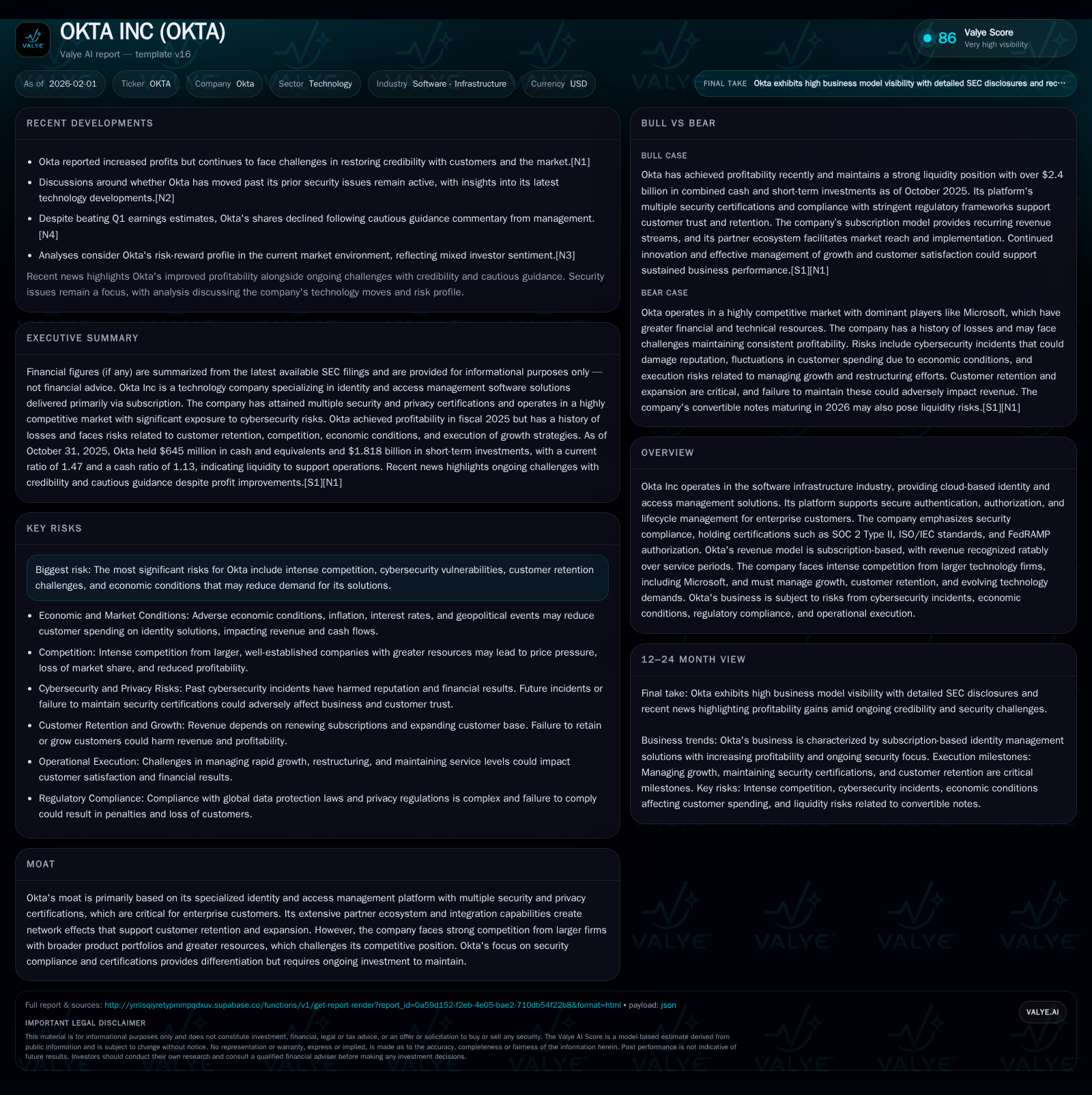
Okta Inc reported quarterly earnings surpassing estimates but faced share price declines due to cautious forward guidance and lingering concerns about its security credibility. The company operates a subscription-based platform emphasizing robust security certifications and compliance, serving enterprise customers with identity and access management solutions. Competitive pressure from tech giants like Microsoft and the need for continual innovation and certification upkeep remain critical challenges. Okta’s financial position shows improved profitability and liquidity, yet its growth trajectory is subject to macroeconomic and operational risks.
What Changed Recently
Okta reported Q1 earnings that beat analyst expectations on profitability metrics but simultaneously issued cautious commentary on future guidance that led to a decline in share price [N1]. Market reaction reflects persistent concerns over Okta’s security credibility, despite the company’s efforts to improve its standing following prior cybersecurity incidents [N2][N3]. This mixed outcome underscores the tension between operational improvements and reputational recovery. Industry observers highlight that Okta’s moves to enhance its platform and certifications are necessary but may not fully offset competitive headwinds or market skepticism [N4].
Business Model as a System
Okta operates a cloud-based identity and access management platform delivered primarily via subscription. Revenue recognition follows a ratable model over contract periods, emphasizing recurring revenue streams [S9]. The company’s value proposition centers on secure authentication, authorization, and lifecycle management for enterprise IT environments.
Critical to Okta’s system model is its extensive portfolio of security and privacy certifications including SOC 2 Type II, ISO/IEC 27001:2022, ISO/IEC 27017, ISO/IEC 27018, CSA Star Level 2, and FedRAMP authorization, enabling compliance with rigorous regulatory regimes and positioning the platform for both commercial and government customers [S1][S3]. Failure to maintain or expand these certifications risks contract losses and reputational damage.
Customer agreements include service level commitments guaranteeing platform availability, with penalties for failures to meet uptime requirements, imposing operational discipline on infrastructure stability [S1][S2]. Okta’s infrastructure depends on third-party cloud providers and internal capacity planning; any disruption can directly impact customer satisfaction and contractual obligations.
The go-to-market approach incorporates direct sales and an ecosystem of channel partners and developers who resell, integrate, and build applications leveraging Okta’s APIs [S4]. Partner incentives are critical but complicated by partners’ relationships with competitors, requiring ongoing investment to maintain alignment and prevent channel attrition.
Public sector sales add complexity through additional compliance requirements, variable government budget cycles, and potentially adverse contract termination clauses [S5][S6]. Okta must balance investments in compliance and sales resources against the revenue potential of this segment.
Research and development represent a strategic lever in Okta’s system to maintain competitive differentiation and address evolving customer needs [S16][S17]. However, R&D spend must be balanced against operating leverage and profitability objectives.
Industry Map & Competitive Battlefield
Okta competes in the software infrastructure market specializing in identity and access management (IAM), a segment experiencing rapid growth driven by escalating cybersecurity threats and digital transformation. Key competitors include Microsoft (Azure Active Directory), Ping Identity, IBM, and emerging startups with innovative authentication technologies.
Larger competitors leverage broader product portfolios and integration into extensive enterprise suites, enabling bundling and cross-selling that challenges Okta’s standalone IAM approach [S17]. Microsoft’s scale and ability to offer zero or negative margin pricing on bundled identity services exert pricing pressure.
Okta’s moat is anchored in its specialized platform, security certifications, and a developer ecosystem that creates network effects and customer stickiness [S1][S4]. The platform’s compliance with diverse regulatory frameworks, including FedRAMP for government contracts, differentiates it in public sector engagements.
The competitive battlefield is marked by accelerating innovation cycles and shifting customer expectations for seamless, secure, and user-friendly identity solutions. Customers increasingly demand multi-factor authentication, passwordless access, and integrations with zero trust architectures.
Channel relationships serve as both a growth vector and competitive battleground, with partners potentially swayed by better incentives from competitors or acquisitions disrupting existing alliances [S4]. Maintaining and expanding these partnerships is vital to Okta’s distribution strategy.
Where the Economics Become Real
Okta’s unit economics hinge on subscription pricing, customer retention, and scalability of infrastructure. Subscription terms vary in length and size, creating variability in revenue recognition and quarterly results [S9][S12]. Renewal rates and upsell to existing customers materially influence revenue growth and margin expansion.
Cost structures include significant investments in research and development to innovate and maintain security compliance, sales and marketing to acquire and retain customers, and general infrastructure costs to meet service level agreements [S16]. The balance between operating expense growth and revenue expansion is critical to achieving sustained profitability.
Okta’s infrastructure dependency on cloud service providers introduces margin and operational risks; capacity planning errors or interruptions can lead to service credits and reputational damage [S2]. Additionally, cybersecurity incidents impose both direct costs and indirect costs through customer trust erosion.
Financially, Okta has moved to profitability as of fiscal 2025, with net income reported at $43 million and a healthy liquidity position including $645 million in cash and equivalents and a current ratio of 1.47 [S13]. However, outstanding convertible notes and other debt instruments introduce financial leverage risks and potential dilution from note conversions [S13][S15].
Economic conditions and IT spending cycles create demand variability, affecting sales pipeline visibility and renewal behavior, which can cause quarter-to-quarter earnings volatility [S9][S12]. Pricing power is challenged by competitive discounting and customer cost scrutiny, especially in downturns.
Diligence Questions / Disconfirming Signals
- How sustainable are Okta’s customer retention and expansion rates in the face of pricing pressure and competition from tech giants?
- What is the current status and roadmap for maintaining and expanding Okta’s security certifications, and how do these impact customer acquisition and contract renewals?
- To what extent do prior security incidents continue to affect customer trust and brand reputation, and what measures has Okta implemented to mitigate these risks?
- How effective is Okta’s partner ecosystem in driving new business, and what threats exist from partner defections or acquisitions by competitors?
- What are the contingency plans for infrastructure disruptions, and how has Okta improved operational resilience since past incidents?
- How will macroeconomic headwinds and IT budget constraints influence Okta’s sales cycles and pricing strategies?
- What is the runway for achieving consistent profitability, given the balance of growth investments and operational leverage?
- How exposed is Okta’s public sector business to regulatory changes, budget shifts, and contract termination risks?
- What is the impact of the convertible notes on capital structure and shareholder dilution under various scenarios?
- How differentiated is Okta’s platform roadmap in addressing emerging identity standards and zero trust security frameworks?
This analysis is based on publicly available information and recent news as of early 2026. It does not constitute investment advice or recommendations. Readers should perform their own due diligence and consider multiple sources before forming views related to Okta Inc or the broader identity management market.
Disclaimer: This is research-only, informational analysis and not investment advice. It may include AI-generated interpretation and general industry context. Always verify important details using primary sources.

Comments