Optex Systems Holdings Inc: Navigating Defense Optics Amid Government Budget Dynamics
A detailed analysis of Optex Systems Holdings’ operational dynamics, segment performance, and government contracting environment.
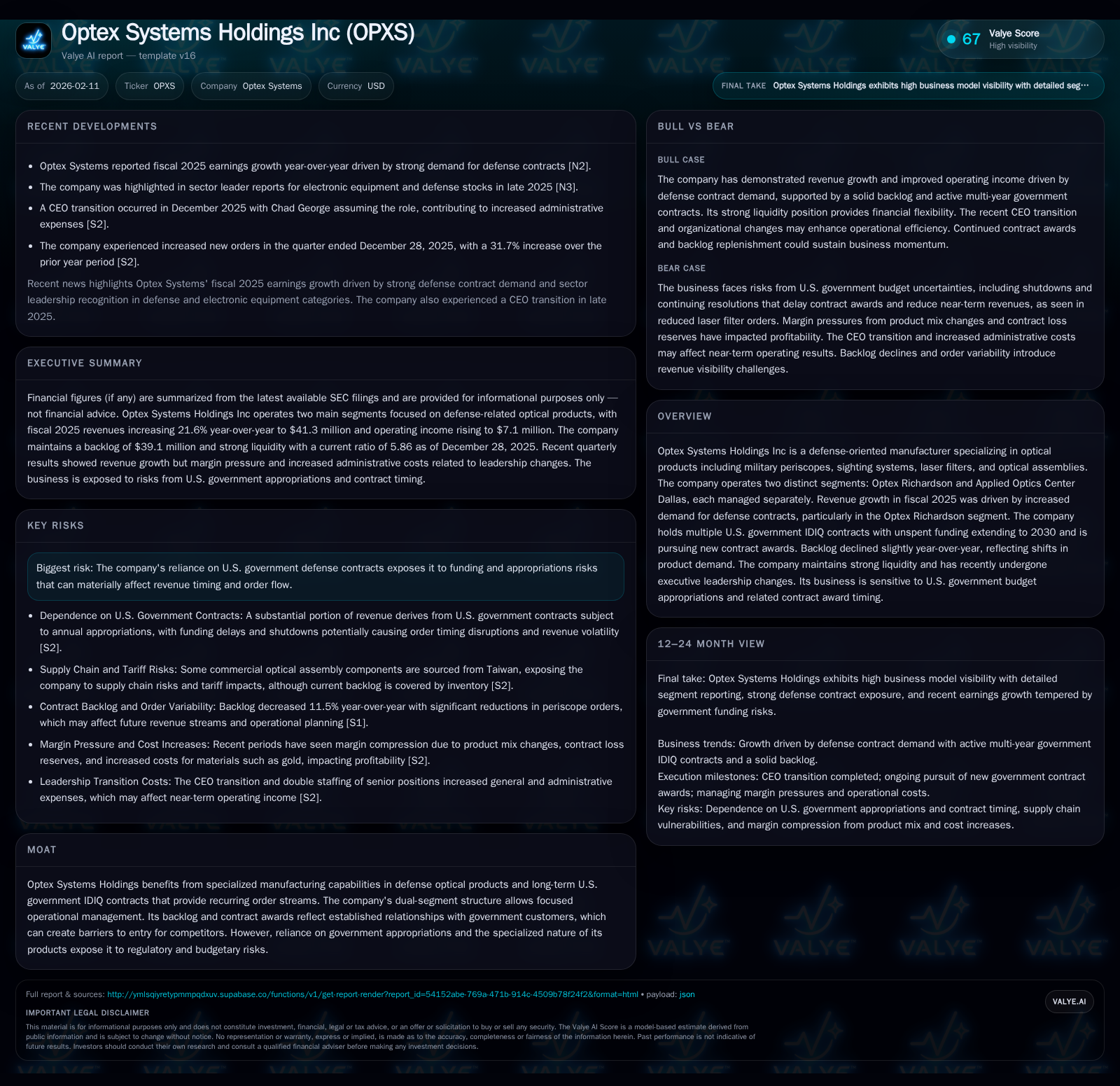
Optex Systems Holdings Inc operates two specialized segments focused on defense optical products, including military periscopes and laser filters, relying heavily on U.S. government contracts with long-term IDIQ agreements. Fiscal 2025 saw revenue growth driven primarily by Optex Richardson’s increased periscope production despite past supply chain disruptions. The company faces ongoing risks linked to government appropriations, contract timing, and supplier dependency but maintains strong liquidity and has implemented operational capacity improvements. Future revenue trajectories hinge on evolving defense budgets and contract awards amidst macro-level political uncertainty.
Company Overview
Optex Systems Holdings Inc is a niche player in defense-oriented optical manufacturing, notable for its highly specialized products such as military periscopes, sighting systems, laser filters, and optical assemblies. Operating via two separate segments — Optex Richardson and Applied Optics Center Dallas — the company addresses distinct product lines with tailored management structures. This dual-segment setup enhances focus on product-market fit and operational efficiency.
Segment Performance Analysis
Optex Richardson Segment
The Richardson segment is the larger revenue generator, contributing $23.8 million in fiscal year (FY) 2025, up from $18.2 million in FY24 — a significant growth of approximately 31%. This rise was principally driven by increased orders for military periscopes amid heightened defense spending priorities. However, prior material shortages during H1 FY24 disrupted production schedules materially, delaying deliveries into FY25 and early FY26 [S1]. The company responded decisively by securing alternative component suppliers and investing in new manufacturing equipment plus overtime labor capacity. These efforts culminated in a notable 56% increase in periscope production volume year-over-year.
Despite these improvements, gross margin at Optex Richardson remained moderate at around 25.5%, reflecting perhaps lingering inefficiencies or cost pressures associated with ramping production after disruption.
Applied Optics Center Dallas Segment
The Dallas-based Applied Optics Center realized revenues of $17.6 million in FY25 (slightly down from $15.8 million FY24 when including intersegment reconciliations), specializing primarily in laser filters and other optical components serving both defense and some commercial applications. Gross margins here are comparatively healthier at ~32%, indicating stronger profitability metrics for this unit.
That said, the segment experienced some contraction in new contract awards in Q1 FY26 largely attributable to the late FY25 U.S. government shutdown and continuing resolution periods that deferred funding decisions [S2]. Management anticipates renewal of contract awards once full budget appropriations stabilize.
Market Drivers & Risks
Dependence on U.S. Government Contracts
A substantive portion of Optex’s revenue stems from U.S. defense contracts under multiple Indefinite Delivery/Indefinite Quantity (IDIQ) agreements extending broadly through 2030 [S1]. These provide predictable order streams but expose the company to high sensitivity regarding U.S. budgetary processes.
The failure of Congress to enact appropriations promptly often triggers Continuing Resolutions (CRs) or government shutdowns—as seen Oct-Nov 2025—temporarily freezing contract awards or option exercises [S2]. While CR funding maintained baseline expenditures temporarily, certain new program initiatives were postponed impacting segment backlog composition.
Supply Chain & Operational Risks
Specialized supplies—particularly unique materials used in periscope covers and housings—have caused notable production bottlenecks historically [S1]. Though mitigated recently through supplier diversification and inventory management, these remain a structural risk given limited alternative sources globally.
Labor shortages have moderated since FY23 enabling improved output but must be monitored continuously to prevent future constraints.
Tariffs & Geopolitical Considerations
Tariff impacts appear limited due to predominantly domestic sourcing of defense product inputs. Certain commercial component imports from Taiwan are managed via adjusted pricing models that anticipate tariff pass-throughs [S2]. Nevertheless, any escalation in trade tensions could introduce risks not yet fully reflected.
Financial Health & Liquidity Position
As of December 28, 2025, Optex reported solid liquidity metrics supported by $5.8 million cash equivalents within a current asset base over $25 million against current liabilities near $4.35 million — translating into an exceptionally strong current ratio of ~5.86 [F1].
This liquidity buffer enables ongoing capital investments such as machinery upgrades aimed at alleviating process bottlenecks alongside sustaining working capital requirements associated with large defense contracts.
Net income recorded was $242 thousand for the quarter ending December 2025 [F1], indicating modest profitability amid ongoing investment phases.
Strategic Outlook & Operational Initiatives
The company's strategic priorities appear aimed at strengthening supply chain resilience, expanding periscope manufacturing capacity at Optex Richardson, and securing additional contract wins particularly for its Applied Optics Center’s laser filter products once government funding normalizes post-CR.
Recent executive leadership changes underscore an adaptive management approach responsive to shifting market dynamics and internal challenges.
Industry analytics suggest sustained U.S. defense spending growth but with notable rebalancing away from ground-based systems towards emerging technologies such as unmanned systems which may influence future product demand profiles for Optex’s optical offerings [Analysis].
Conclusion
Optex Systems Holdings occupies a specialized niche within defense optics manufacturing anchored by established government contracts underpinning recurring revenue streams. While recent operational challenges—supply chain disruptions combined with budgetary uncertainties—have impacted delivery timelines and certain segment revenues, management's focused interventions have restored improved production capacity particularly within its flagship Optex Richardson plant.
Nevertheless, lingering risks tied to U.S. government appropriation cycles, supplier concentration, and geopolitical headwinds warrant careful ongoing monitoring.
From a capital structure standpoint, strong liquidity provides operational flexibility as the company navigates evolving contract awards cycles into the mid-2020s horizon.
Investment professionals following this space should continue assessing quarterly updates for clarity on contract pipeline progression alongside any shifts in product mix correlated with changing defense procurement priorities.
This report is intended solely for informational purposes based on publicly available data as of February 2026 and does not constitute investment advice or recommendations.
Disclaimer: This is research-only, informational analysis and not investment advice. It may include AI-generated interpretation and general industry context. Always verify important details using primary sources.

Comments