Otis Worldwide Corp: Navigating Transformation and Market Leadership in Vertical Mobility
Otis Worldwide advances its global elevator and escalator leadership amid operational overhaul and sector challenges.
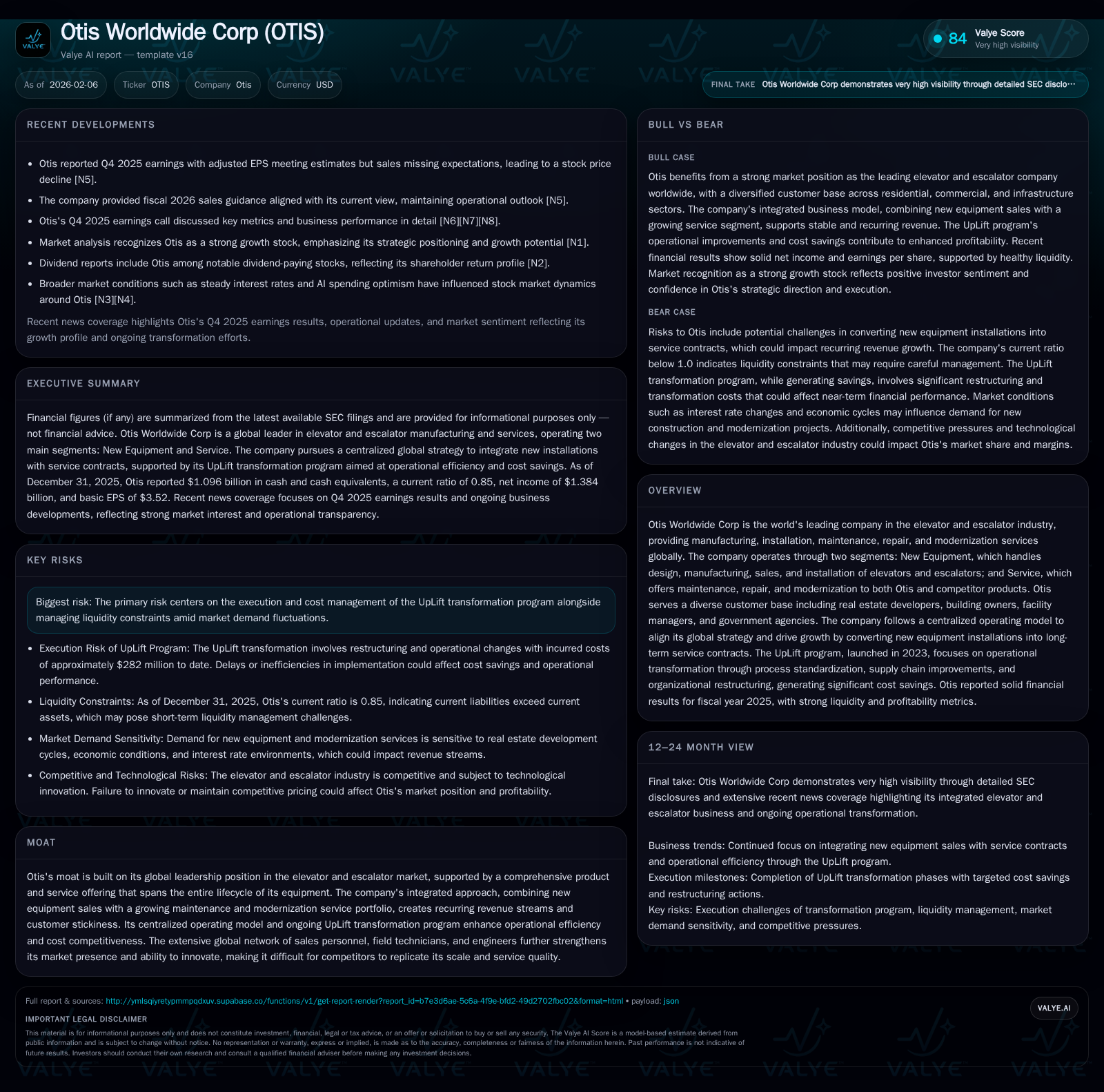
Otis Worldwide Corp stands as the preeminent global elevator and escalator provider, integrating new equipment manufacturing with extensive maintenance and modernization services. The company’s ongoing UpLift program targets $200 million in annual operational savings through standardized processes and supply chain enhancements but introduces substantial near-term restructuring expenses and execution risks. Recent earnings reflect a mixed picture—meeting earnings per share expectations while missing sales targets—underscoring the delicate balance between transformation costs and maintaining growth momentum. Otis’s entrenched market position, driven by its integrated lifecycle services and extensive field presence, buttresses its competitive advantage though liquidity concerns and macroeconomic factors persist as challenges.
Otis at a Glance: Leading the Vertical Mobility Market
Otis Worldwide Corp occupies a commanding role in the vertical transportation space, delivering elevators, escalators, moving walkways, plus installation, maintenance, repair, and modernization services worldwide [S1]. Its two main segments — New Equipment and Service — provide distinctly synergistic offerings. The New Equipment segment encompasses design, manufacture, sale, and installation of passenger and freight elevators alongside escalators tailored for residential, commercial, retail, or infrastructure projects. Customers here primarily include real estate developers, building owners, facility managers, general contractors, and government entities.
Conversely, the Service segment generates recurring revenues by servicing both Otis’s own products and competitor brands through maintenance contracts and modernization upgrades aimed at extending assets’ functional lifecycles [S1]. This comprehensive lifecycle approach not only addresses capital expenditures but fosters sticky customer relationships via continuous upkeep — a core moat element.
The company operates under a centralized global operating model designed to streamline execution while supporting its overarching strategy: leveraging new equipment sales as entry points to secure long-duration service contracts [S1]. This dual-segment structure fosters resilience by balancing cyclical capital goods demand with stabilizing service income.
Decoding the UpLift Program: Ambition Meets Execution
Announced mid-2023, Otis’s UpLift initiative serves as a significant operational transformation effort targeting enhanced process consistency and supply chain efficiencies [S1]. Its blueprint includes organizational redesigns resulting in restructuring actions coupled with technological procurement standardization. With total estimated restructuring plus transformation costs approximating $300 million through 2026—including an $18 million tail impact next year—the program presents immediate cost burdens.
Substantial annual run-rate savings of about $200 million are expected upon full realization. Interim results confirm notable cash savings: roughly $70 million pre-tax benefits realized per annum across 2024-2025 driven by streamlined organizational layers, simpler operating structures, and lowered digital tech expenditures [S1]. However, these gains coexist with heightened expense volatility due to severance packages classified under selling, general & administrative (SG&A) expenses alongside consultant fees embedded within other expense lines.
Market dialogue underscores a double-edged sword dynamic—while UpLift promises structural cost competitiveness enhancements critical for sustaining margins long term, it simultaneously injects complex execution demands that impair short-term financial clarity as integration unfolds [N14]. The sheer scale of external consulting engagements hints at substantial change management needs beyond pure cost-cutting.
Financial Pulse: Navigating Growth, Profitability, and Liquidity
Otis reported a full-year net income of approximately $1.384 billion as of year-end 2025 with underlying revenue trends indicating persistent top-line pressure [F1]. The latest quarterly results—Q4 2025—met analyst earnings per share forecasts but missed revenue expectations; this disconnect highlights incipient demand challenges compounded by transitional transformation expenses [N1][N14].
Liquidity metrics deserve particular scrutiny. Otis’s current ratio stands at roughly 0.85 (current assets around $6.5 billion versus current liabilities near $7.65 billion), signaling tighter working capital cushions than typical investment-grade industrial peers [F1]. Such positioning warrants close monitoring given cyclical sales fluctuations plus ongoing expenditure on operational restructuring.
Free cash flow profiles are influenced by both normal business seasonality plus varying timing related to UpLift outlays. Although recent quarters confirm positive cash generation bolstered by efficiency initiatives, intense spending on restructuring-related severance costs partially offsets these gains within periods analyzed [S1].
From New Installations to Recurring Revenue: The Service Segment Edge
A defining feature of Otis’s business model lies in its deliberate strategy to convert new equipment installations into longer-term service relationships [S1]. This conversion approach ensures that initial customer engagement through capital expenditure gradually moves towards predictable maintenance contracts securing steady revenue streams.
This model deepens client dependency: once an elevator or escalator is installed by Otis personnel—a mix of specialized field technicians distinct from installers—the customer is incentivized to continue using Otis for upkeep due to familiarity with product configuration nuances plus confidence in response capabilities [S1]. Modernization offerings further extend asset lifespans which can prevent migration towards competitors even during contract renegotiations.
This lifecycle integration creates meaningful switching costs in an industry where downtime risks safety compliance lapses or operational disruptions potentially costly for building operators. Therefore, service portfolio growth not only enhances top-line stability but widens intrinsic barriers holding back alternative entrants.
Market Dynamics: Competitor Landscape and Customer Dependency
Elevators and escalators represent capital-intensive engineering products coupled with technologically sophisticated maintenance requirements. Otis leverages this complexity through scale advantages reflected in its sizeable network of engineers, field technicians performing both installation and servicing roles distinctively skilled for these functions [S1].
Competitively the marketplace is constrained due to high entry barriers including certification standards for safety compliance across geographies plus investment needed in digital diagnostics tools increasingly integrated into next-gen systems [analysis]. Otis’s global footprint facilitates rapid deployment capabilities that smaller regional players cannot easily match.
Customer relationships span large real estate developers to government agencies whose procurement preferences often favor legacy providers with proven track records minimizing risk premiums associated with vertical mobility failures [S1]. Thus Otis’s brand recognition alongside established trust contributes materially to its robust moat against price erosion attempts from emerging competitors.
Balancing Act: Cost Management and Restructuring Pressures
UpLift-related expenses have exerted meaningful influence on SG&A outlays evidenced by batch restructuring charges recorded primarily as severance costs plus elevated consulting fees reflecting transformation project demands [S1][N14]. These costs collectively represent significant near-term profit headwinds acting alongside ambiguous volume trajectories during rollout phases.
Transparency regarding these burdens has improved with detailed disclosure breaking down uplift costs across transformation versus restructuring buckets; nevertheless they contribute to observed volatility when juxtaposed against relatively steady underlying operating results absent such initiatives [S1]. For investors or analysts interpreting quarterly performances this layering clouds straightforward trend assessment complicating consensus estimates accuracy post-announcement.
Tension arises between achieving labor rationalization benefits while managing morale impacts ultimately tied to workforce reductions common during restructuring cycles; such dynamics bear watching given integration timelines still progressing well into 2026 [S1][N14]. Operational discipline needed here impacts overall sustainability of realized savings beyond projected figures.
Guidance Versus Reality: Q4 Highlights and FY26 Outlook
The latest quarterly earnings release spotlights this balancing act vividly: adjusted earnings per share matched market consensus yet revenues undershot estimates highlighting struggles winning or converting sufficient orders amidst ongoing structural pauses linked with UpLift deployment [N1][N5][N14]. Management maintains FY26 sales guidance aligned with current understanding though cautiously underscores external demand uncertainties combined with internal execution variability impacting order inflows.[N14]
Market reactions were naturally muted or negative reflecting this mixed message — while bottom-line vigilance was rewarded compared to prior quarters’ shortfalls top-line softness dampened enthusiasm resulting in downward stock pressures during initial post-earnings trading sessions [N1]. Forward-looking commentary emphasized continued commitment towards UpLift milestones paired with selective investment hesitancy until clearer volume patterns emerge confirming growth stabilization course.[N14]
Risk Radar: Execution, Liquidity, and Macroeconomic Crosswinds
Anchoring key risks is the complexity inherent in successfully executing the multifaceted UpLift program. Missed deadlines or cost overruns could erode anticipated margin gains or require additional capital infusions further straining liquidity profiles already highlighted by working capital tightness (current ratio < 1) [S1][N12][N13].
Externally macroeconomic variables including interest rate stances—recently steady after Fed pauses—and broader economic cycles dictate building construction investment flows directly influencing Otis’s new equipment order book trajectories [N12][N13]. Volatility here compounds forecast difficulty given extended project lead times.
Lastly legal contingencies remain stable presently without material new developments according to disclosed contingent liabilities reports but remain perennial considerations due to regulatory compliance intensity linked to safety-critical infrastructure components embedded within elevators/escalators globally.[S2]
Conclusion Approaching Year-End 2026
Otis Worldwide embodies an integrated leadership model marrying technologically advanced product manufacturing with expansive maintenance contracts underpinning resilient cash flows fundamental within vertical mobility infrastructure markets. The ambitious UpLift operational reorganization aims at securing durable competitive advantages through enhanced cost structures though challenges inherent during transition phases evoke cautious near-term outlooks on profitability trends.
Strategically well-positioned via global reach plus comprehensive lifecycle solutions portfolio offers growth potential; simultaneously liquidity pressures coupled with external economic sensitivities warrant vigilant ongoing assessment before fully extrapolating sustainable margin expansion scenarios. Hence stakeholders should appreciate nuanced interplay between transformative investments underway versus cyclical industry dynamics shaping ultimate financial outcomes into forthcoming fiscal periods.
Disclaimer: This analysis reflects information available as of February 6th, 2026 sourced from company filings (SEC), market news outlets including Nasdaq.com articles cited herein; it does not constitute investment advice or recommendations.
Disclaimer: This is research-only, informational analysis and not investment advice. It may include AI-generated interpretation and general industry context. Always verify important details using primary sources.

Comments