
Integrated Service Expansion Drives Otis Worldwide’s Resilient Q2 Performance
Otis Worldwide’s Q2 2026 results highlight robust service revenue growth and operational improvements from its UpLift program, offsetting cyclicality in new equipment demand.
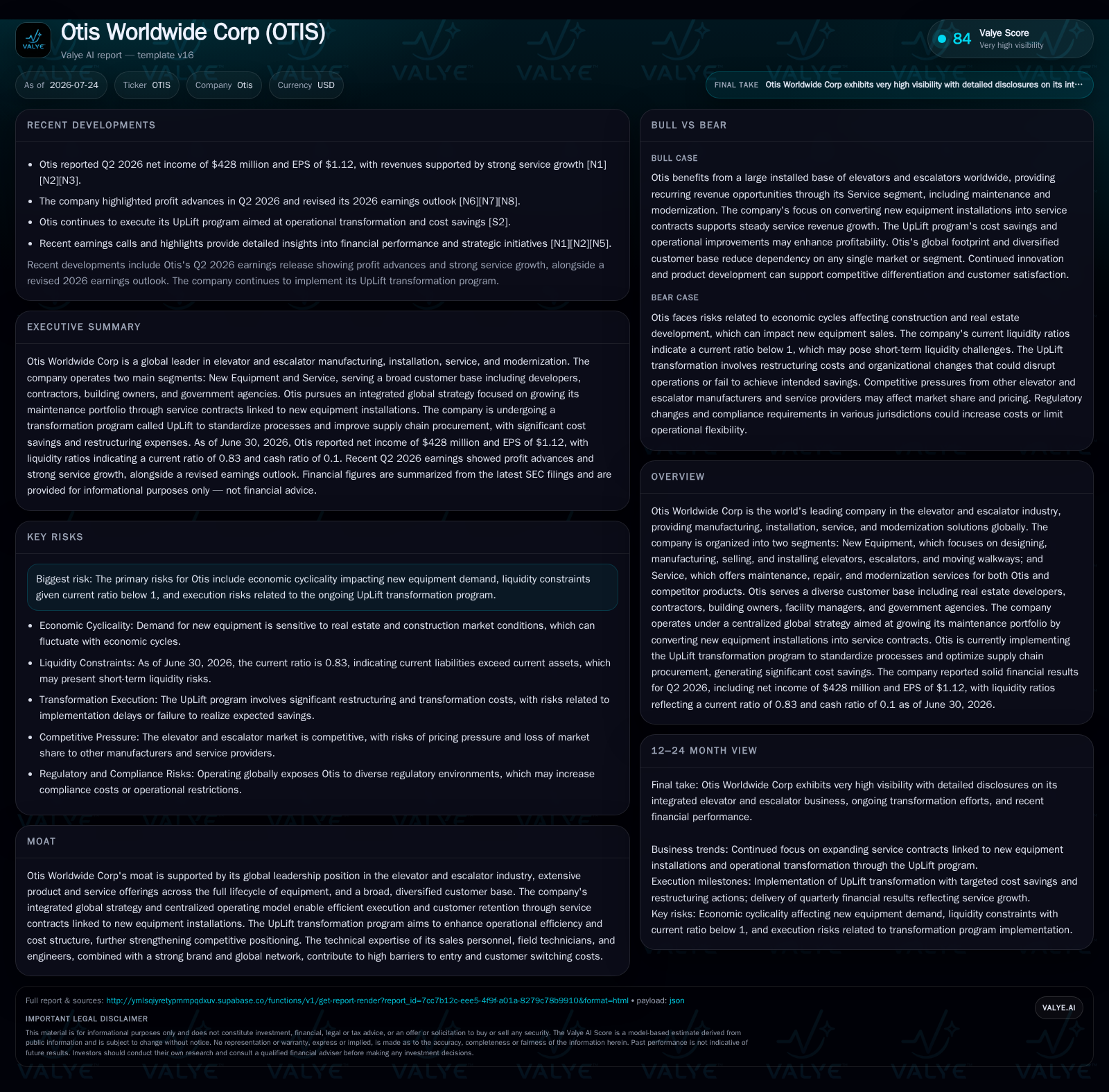
In Q2 2026, Otis Worldwide demonstrated the resilience of its integrated business model as service segment revenue growth bolstered overall performance despite moderate softness in new equipment orders amid a cyclical environment. The ongoing UpLift transformation program is advancing process standardization and supply chain optimization, generating meaningful cost savings that support margin stability. Otis’s strategy of converting new installations into long-term maintenance contracts underpins recurring revenue growth and customer retention. However, liquidity constraints reflected in a current ratio below 1 and execution risks linked to the transformation initiative remain critical watchpoints.
Q2 2026 Operational Progress Underscores Service Segment Momentum
Otis Worldwide’s Q2 2026 filing reveals continued strength in its Service segment, which offset softness in new equipment sales amid broader industry cyclicality. Maintenance revenues expanded due to rising contract renewal rates and an increasing portfolio where converted new installations translate into recurring contracts [S2]. This dynamic secures a more predictable revenue base insulated from fluctuations in capital spending by developers and building owners. The company's focus on growing its maintenance footprint supports a positive trend in field technician utilization—a critical productivity metric responsible for maintaining service capacity without proportional cost increases [N1]. Meanwhile, supply chain lead times have improved incrementally due to the UpLift program's digital procurement initiatives, helping reduce installation cycle variability [S2]. However, backlog for new equipment remains moderate, reflecting cautious end-market buying patterns influenced by macroeconomic conditions [N3]. This balance between cyclical capital demand and stable service income underpins Otis's near-term sales trajectory.
Integrated Product-Service Model: Leveraging Installation into Long-Term Maintenance Contracts
Otis operates through a dual-segment model comprising New Equipment—designing, manufacturing, selling, and installing elevators, escalators, and moving walkways—and Service, which offers maintenance, repair, and modernization services for both Otis’s own products and competitors’ [S1]. This integrated approach allows Otis to capitalize on the full lifecycle of vertical transportation equipment by initially capturing project wins via New Equipment sales followed by converting those assets into long-term service contracts. Customers include real estate developers, general contractors for New Equipment sales, and building owners or facility managers for Service contracts. Such a lifecycle strategy generates durable customer retention due to high switching costs embedded in preventive maintenance routines, safety compliance inspections, and customized repair solutions [S1]. Additionally, modernization services provide upgrade paths that extend asset life while unlocking incremental revenue unrelated to new installations. These recurring revenue streams help insulate Otis against the capital expenditure-driven volatility affecting new installations.
UpLift Transformation: Streamlining Supply Chain and Cutting Costs to Sustain Margins
Announced mid-2023, the UpLift program is central to Otis’s efforts to overhaul operating efficiency through standardized global processes and enhanced supply chain procurement automation [S1]. UpLift targets approximately $200 million in annual run-rate savings by simplifying organizational structures, reducing digital technology costs, and optimizing spans across functions [S1]. The program has already generated around $70 million pre-tax savings annually in 2024 and 2025 combined with ongoing investments totaling roughly $300 million since inception [S1]. These transformation expenses primarily include severance charges recorded mostly within SG&A expenses alongside consultancy fees booked in other income (expense) [S1]. Effective execution of UpLift is crucial for margin preservation given external pressures on raw material prices and labor costs within installation services. Continued gains in operating leverage from this initiative provide Otis with enhanced competitiveness versus global peers who face similar inflationary headwinds.
Elevator Industry Cyclicality Balanced by Recurring Service Revenue Resilience
The elevator industry's demand drivers exhibit notable cyclicality closely tied to real estate development cycles impacting New Equipment sales order books [S1], [S2]. In contrast, Service revenues—comprising maintenance contracts including preventive maintenance inspections and modernization projects—display higher stability as upkeep needs persist regardless of construction activity levels [S1]. This sector-specific revenue segmentation places significant emphasis on managing installation volumes without compromising ongoing servicing capabilities. When urban development slows or infrastructure investments moderate during economic downturns, the steady flow of maintenance renewals cushions the financial impact on Otis. Moreover, modernization projects respond partly to regulatory changes mandating safety upgrades or accessibility improvements that boost demand even during periods of lower capital expenditures on new builds.
Competitive Dynamics and Peer Context within Global Elevator Manufacturing Landscape
Otis sits among leading global elevator manufacturers alongside firms like KONE Corporation and Schindler Group that similarly combine extensive product portfolios with integrated service offerings. Its scale affords centralized strategic planning across nearly all aspects of design, manufacturing, installation logistics, service delivery networks, and customer engagement processes. Compared to regional/local elevator providers primarily focused on servicing or installation only segments, Otis’s full value-chain control contributes to higher barriers to entry due to capital intensity and technical expertise requirements. This expansive footprint enables consistent customer retention strategies leveraging brand strength and comprehensive lifecycle solutions unavailable to smaller competitors.
Growth Catalysts: Urbanization Trends, Modernization Demand, and Service Portfolio Expansion
Wider industry drivers supporting Otis’s growth comprise accelerated urban density worldwide prompting increased vertical transportation needs in residential and commercial buildings. Concurrently aging elevator fleets necessitate escalating modernization projects which boost retrofit-related revenues—a less cyclical stream than new equipment sales. Regulatory mandates globally enhance this trend by compelling safety-critical system upgrades. Additionally, expansion of the service portfolio beyond basic repairs into preventive maintenance programs improves contract lengths enhancing lifetime customer value. Emerging markets represent additional opportunity zones where rising infrastructure investments fuel demand for entire elevator ecosystems encompassing design through long-term servicing. Incorporating IoT-enabled smart elevator technologies also positions Otis favorably amid waves of technological disruption enhancing safety compliance and operational efficiency.
Watchpoints: Liquidity Constraints, Execution Risks on UpLift, and New Equipment Demand Volatility
Despite operational strengths, recent filings indicate potential liquidity tightness with a current ratio below 1 (0.83), suggesting working capital management challenges requiring monitoring especially given significant upfront cash outlays tied to inventory buildup or payables timing mismatches [F1]. Net debt stood near $7.46 billion at June-end 2026 highlighting continued leverage usage consistent with capital-intensive operations but calls attention to interest coverage dynamics if earnings weaken [F1]. Execution risk related to UpLift remains non-trivial; transformation costs totaling over $280 million incurred so far bring uncertainty around achieving planned savings within targeted timelines without disrupting customer delivery or employee morale [S1], [S2]. Lastly, the inherent volatility of new equipment order intake owing to macroeconomic factors such as real estate investment cycles demands a close watch given its disproportionate influence on short-term revenue swings.
Financial Profile Discussion: Leveraging Debt with Improving Cash Generation
Otis maintains substantial leverage reflective of its global industrial footprint with total debt approximating $8.27 billion as of June 30, 2026 against cash reserves near $813 million resulting in net indebtedness above $7.4 billion [F1]. The sub-1 current ratio signals working capital friction possibly driven by inventory buildup or payable scheduling that could pressure short-term liquidity if not managed carefully [F1]. However, the solid free cash flow generation typical of strong recurring revenue segments partially offsets these concerns given predictable maintenance contract inflows supporting operating margins at an acceptable level despite transient headwinds [S2]. The ongoing success of the UpLift program will be pivotal in sustaining margin expansion without resorting to price increases alone in a competitive pricing environment shared by peers like KONE or Schindler. Maintaining disciplined capital allocation including refinancing maturing notes such as December 2026 maturities through recent bond issues supports financial flexibility amidst market uncertainty [S3], [S14]. Overall, Otis balances considerable debt leverage against steady cash flows typical for integrated elevator lifecycle providers.
Disclaimer: This analysis is based solely on publicly available information from SEC filings dated up to July 23-24, 2026 and secondary news sources referenced herein. It does not constitute investment advice or research views but aims to provide an analytical perspective grounded in disclosed facts.
Disclaimer: This is research-only, informational analysis and not investment advice. It may include AI-generated interpretation and general industry context. Always verify important details using primary sources.

Comments