
Outlook Therapeutics Advances EU Wet AMD Market Access While Addressing U.S. FDA Hurdles
The company recently reported progress in European commercialization of ONS-5010/LYTENAVA alongside ongoing challenges in U.S. regulatory approval and financing.
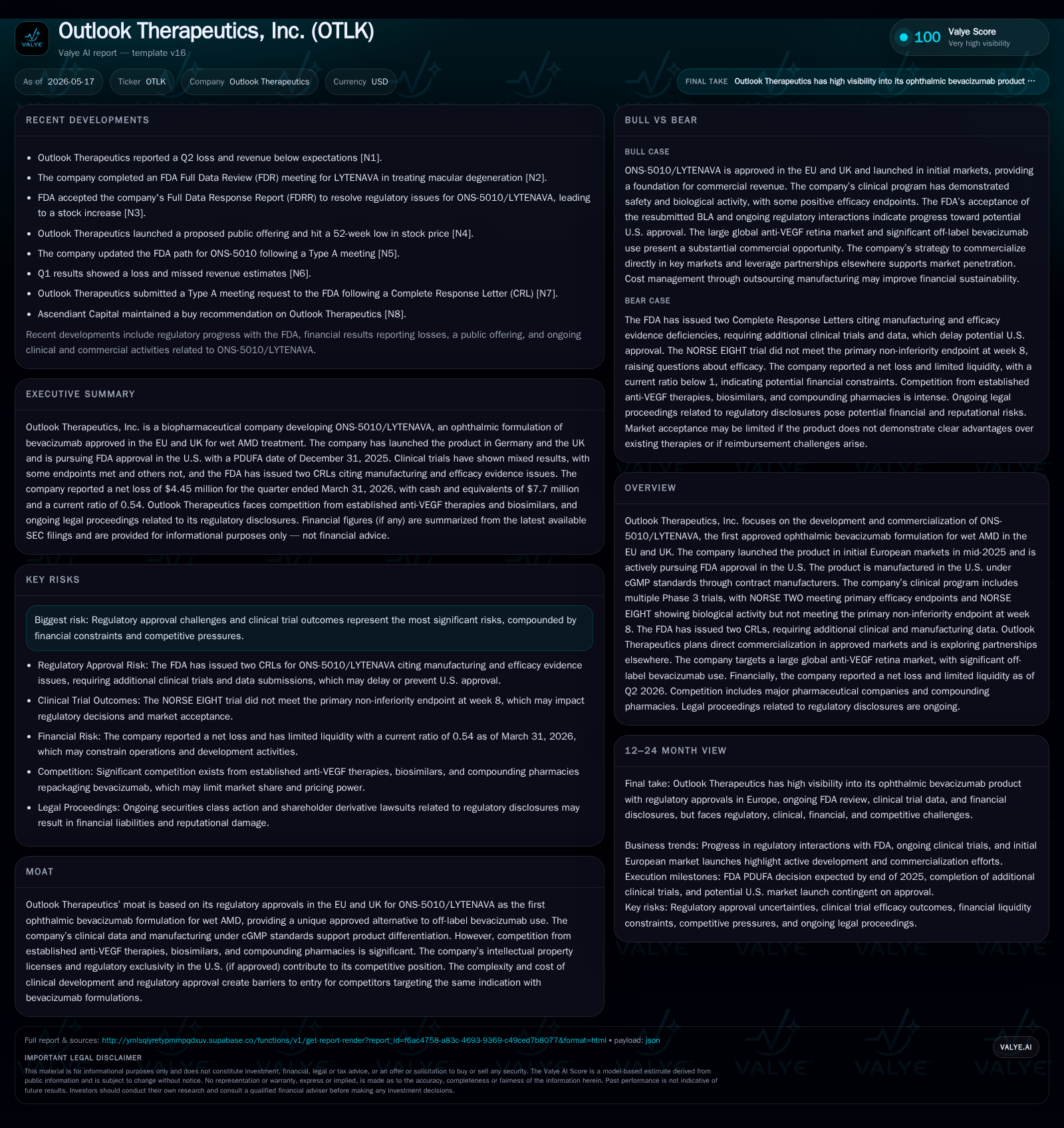
In its latest quarterly filing, Outlook Therapeutics disclosed early-stage commercialization of its first ophthalmic bevacizumab formulation approved in the EU and UK for wet AMD, with launches in Germany and the UK starting mid-2025. The company continues to pursue FDA approval amid multiple complete response letters requiring further clinical and manufacturing data. Financially, Outlook maintains a cash balance of approximately $7.7 million as of March 2026 and has entered a new $100 million ATM equity offering to support operations. The company’s competitive edge is anchored on regulatory approvals that provide an alternative to off-label bevacizumab use, but significant risks remain from regulatory uncertainties, competitive pressures, and capital constraints.
Recent Operating Update
Outlook Therapeutics’ latest quarterly filing on May 15, 2026 ([S2]) provides key insights into its current operational status: the company reports ongoing commercialization activity of ONS-5010/LYTENAVA in initial European markets following regulatory approvals from the European Commission and UK MHRA. The product was launched directly in Germany and the UK in June 2025, marking a significant milestone as the first ophthalmic bevacizumab formulation approved expressly for wet age-related macular degeneration (wet AMD).
However, the company continues to face substantial regulatory hurdles in the U.S., where the Food and Drug Administration (FDA) has issued two complete response letters (CRLs) on its biologics license application (BLA), citing requirements for additional clinical efficacy data and manufacturing process validations ([S1], [N3]). To address these issues, Outlook conducted a Federal Dispute Resolution meeting with the FDA in April 2026 ([N2]) aiming to resolve outstanding points.
On May 13, 2026, Outlook announced a new At-The-Market (ATM) sales agreement with H.C. Wainwright & Co., allowing up to $100 million capital raise through common stock issuance over time ([S3]). This follows termination of a prior ATM program with BTIG. The fresh equity initiative indicates management’s intent to secure further funding amid persistent cash burn.
Business Model
Outlook Therapeutics operates predominantly as a biopharmaceutical developer and commercializer focused on an ophthalmologic niche: treating wet AMD via ONS-5010/LYTENAVA—its proprietary ophthalmic formulation of bevacizumab. This product offers an approved alternative to the widespread off-label use of repackaged bevacizumab originally developed for oncology.
The company’s revenues are primarily expected from direct sales post-market launch where regulatory approval exists—currently Europe—and potentially from future U.S. launches upon FDA approval. Sales volume will be driven by physician adoption shifts away from unapproved compounded products toward an approved therapeutic offering perceived as safer and more reliable.
Pricing power hinges on formal approval status versus off-label bevacizumab usage though price sensitivity remains given competitive branded anti-VEGF agents such as ranibizumab (Lucentis) and aflibercept (Eylea). Outlook relies on streamlined contract manufacturing under cGMP standards in U.S.-based facilities which add credibility but entail fixed cost structures impacting margin scalability ([S1]).
Marketing efforts thus far focus on direct EU engagement with physicians and health authorities; future revenue expansion plans contemplate partnerships or direct commercialization outside Europe depending on market access dynamics.
Industry Structure and Competitive Position
The global retina anti-VEGF therapy market constitutes a multibillion-dollar opportunity with estimates exceeding $12 billion annually, split between Europe ($3.6 billion) and the U.S. ($8.5 billion) ([S1]). Within this space, bevacizumab holds an outsized role through off-label use facilitated by compounding pharmacies — an economical but less standardized channel.
Outlook’s moat derives substantially from being the first approved ophthalmic bevacizumab option endorsed by regulators in the EU and UK, offering payors and clinicians a compliant alternative that may reduce liability concerns inherent to off-label compounding. Regulatory exclusivity — if granted in the U.S.—would further extend this competitive advantage.
Nonetheless, competition is intense. Established multi-indication anti-VEGF drugs such as Roche’s Lucentis and Regeneron’s Eylea maintain strong market presence supported by extensive clinical data and premium reimbursement pathways. Biosimilar entrants also threaten to erode pricing levels.
Further complicating competitive dynamics are entrenched prescribing habits favoring off-label bevacizumab due to cost containment pressures alongside available compounded products whose supply chain agility challenges conventional pharmaceutical brands.
Growth Drivers
- Regulatory Approvals Expansion: Further approvals across additional European countries or other international markets would expand direct commercialization opportunities beyond initial launches.
- FDA Approval Success: An eventual green light for ONS-5010’s BLA would unlock access to the pivotal U.S. market where approximately one-third of wet AMD therapy use involves bevacizumab off-label.
- Physician Adoption Pattern Shift: Trials establishing safety advantages or manufacturing consistency over compounded products could encourage switch among retina specialists.
- Market Demand Underpinnings: Aging populations globally sustain structural growth in wet AMD incidence supporting steady demand for anti-VEGF treatments.
- Pricing Negotiations: Favorable negotiations with payors based on formal product approval could improve pricing flexibility relative to compounded alternatives.
- Manufacturing Scale-up: Enhancing contract manufacturing efficiency may improve margins enabling reinvestment in commercial infrastructure.
Risks / Watchpoints / Growth Constraints
Regulatory uncertainty remains paramount; FDA’s requests reflect the challenge of navigating biologics approvals specifically for ophthalmic formulations of existing oncology drugs ([S1],[S11]). Failure to satisfy these conditions constrains market entry timing threatening revenue realization horizons.
Competitive risk looms large due to entrenched brands offering broad label indications backed by clinical programs extending beyond monotherapy into combination regimens or longer dosing intervals.
Financial constraints are evident: despite recent partial equity raises totaling several millions ([S3]), operating cash burn persists without visible commercial scale revenue inflows for now, necessitating vigilant capital management given about $7.7 million cash on hand (Q1 2026) against current liabilities exceeding $38 million ([F1]).
Price erosion risks stem from heightened global scrutiny over drug costs prompted by evolving government policies such as Medicare Drug Price Negotiation Program extensions under U.S. healthcare reform ([S10], [S22]). This echoes across European HTA processes incorporating cost-effectiveness assessments influencing reimbursement decisions post-approval.
Intellectual property protection gaps may limit exclusivity duration allowing biosimilar entry sooner than expected unless regulatory exclusivities fortify barrier periods.
Manufacturing reliance on third-party contract manufacturers injects execution risk around quality control compliance essential for passing rigorous regulatory inspections amid ongoing FDA scrutiny ([S1]).
What to Watch Next
Key milestones include:
- Progress updates or outcomes from any supplementary Phase 3 or clinical bridging studies mandated by the FDA necessary for overcoming CRLs.
- Advancement or delays related to resolving Chemistry, Manufacturing, and Controls (CMC) issues flagged by regulators.
- Expansion announcements regarding market authorizations or commercial rollouts beyond Germany and UK in Europe or other regions.
- Utilization metrics signaling early physician uptake trends from initial Europe launch footprints.
- Financial updates reflecting capital drawdown pace vis-à-vis fundraising initiatives under newly established ATM facility ([S3]).
- Regulatory communications clarifying timing prospects for potential U.S. market entry subject to BLA acceptance criteria fulfillment.
- Any developments arising from pending securities litigation impacting management bandwidth or financial reserves ([S5]).
Financial Profile (Brief)
Latest financial snapshot
| Metric | Value | Period |
|---|---|---|
| Cash & equivalents | $8mm | |
| 2026-03-31 | ||
| Total debt | $10mm | |
| 2026-03-31 | ||
| Net debt | $2mm | |
| 2026-03-31 | ||
| Current assets | $21mm | |
| 2026-03-31 | ||
| Current liabilities | $39mm | |
| 2026-03-31 | ||
| Current ratio | 0.54x | |
| 2026-03-31 |
Source: SEC companyfacts cache [F1].
As of March 31, 2026, Outlook Therapeutics held approximately $7.7 million in cash and equivalents with total debt around $9.8 million resulting in net debt near $2.1 million ([F1]). Current assets stood at about $20.9 million while current liabilities exceeded $38.8 million yielding a current ratio below unity at roughly 0.54 — indicative of near-term liquidity pressure ([F1]).
Operating income remains negative indicating ongoing investment in product development and commercialization activities without offsetting operational cash generation yet ([F1]). Recent moves including the new $100 million ATM sales agreement suggest management is seeking fresh capital sources to bridge runway toward critical clinical/regulatory inflection points ([S3]).
Disclaimer
This analysis is based solely on information disclosed up to May 17, 2026, including SEC filings and publicly available news sources referenced herein without provision of investment advice or recommendations. All financial figures are drawn strictly from cited filings or authoritative sources without extrapolation beyond documented data points.
Disclaimer: This is research-only, informational analysis and not investment advice. It may include AI-generated interpretation and general industry context. Always verify important details using primary sources.

Comments