
PAMT CORP's Cyclical Downturns and Service-Centric Strategy Under Pressure
PAMT CORP faces intense profit pressures driven by industry cyclicality and tariff risks, testing its customer-focused operational model.
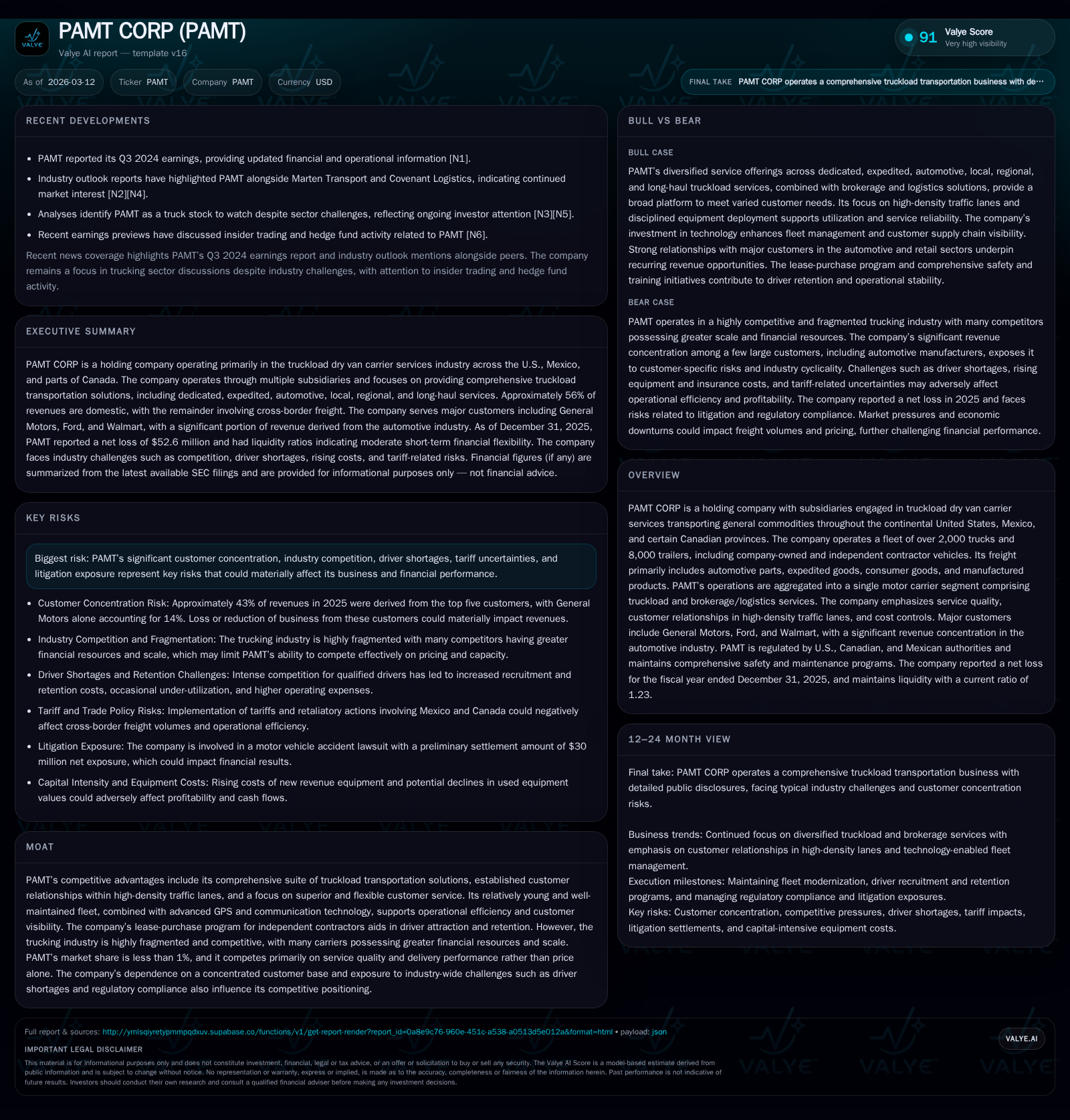
PAMT CORP experienced a sharp deterioration in financial performance through 2024–2025 after years of growth, largely due to macroeconomic challenges including tariffs impacting its cross-border freight volumes and concentrated exposure to the automotive sector. Despite these headwinds, PAMT emphasizes service quality, operational discipline in high-density lanes, and a relatively young fleet supported by technology and a lease-purchase program for contractors. However, ongoing tariff uncertainty, elevated claims expenses, mounting litigation liabilities, and cash flow pressures raise questions about capital allocation priorities and recovery prospects. Observers should carefully watch quarterly earnings for signs of margin stabilization or further weakening tied to evolving trade policies and industry consolidation trends.
From Growth to Decline: Tracing PAMT's Performance Trends (2016–2025)
PAMT CORP showed modest revenue growth from $108.4 million in FY2016 to $110.9 million by FY2017 [F1]. However, profitability has significantly deteriorated since FY2023. Operating income dropped from a positive $30.3 million in FY2023 to losses of $36.8 million and $64.1 million in FY2024 and FY2025 respectively—a decline exceeding 74% year-over-year from FY2024 to FY2025 [F1]. Correspondingly, net income swung from a gain of $18.4 million in FY2023 to losses of $31.8 million in FY2024 and worsening to -$52.6 million by FY2025 [F1].
Operating cash flows fell sharply by over 70% from approximately $59 million in FY2024 down to about $17.3 million in FY2025 [F1]. Capital expenditures peaked at around $140.8 million in FY2024 before dropping substantially to about $40.7 million in FY2025 [F1], indicating reduced reinvestment following prior heavy spending.
Historical performance (annual)
| FY | Net ($mm) | CFO ($mm) | OpInc ($mm) | Capex ($mm) | Net YoY |
|---|---|---|---|---|---|
| 2025 | -53 | 17 | -64 | 41 | -65.5% |
| 2024 | -32 | 59 | -37 | 141 | -272.6% |
| 2023 | 18 | 115 | 30 | 34 | -79.7% |
| 2022 | 91 | 169 | 124 | 65 |
Source: SEC companyfacts cache [F1].
Capital returns and efficiency (annual)
| FY | Buybacks ($mm) | FCF ($mm) | ROE% |
|---|---|---|---|
| 2025 | 15 | -23 | -25.0 |
| 2024 | 5 | -82 | -11.5 |
| 2023 | 5 | 81 | 5.9 |
| 2022 | 7 | 103 | 30.2 |
Source: SEC companyfacts cache [F1].
Note: Revenue data is partial; growth inferred from available points [F1].
Service Quality as Differentiator in a Fragmented Trucking Industry
Operating within a highly fragmented trucking market where PAMT holds less than one percent market share [S4], the company competes primarily through service quality rather than price wars. It focuses on becoming a "core carrier" for customers through high utilization within concentrated traffic lanes across the U.S., Mexico, and Canada [S4][S6]. This approach aims to optimize equipment deployment and reduce empty miles.
A dedicated sales team manages customer relationships emphasizing balanced freight flows by geography while operational efficiency reduces overhead costs [S4]. The company incentivizes driver retention through lease-purchase programs for independent contractors facilitating equipment ownership [S6]. Technological integration offers customers real-time shipment visibility enhancing service reliability [S23]. These factors help mitigate pricing pressures common among larger competitors with greater scale.
Navigating Cross-Border Tariffs and Automotive Sector Dependencies
Approximately 44% of PAMT's revenues derive from freight involving Mexico or Canada borders [S6][S10], with about 35% linked directly or indirectly to the automotive industry [S7]. Major clients include General Motors (14%), Ford (9%), and Walmart (~8%) [S4][S7].
Since 2025 the U.S. government introduced tariffs up to 25% on imports from Mexico and Canada—with some suspensions following court rulings—but ongoing uncertainty remains as new tariffs may be implemented under different authorities as of early 2026 [S1][S2][S19][S20]. These tariffs increase supply chain costs potentially reducing cross-border freight demand as customers adjust sourcing.
Labor disruptions such as the United Auto Workers strike affecting major automotive plants during late 2023 into early 2024 also lowered transport volumes handled by PAMT during those periods [S7][S8], compounding cyclical vulnerabilities tied to automotive sector exposure.
Operational Efficiency: Fleet Composition and Utilization
At December 31, 2025 PAMT operated about 2,094 trucks including approximately 493 independent contractor trucks plus over 8,020 trailers [S4][S23]. The average truck age is around two years—a relatively young fleet—supporting lower maintenance costs and better fuel efficiency critical amid diesel price volatility which the company does not hedge against [S1][S23].
Fleet management emphasizes lane discipline within dense corridors enabling consistent capacity deployment for time-sensitive deliveries aligned with just-in-time manufacturing demands from key customers [S6]. Preventive maintenance programs are rigorously applied alongside GPS-enabled cargo tracking enhancing service reliability [S23][S25]. Independent contractors provide operational flexibility adapting capacity without fixed cost burdens while lease-purchase arrangements promote driver loyalty amidst ongoing industry-wide driver shortages exacerbated by regulatory constraints such as FMCSA drug testing rules limiting labor pools [S24][S25].
Capital Allocation Review: Buybacks Amid Losses
Despite net losses exceeding $52 million in FY25 and shrinking operating cash flow down to approximately $17 million after peaking above $114 million two years earlier—PAMT increased share repurchases markedly from about $5.3 million in FY24 to nearly $14.9 million in FY25 [F1][S26]. This indicates management’s continued emphasis on shareholder returns despite constrained free cash flow (negative approximately $23.4 million calculated as CFO minus capex for FY25).
Total equity declined materially from roughly $314 million at end-FY23 down about $104 million by end-FY25 reflecting accumulated deficits [F1]. Current assets stood near $171 million against current liabilities of approximately $139 million yielding a current ratio around 1.23—adequate but indicating limited liquidity buffer under stress conditions [F1][S13].
Return on equity turned deeply negative near -25%, driven primarily by net losses eroding invested capital highlighting capital strain that may limit reinvestment absent fresh financing or improved earnings amid volatile credit markets [F1][S21].
Outlook: Key Risks and Milestones Ahead
Key factors shaping PAMT's near-term prospects include:
- Resolution or enforcement of tariffs affecting US-Mexico-Canada trade impacting cross-border freight volumes.
- Automotive customer labor relations outcomes plus supply chain strategy shifts given significant revenue dependence on this sector.
- Margin trends amid inflationary cost pressures including fuel prices and claims expenses related to recent litigation settlements.
- Driver retention success amidst persistent industry shortages critical for sustaining differentiated service levels.
- Capital allocation balancing buybacks against potential needs for balance sheet repair.
- Competitive pressures due to industry consolidation favoring larger carriers with scale advantages.
No explicit forward guidance or announced milestone events post-FY25 filings were identified at this time; thus recovery hinges on navigating these macro factors alongside operational execution effectiveness [N1][S1][S8][S11][S21][S27].
This analysis integrates publicly available audited financial disclosures through March 12th, 2026 reflecting fiscal year-end December 31st, 2025 results provided directly by PAMT CORP’s SEC filings unless otherwise noted.
Disclaimer: This is research-only, informational analysis and not investment advice. It may include AI-generated interpretation and general industry context. Always verify important details using primary sources.

Comments