
Park Dental Partners Solidifies Growth Through Long-Term Affiliations and Operational Scale
Park Dental Partners leverages exclusive long-term agreements and dentist governance to drive operational efficiencies and expand its multi-state dental network.
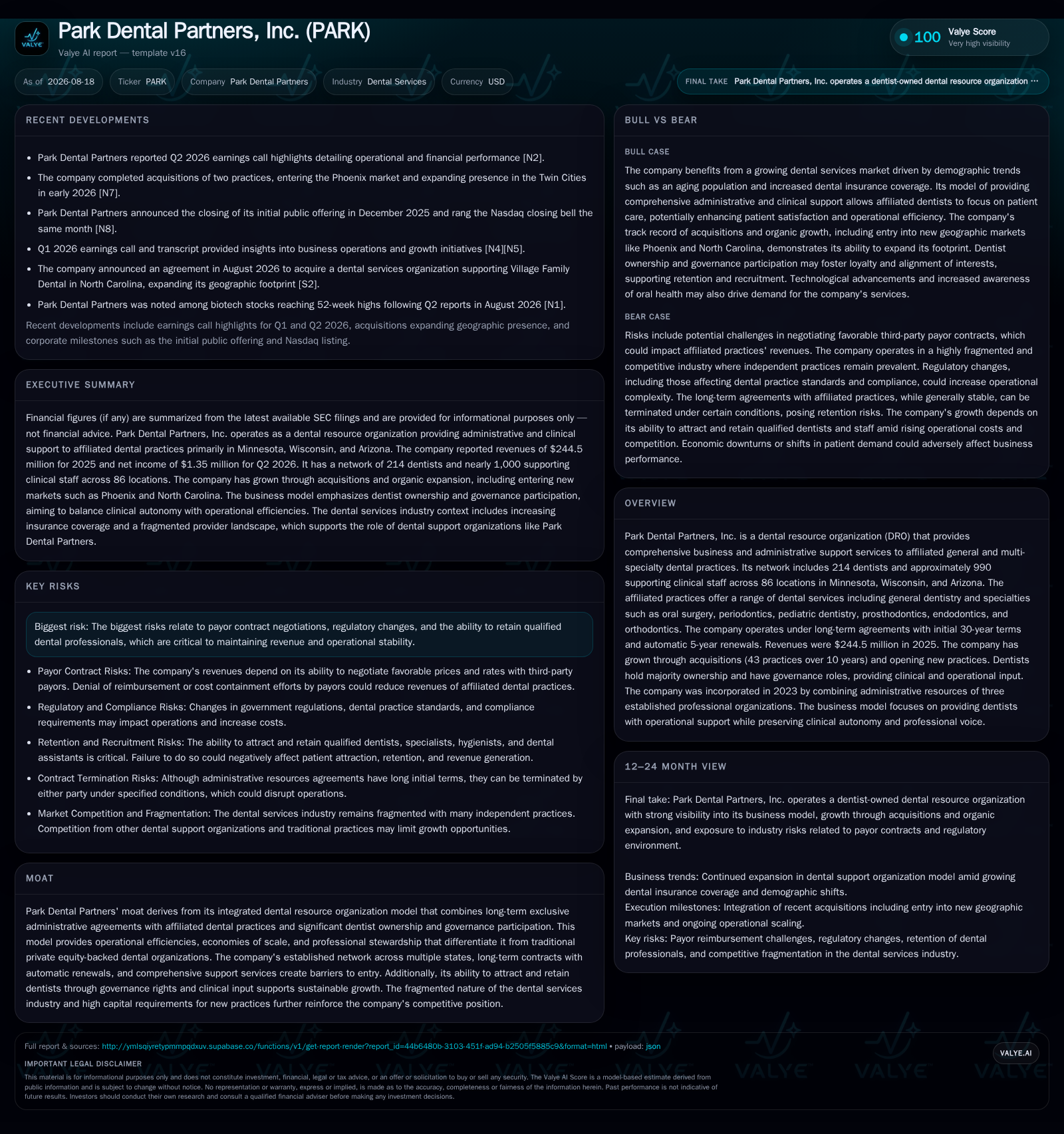
Park Dental Partners, Inc. operates as a Dental Resource Organization providing administrative and business support to affiliated dental practices, primarily in Minnesota, Wisconsin, and Arizona. Its model integrates dentists as majority owners and governance participants, supporting a growing network of 86 locations and over 200 dentists. Recent results show stability in operational performance with a $1.35 million net income in Q2 2026, supported by economies of scale and scalable infrastructure. The company faces typical industry risks such as payor negotiations, regulatory changes, and talent retention but benefits from durable long-term contracts averaging 30 years with automatic renewals. Growth is driven by acquisitions and selective market expansion into medium to large metropolitan areas.
Recent Operating Update
In its Q2 2026 filing dated August 13, Park Dental Partners disclosed continued operational stability with net income of approximately $1.35 million and operating income of $1.26 million for the quarter ended June 30 [F1]. The company reported no common stock repurchases during the quarter and no changes to previously disclosed use of IPO proceeds [S2]. This steady profitability reflects the company's ability to leverage its scalable administrative infrastructure amidst ongoing expansion initiatives. A related event filing on August 12 confirmed the firm’s plans to solidify growth through acquisitions as it recently entered into a transaction agreement to acquire Village Family Dental’s equity interest via an asset-purchase structure [S3][S18]. This ongoing consolidation aligns with Park’s strategic emphasis on entering new medium-to-large metropolitan statistical areas (MSAs) where it can apply its integrated business model effectively.
Business Model Overview
Park Dental Partners operates as a Dental Resource Organization (DRO), providing comprehensive business support services—including billing, human resources, scheduling, compliance management, marketing, and IT infrastructure—to affiliated dental practices across primary care general dentistry and multiple specialties such as oral surgery, orthodontics, periodontics, pediatric dentistry, prosthodontics, and endodontics [S1]. Unlike conventional private equity-backed DSOs focused primarily on rapid expansion or financial engineering, Park emphasizes long-term partnerships with affiliated practices through exclusive administrative agreements initially spanning 30 years with automatic five-year renewals [S1]. Such contract duration markedly reduces revenue volatility related to affiliation terminations.
A distinctive feature of Park's model is that affiliated dentists retain majority ownership stakes in their respective groups while participating actively in governance roles. This structure cultivates professional stewardship balanced between business objectives and clinical autonomy [S1]. By integrating dentists into decision-making processes concerning practice operations and growth strategies—rather than functioning solely as contracted providers—the company nurtures dentist retention and alignment of incentives across all stakeholders.
Financially, Park generates revenue principally through administrative service fees from affiliated dental groups under these contractual arrangements [S1][F1]. Volume drivers influencing revenues include the number of active affiliated dentists (currently 214), number of locations (86), clinical staff levels (~990 personnel), patient visit volumes supported by prevailing dental insurance coverage trends, and practice acquisition activity
Industry Structure & Competitive Position
The broader U.S. dental services sector remains highly fragmented compared to other healthcare segments due to historically independent practice models [S1]. However, consolidation via DSOs/DROs has accelerated amid growing demand for operational scale advantages amid rising dental insurance coverage—reported at approximately 293 million insured Americans in 2023—leading to increased patient utilization rates [S1].
Within this competitive landscape featuring over one hundred large DSOs nationwide, Park positions itself strategically through differentiated long-established relationships backed by lengthy exclusive contracts combined with meaningful dentist ownership participation [S1]. While peers like Heartland Dental or Aspen Dental emphasize aggressive expansion sometimes under private equity sponsorship schemes with shorter-term affiliation horizons, Park's governance-integrated DRO approach aims to sustain higher alignment between clinical quality priorities and operational scalability.
Key competitive factors include brand recognition within primary markets (Minnesota, Wisconsin, Arizona), insurer relationships facilitating reimbursement efficiency, accessibility of practice locations in targeted MSAs, pricing competitiveness balanced against quality perception among patients, extended hours of operation for convenience, and marketing effectiveness [S1]. These factors drive patient acquisition/retention dynamics which ultimately underpin revenue growth potential.
Growth Drivers
Park's growth levers are anchored in both organic expansion—opening new practice locations—and inorganic growth via selective acquisitions of existing practices willing to affiliate under its model [S1][S29]. The company targets primarily medium-to-large MSAs presenting sufficient patient density to justify multi-specialty group operations benefiting from shared overhead costs.
Advances in dental insurance coverage continue augmenting addressable patient populations while demographic shifts such as aging cohorts increase demand for specialized care including prosthodontics and periodontics. Concurrently rising awareness correlating oral health status with systemic health outcomes stimulates preventive care visits contributing volume upside [S1]
Technological integration remains pivotal: the company's centralized IT platform tracks daily financial/operational metrics by location enabling rapid responses to utilization changes while promoting administrative automation lowering fixed costs per unit delivered [S29]. Additionally, favorable supplier/vendor terms negotiated on a network-wide basis enhance margin profiles signaling expanding operating leverage capabilities.
Continued strategic acquisition activity—as evidenced by the latest announced agreement involving Village Family Dental—is expected to enhance geographic scope and cross-market synergies over time while sustaining high fabric retention via long contract terms [S18][S29]
Risks & Watchpoints
Despite its embedded strengths, Park confronts several industry-specific risks meriting careful monitoring:
- Payor contract negotiations: Dependence on dental insurers exposes revenue streams to reimbursement rate fluctuations potentially compressing margins if unfavorable adjustments occur [S2].
- Regulatory uncertainty: Changes in healthcare/dental practice regulations—pertaining to provider licensure requirements or insurance reimbursement guidelines—could raise compliance costs or limit service delivery modalities.
- Talent retention: Revenue generation critically depends on retaining qualified dentists and specialist clinicians; failure here would reduce patient attraction capacity leading to reduced volumes downstream.
- Practice integration: Failed or suboptimal integration of acquired practices could dilute operational effectiveness or brand reputation impacting profitability trends.
- Concentration risks: With much of its footprint concentrated in Minnesota along with expansion into two additional states (Arizona/Wisconsin), local economic downturns or regulatory shifts could disproportionately affect near-term results.
These risks are accentuated given the high capital intensity for establishing or acquiring full-service multi-specialty groups capable of competing effectively against entrenched local providers.
What To Watch Next
Monitoring these parameters will clarify sustainability of underlying growth assumptions embedded in present valuation perspectives.
Financial Profile Discussion
Park maintains a solid financial position characterized by cash & equivalents totaling approximately $24.4 million against total debt near $11 million as of June 30, 2026—resulting in net cash-positive status of about $13.3 million—which provides stable liquidity for near-term opportunistic acquisitions or capex requirements [F1]. Current assets exceed current liabilities modestly yielding a current ratio near 1.12 consistent with balanced working capital management given operational scale [F1].
Profitability is present but modest at this stage with recent operating income around $1.26 million supporting a net income figure near $1.35 million for Q2 alone reflecting profitable base operations after overhead allocation [F1]. Continued margin expansion depends heavily on integrating new affiliates efficiently and extracting scale advantages especially within indirect cost components such as administration staffing ratios and vendor procurement pricing.
Capital expenditures have been strategically moderate targeting system upgrades rather than heavy facility expansion given affiliate-owned asset usage mitigating balance sheet leverage buildup.[S29]
Overall financial metrics reflect an early-stage consolidator operating within an emerging growth framework balancing expansion investments while establishing foundation profitability benchmarks.
This analysis synthesizes publicly available SEC filings through Q2 2026 alongside industry context relevant to DSOs operating multi-specialty affiliated dental networks. It aims to provide informed insight without offering investment advice or specific future projections.
Disclaimer: This is research-only, informational analysis and not investment advice. It may include AI-generated interpretation and general industry context. Always verify important details using primary sources.

Comments