UiPath Inc's Evolution in Agentic AI and Platform-Driven Operating Leverage
UiPath advances its AI-driven automation platform amid profitability and evolving market dynamics.
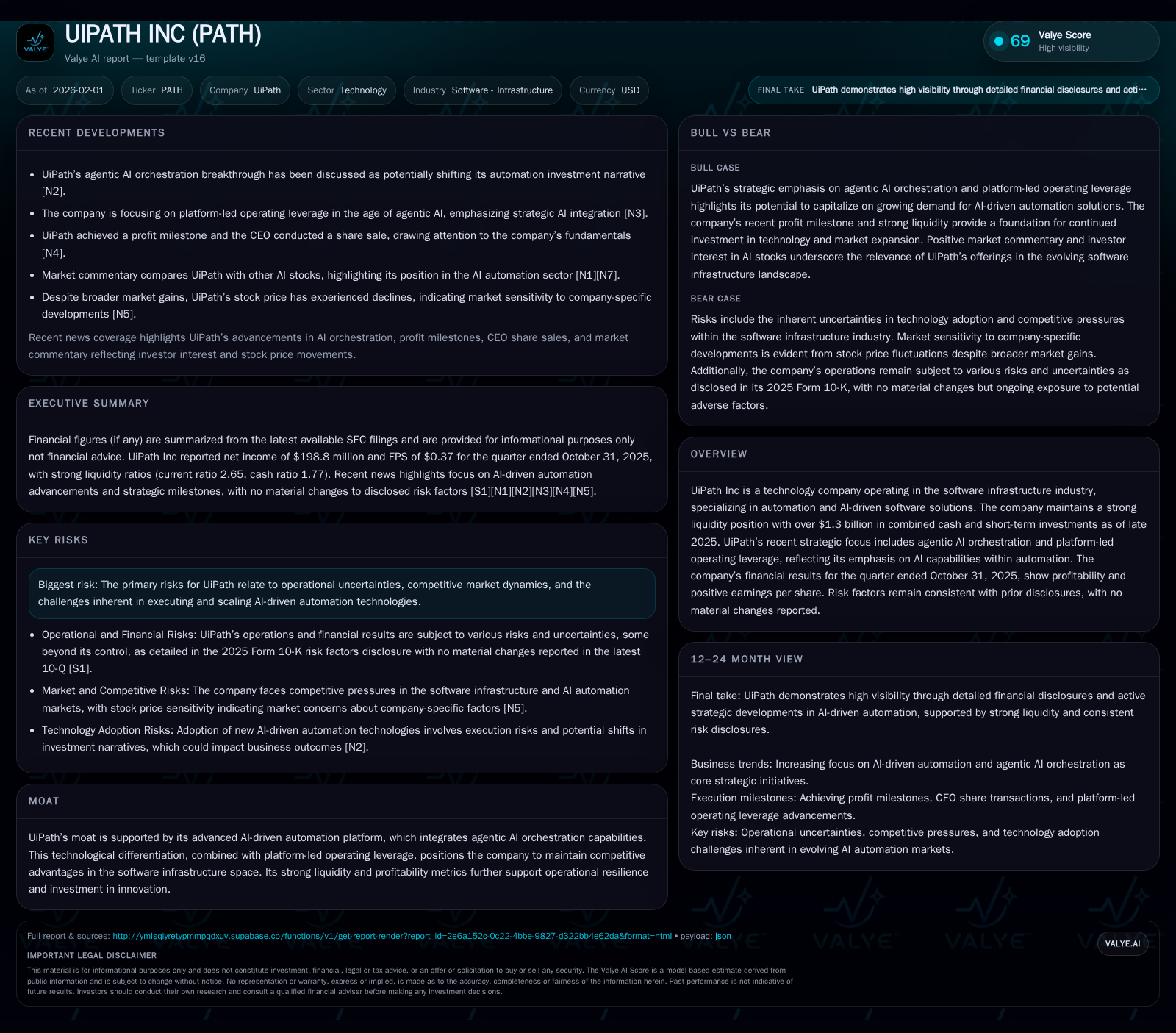
UiPath Inc has recently marked a significant profit milestone alongside strategic initiatives emphasizing agentic AI orchestration and platform-led operating leverage. The company’s financial health remains robust with a strong liquidity position and positive net income reported for the quarter ending October 31, 2025. Despite market volatility and competitive pressures, UiPath’s innovation in AI-driven automation technologies positions it well within the software infrastructure industry. However, risks related to operational execution and market dynamics continue to warrant close monitoring.
What Changed Recently
UiPath recently reported a milestone quarter ending October 31, 2025, achieving profitability with net income of approximately $199 million and demonstrating positive earnings per share — a significant achievement given its prior investment phase [N1]. This financial result coincides with the CEO executing a share sale, which has refocused market conversations on fundamentals rather than speculative growth narratives [N1]. Concurrently, industry commentary has highlighted UiPath’s strategic leap into agentic AI orchestration, an advancement positioning the company as a pioneer in autonomous automation workflows that extend beyond traditional robotic process automation (RPA) [N3].
The company also announced progress in platform-led operating leverage, emphasizing scaling efficiencies where revenue growth increasingly outpaces incremental expenses, a model characteristic of mature software infrastructure providers [N4]. Despite these advances, UiPath’s stock experienced some downward pressure amid broader market movements and investor skepticism, reflecting the complex interplay between innovation optimism and execution risks [N5].
Business Model as a System
UiPath operates within the software infrastructure sector, focusing on automation solutions that blend AI capabilities with RPA. Its product suite centers on enabling enterprises to automate repetitive, rules-based tasks through software robots, supplemented by agentic AI orchestration that introduces autonomous decision-making and adaptive workflows.
The business model leverages a platform approach where customers subscribe to UiPath’s cloud-based automation software, often integrating it deeply into enterprise IT systems. This subscription model drives recurring revenue streams and supports platform-led operating leverage, as fixed infrastructure and development costs spread over a growing user base.
Financial disclosures confirm the company’s strong liquidity position, reporting $744 million in cash and cash equivalents, and total current assets exceeding $2 billion against current liabilities of approximately $789 million, yielding a current ratio of 2.65 — indicative of solid short-term financial health [S3]. The positive net income figure marks a transition from previous periods of investment-heavy losses to sustainable profitability, validating the business model’s scalability.
Risk disclosures remain consistent with prior filings, underscoring persistent uncertainties in market adoption rates, competitive pressures, and the technical complexity of delivering AI-driven automation at scale [S1][S2]. UiPath’s model depends on continuous innovation to maintain differentiation, along with effective sales and customer success functions to drive adoption and expansion within accounts.
Industry Map & Competitive Battlefield
The automation and AI software landscape is intensely competitive and rapidly evolving. UiPath competes primarily with other RPA leaders such as Automation Anywhere and Blue Prism, as well as broader cloud and AI platform providers including Microsoft, IBM, and emerging startups focused on agentic AI and low-code automation platforms.
Customer demand is shifting from basic task automation to intelligent, adaptive automation capable of handling complex workflows with minimal human intervention. This evolution requires substantial R&D investment and seamless integration capabilities, areas where UiPath’s agentic AI orchestration aims to differentiate.
Moreover, platform-led operating leverage is increasingly critical in this market, as customers prefer comprehensive, scalable platforms over point solutions. UiPath’s ability to bundle AI capabilities with its core RPA offering and deliver this as a cloud-native platform is a key competitive advantage, although incumbent providers with deep enterprise relationships and vast ecosystems remain formidable rivals.
Sales cycles in this space are elongated and subject to enterprise IT governance, requiring UiPath to balance innovation with reliability and compliance. The company’s strategy to deepen platform integration and expand AI orchestration is aligned with broader industry trends favoring intelligent automation over simple task automation.
Where the Economics Become Real
Unit economics for UiPath hinge on expanding subscription revenues while managing customer acquisition costs and operational expenses. The platform-led model supports high gross margins typical of SaaS infrastructure businesses, provided incremental costs for cloud hosting, R&D, and customer support are controlled.
The reported profitability suggests UiPath is successfully scaling its revenue base faster than operating expenses, validating the leverage effects of its AI-enhanced platform. However, sustaining this requires continuous innovation to retain customers and prevent churn, especially as competitors intensify their product offerings and pricing pressures.
Capital allocation decisions, including R&D spend and go-to-market investments, directly impact future margin expansion. Liquidity levels afford some flexibility to invest in product development and sales capacity, but operational discipline remains crucial, particularly given the inherent risks in commercializing emerging AI technologies.
Customer lifetime value (LTV) depends on the platform’s stickiness and the ability to upsell advanced automation features. The agentic AI orchestration layer may increase switching costs and drive deeper integration, potentially boosting LTV. Conversely, execution missteps or failure to meet evolving customer expectations could impair retention and growth.
Diligence Questions / Disconfirming Signals
How does UiPath quantify the incremental revenue and margin impact attributable to its agentic AI orchestration capabilities versus legacy RPA offerings?
What indicators are available regarding customer adoption rates and satisfaction specifically around the AI orchestration platform?
How sustainable is the current profitability, considering the competitive intensity and potential cost pressures from ongoing R&D and sales expansions?
What are the primary causes behind recent stock volatility, especially in light of CEO share sales, and how might these reflect internal confidence or market sentiment?
Are there emerging competitors or technologies that could disrupt UiPath’s platform-led operating leverage thesis?
What operational bottlenecks exist in scaling AI orchestration, particularly in terms of engineering talent, cloud infrastructure, or enterprise integration complexities?
How is UiPath managing risks around AI governance, security, and compliance, given increasing enterprise scrutiny?
What is the visibility into pipeline and contract renewals, and how tightly linked are these to the new AI-enhanced product features?
This analysis synthesizes publicly available information as of early 2026. It is intended for informational purposes and should not be construed as investment advice or a recommendation. Readers should conduct their own due diligence and consider multiple perspectives before forming conclusions about UiPath’s prospects or valuation.
Disclaimer: This is research-only, informational analysis and not investment advice. It may include AI-generated interpretation and general industry context. Always verify important details using primary sources.

Comments