
PreAxia Health Care Payment Systems Advances Digital HSA Management Amid Capital Challenges
The latest quarter underscores PreAxia’s growth ambitions in AI-powered health payment solutions while spotlighting critical liquidity constraints.
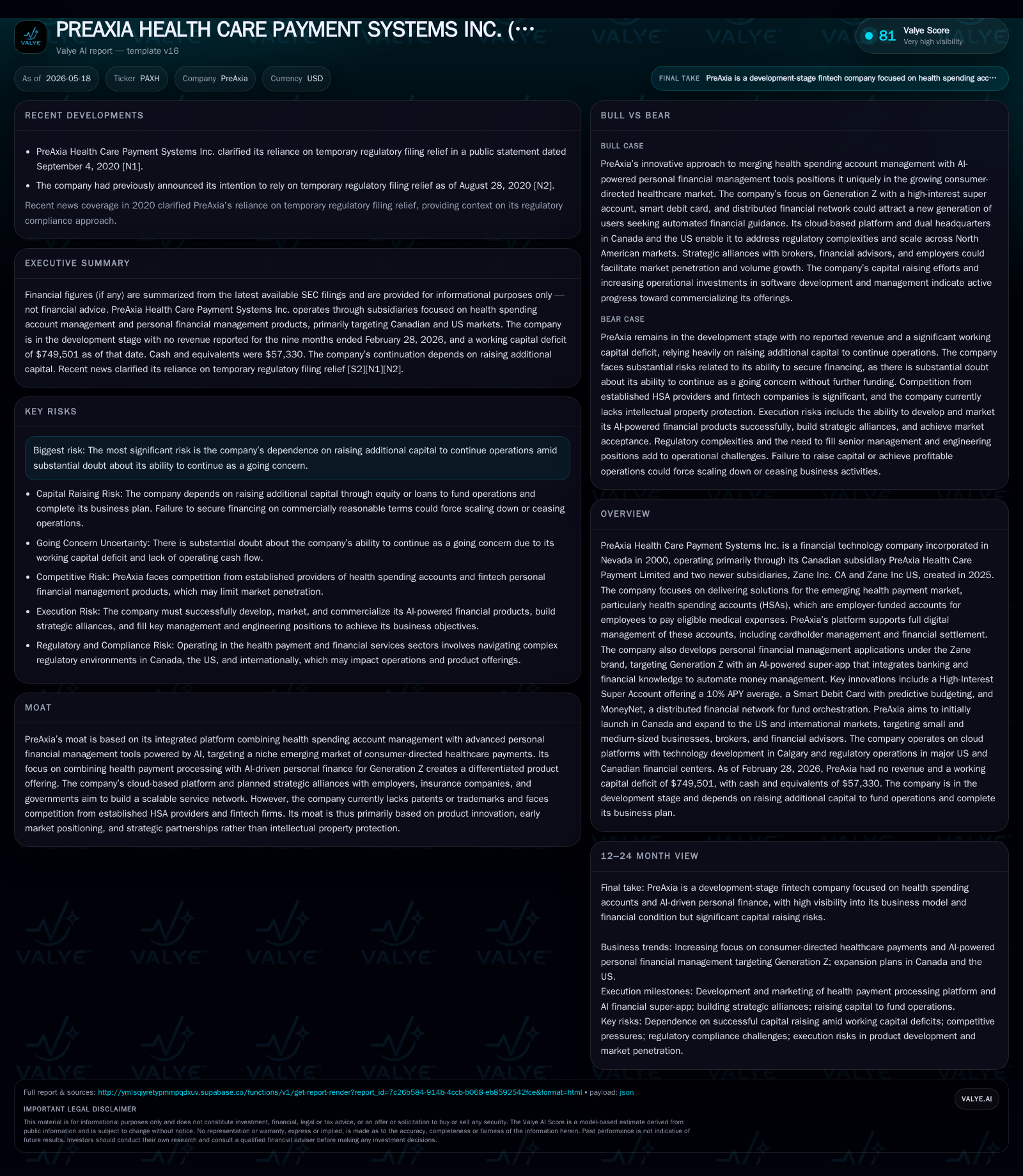
PreAxia Health Care Payment Systems continues to develop its digital platform targeting the burgeoning health spending accounts (HSA) market, blending employer-funded health payment processing with AI-driven personal financial tools. The company's recent quarterly filing reveals zero revenue alongside rising expenses but an improved working capital deficit due to equity raises and debt conversion. Despite clear product differentiation and strategic positioning in an evolving consumer-directed healthcare payments industry, PreAxia faces substantial ongoing capital risks that could impede execution and scalability.
Latest Operating Developments Signal Urgent Capital and Execution Challenges
PreAxia’s most recent quarterly report for the period ended February 28, 2026 outlines a continuation of zero revenue generation, combined with sharply increased expenses totaling roughly $95K for the quarter versus $13K a year ago [S2]. This reflects ongoing investment in research and development, management costs, consulting services, and administrative overhead as the company refines its health payment platform and personal financial management applications. Despite no top-line inflows yet, the working capital deficit shrank significantly from around $2.34 million at mid-2025 to approximately $749K by February 2026 [S4]. This improvement was chiefly driven by debt conversion into equity and fresh stock sales, illustrating interim investor support but underscoring persistent liquidity risk.
The company’s current ratio deteriorates to an acute 0.07 given current assets of just over $57K against liabilities exceeding $806K [F1][S2]. Such leverage paints a challenging near-term balance sheet picture demanding prompt capital injection to avoid scaling back or ceasing operations entirely. Additionally, internal control issues noted in prior filings and corrections to prior quarterly reports suggest operational growing pains that could affect investor confidence [S3].
Business Model: Integrating Health Spending Account Processing with AI Personal Finance
PreAxia’s revenue mechanism relies primarily on fee-based processing of Health Spending Accounts (HSAs), which are employer-funded accounts allowing employees to pay eligible medical expenses directly [S1]. Employers deposit funds into these accounts; employees access these monies via prepaid cards managed through PreAxia’s digital platform, which streamlines account administration by fully digitizing cardholder management, settlements, and reconciliation processes. This reduces paperwork and operational costs for both employers and plan administrators.
Alongside HSAs, PreAxia is building out Zane Inc CA and Zane Inc US subsidiaries focused on AI-powered personal financial management tools targeted at Generation Z users [S19]. The "personal AI banker" super-app concept aggregates banking functions across institutions, employing advanced predictive budgeting, automated fund transfers (MoneyNet), and a high-interest super account offering a notable ~10% APY—blurring traditional banking boundaries. Revenue drivers in this suite are expected to emerge from subscription fees or service charges tied to enhanced financial advisory functionalities.
This business model thus integrates a B2B payment processing infrastructure serving employers and insurers with B2C fintech applications aimed at younger individuals seeking automated finance solutions. PreAxia monetizes through a combination of service fees on HSA account volumes—the transaction pricing linked to usage—and emerging subscription or transactional revenues from Zane’s AI offerings.
Competitive and Industry Landscape in Health Payment Systems
The industry context for PreAxia spans financial services intersecting with health care benefits administration—a space witnessing rapid growth due to escalating health costs and regulatory shifts promoting consumer-directed healthcare spending [S1]. HSAs represent a crystallizing growth conduit favored by insurance companies and employers aiming to control costs while empowering employee benefit usage.
Competition includes well-entrenched HSA providers and fintech firms operating both payment platforms and personal finance apps. Unlike many traditional providers focused strictly on either banking services or benefits administration, PreAxia attempts an integrated approach combining digital HSA management with AI-driven personal money management tailored for Gen Z. However, the company currently lacks intellectual property protections such as patents or trademarks, making differentiation reliant on product innovation speed and breadth of strategic alliances.
Pricing models vary but generally reflect transaction volumes processed or flat service fees per account under management. Switching costs for employers stem from integration complexity with payroll systems or existing benefits platforms but may erode if competing platforms offer superior digital experiences or cost savings.
Regulatory compliance poses both constraints and barriers; healthcare finance is heavily regulated across jurisdictions in Canada and the U.S., impacting product design timelines as well as customer onboarding standards [S1]. Capacity constraints are minimal given cloud-based architecture but scaling requires sufficient capital investment.
Growth Opportunities Supported by Emerging Market Trends and AI Innovation
The underlying market opportunity supporting PreAxia rests on solid structural growth trends: U.S. HSAs held assets exceeding $122 billion as of 2023 with rapid compound annual asset growth exceeding 11–18% annually [S1], combined with expanding Canadian group insurance markets where corporate demand for employee health financing vehicles is increasing [S1]. This presents a sizable addressable market for digitally enabled HSA platforms.
PreAxia aims to capitalize through several vectors: enlarging employer client bases initially in Canada before penetrating the sizeable U.S. market via Zane US; further expanding product functionality into complementary health payment products; leveraging AI innovations embedded in its Zane brand to differentiate from traditional fintech competitors; and building partnerships across insurance carriers, banking institutions, employers, and governmental agencies [S1][S8].
The Zane super-app’s unique proposition—involving high-interest accounts coupled with smart debit cards enforcing spending discipline—targets Gen Z consumers who favor tech-enabled automation over manual budgeting approaches. Combining personalized AI advisory with HSA integration could drive network effects if scaled successfully.
Key Risks: Capital Dependence, Market Adoption, and Competitive Pressures
A paramount risk spotlighted repeatedly in filings is PreAxia’s reliance on raising substantial additional equity capital to sustain operations through commercialization phases [S1][S2][F1]. The absence of any revenue exacerbate solvency concerns compounded by high cash burn related to ongoing software development, management salaries (notably CEO consulting fees rising substantially), consulting contracts, and professional fees [S13], while current liquidity metrics remain precarious [F1].[S8]
Market adoption timelines remain uncertain: penetration into conservative employer benefits markets demands overcoming incumbent provider relationships along with meeting intricate regulatory requirements. Without initial cash flow generation from account management fees or app subscriptions soon, business continuity risks amplify.
Competition from entrenched HSA processors—often integrated within insurance ecosystems—and legacy fintech wallet providers challenge both pricing power and customer acquisition costs. Additionally, failure to protect proprietary technology through patents or contracts places weight on strategic alliance fidelity.
Finally, operational risks linked to correcting prior accounting errors raise concerns about internal controls that could impair investor perception or delay audits [S3].
Milestones to Watch: Capital Raises, Product Launches, and Strategic Partnerships
Near-term execution hinges critically on PreAxia securing sufficient funding rounds to cover projected operating losses estimated near $1 million over twelve months encompassing creditor payments and business plan completion guided by management disclosures [S8][S1]. Public announcements of successful private placements will be key signals.
Product-wise, commercial rollout progress of the Zane branded personal financial management applications both in Canada (Zane Inc CA) and the United States (Zane Inc US) subsidiaries will mark important milestones along with customer onboarding data if available publicly. Expansion of strategic alliances with large employers, health insurers, governments or other ecosystem partners will provide evidence of market traction aligned with stated objectives [S8][S1].
Operational hiring progress for senior sales, engineering leadership also merits tracking as staffing adequacy will influence development velocity.
Financial Overview: Liquidity Status and Balance Sheet Constraints
At February 28, 2026 quarter-end PreAxia held roughly $57K in cash balanced against approximately $81K total debt implying net debt near $24K [F1]. However current liabilities totaled nearly $807K producing a stark working capital deficit close to $750K with a critically low current ratio near 0.07 signaling pronounced short-term liquidity risk [F1][S8].
While the significant improvement over the previous year’s working capital shortfall (~$2.34 million) reflects investor willingness to convert loans into equity or purchase stock recently [S4], absent sustained inflows this condition poses going concern challenges explicitly disclosed by management multiple times across filings [S1][S2][S8]. The company maintains that no off-balance sheet arrangements materialize at present but warns that failure to obtain financing promptly would force scaling back operations or shutdown.
Ongoing losses driven by R&D spend ($307K nine months), higher consulting/management fees (~$400K nine months combined), professional fees, along with non-interest-bearing related party loans underscore urgency for operational leverage improvements once products launch commercially [S13][S22]
This analysis represents an informed industry perspective based strictly on publicly filed statements without endorsement or investment advice. Investors should conduct their own due diligence regarding PreAxia Health Care Payment Systems Inc.’s developmental stage profile characterized by innovative fintech initiatives tempered by near-term liquidity constraints.
Disclaimer: This is research-only, informational analysis and not investment advice. It may include AI-generated interpretation and general industry context. Always verify important details using primary sources.

Comments