
Phillips Edison & Company, Inc.: A Grocery-Anchored REIT with Stable Fundamentals Amid Sector Shifts
Phillips Edison & Company focuses on grocery-anchored shopping centers, leveraging geographic diversification and essential retail tenants for resilient cash flows.
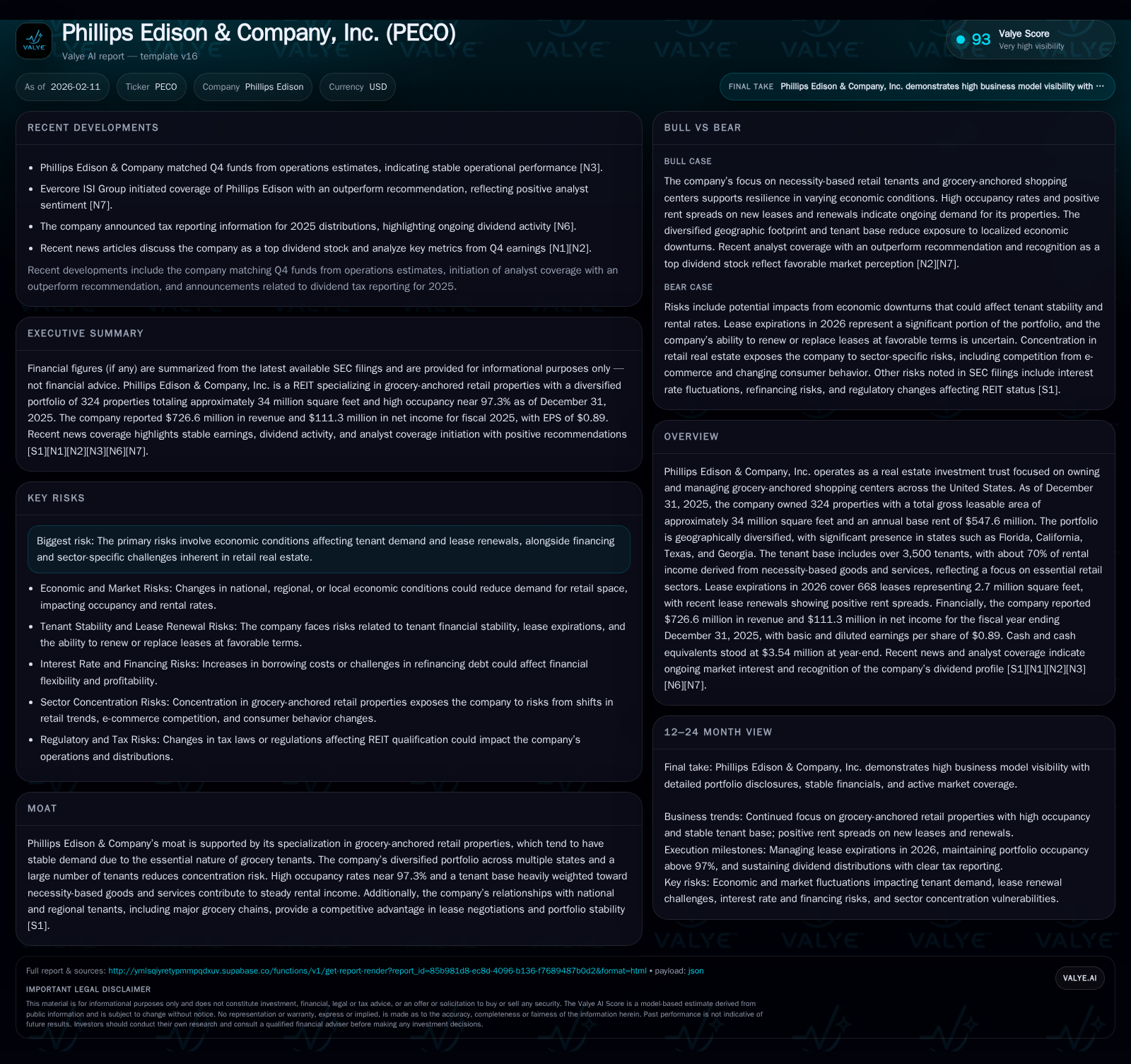
Phillips Edison & Company, Inc. (PECO) operates primarily as a grocery-anchored retail real estate investment trust (REIT), owning a portfolio of 324 properties totaling roughly 34 million square feet across the United States. The company’s emphasis on necessity-based retail tenants — with grocery stores as anchors — drives occupancy rates near 97%, providing stable rental income supported by over 3,500 tenants. Geographic diversification further mitigates concentration risk while recent lease renewals have shown positive rent spreads. However, evolving economic conditions and financing environment considerations remain primary risks for PECO’s operational continuity and performance.
Company Overview
Phillips Edison & Company, Inc. (ticker: PECO) is a publicly traded real estate investment trust specializing in grocery-anchored shopping centers throughout the United States [S1]. As of December 31, 2025, the company managed a substantial portfolio of 324 properties encompassing approximately 34 million square feet (GLA), generating an annual base rent (ABR) totaling roughly $547.6 million [S1][F1]. This focus on grocery-anchored retail distinguishes PECO within the broad retail REIT landscape by targeting assets underpinned by grocery stores and other essential service providers — categories historically resilient to economic cycles due to consistent consumer demand.
Portfolio Composition and Geographic Diversification
The company's properties exhibit significant geographic spread across multiple U.S. states, limiting exposure to localized economic downturns. Notably, Florida ($67.4M ABR), California ($57.8M), Texas ($51.7M), and Georgia ($46.9M) rank among the largest contributors to annualized rent, collectively accounting for more than 40% of total ABR [S1]. Beyond these states, investments are distributed across markets such as Ohio, Illinois, Colorado, Virginia, Minnesota, Massachusetts, Nevada, and several others.
Within urban concentrations, target metropolitan areas include Atlanta ($39.6M ABR), Chicago ($29.3M), Dallas ($26.1M), Sacramento ($23.2M), Denver ($22.4M), Houston ($22M), Minneapolis ($21.8M), Las Vegas ($16M), Washington D.C. ($15.6M), and Tampa ($14.8M) [S1]. These cities underpin the portfolio's revenue base while representing diverse regional demographics and economic dynamics.
Tenant Base and Lease Structure
PECO’s tenant roster encompasses over 3,500 lessees with a dominant allocation toward necessity-driven goods and services (~70% of rental income) [S1]. Anchor tenants predominantly consist of national and regional grocery chains that function as reliable traffic generators for adjoining retailers within each center.
This tenant anchoring translated into strong operational metrics at year-end 2025: a high occupancy rate of approximately 97.3% underscores effective property management and market positioning [S1]. Lease maturity profiles reveal notable lease expirations coming due in 2026 involving around 668 leases totaling roughly 2.7 million square feet — an important renewal cohort which recently showed encouraging positive rent spreads indicative of modest leasing power in the current market environment [S1].
Financial Performance Highlights
For fiscal year ending December 31, 2025, Phillips Edison reported revenue of $726.6 million alongside net income amounting to $111.3 million [F1]. While exact margins are nuanced by property expenses and general overheads inherent to managing a large retail portfolio, these top-line figures affirm steady cash flows aligned with the defensive nature of grocery-anchored REIT assets.
Liquidity remains modest but serviceable with cash and equivalents reported at about $3.54 million at year-end [F1], though it represents only a fraction relative to total portfolio value emphasizing reliance on operational funds flow and debt capacity to finance ongoing activities.
Competitive Position and Moat Analysis
The competitive moat for Phillips Edison largely emanates from its concentrated strategy targeting grocery-anchored centers—a retail niche less vulnerable to shifts toward e-commerce compared to discretionary retail formats [S1]. These assets benefit from real-world consumer foot traffic driven by essential shopping trips.
Moreover, PECO’s expansive tenant base reduces reliance on any single operator or segment; coupled with geographic dispersion across economically diverse locales further mitigating concentration risks typical in retail real estate sectors.
Established relationships with marquee national grocers facilitate ongoing lease renewals favorably affecting occupancy stability and return predictability, critical underpinnings during broader sector disruptions or economic tightening cycles.
Industry Context and Challenges
The retail real estate sector faces multifaceted pressures including the accelerating penetration of digital commerce alternatives diminishing brick-and-mortar foot traffic at non-essential retailers -- an impact largely uneven across different sub-sectors.
Grocery-anchored formats maintain relative resilience; however, retailers must still navigate inflationary cost pressures influencing operating margins and consumer spending behavior variations [Analysis]. Furthermore, rising interest rates globally elevate borrowing costs impacting acquisition volumes and refinancing strategies within REIT structures.
Economic slowdowns act as wildcard variables influencing retailer credit strength affecting lease renewal negotiations and tenancy stability in certain markets.
Near-term Outlook Considerations
Looking forward into early 2026 earnings discussions suggest that Phillips Edison has maintained FFO metrics consistent with market expectations with some analysts noting its profile as an attractive dividend payer within the REIT universe [N3][N2]. Nevertheless, challenges persist regarding lease rollover risk given volume due for expiration coupled with broader macroeconomic uncertainties including inflation trajectory impacts on both consumer patterns and lender appetites.
Investors closely watch quarterly updates around lease renewals results especially rent premium trends post-renewal as indirect barometers for portfolio quality retention capabilities amidst competitive pressures [N1].
Risk Factors Summary
Primary risks facing PECO stem from external factors rather than internal vulnerabilities: macroeconomic fluctuations affecting overall consumer spending can dampen demand for retail floor space indirectly impacting occupancy levels.
Retail sector disruptions tied to e-commerce trends persist but remain muted within grocery-centric holdings; however competition among landlords in certain markets could pressure rental rates over time.
Capital market access remains critical; shifts in interest rate policies could translate into costlier capital raising leading to liquidity constraints if not proactively managed or mitigated through prudent leverage practices [S1]. Cybersecurity risks also present operational considerations given reliance on digital property management systems [S1].
Conclusion
Phillips Edison & Company's niche positioning focusing on grocery-anchored shopping centers provides it a defensible stance amidst a highly dynamic retail real estate environment marked by structural shifts in consumer buying habits and macroeconomic uncertainties. Their geographically diversified portfolio boasts robust occupancy supported by essential service tenants delivering resilient cash flow streams that cushioned bottom-line performance through recent challenging years. Nonetheless vigilance around leasing activity trends amid economic headwinds alongside calibrated capital deployment are critical going forward to sustain their competitive advantage.
Disclaimer: This analysis is provided solely for informational purposes without any recommendation regarding purchase or sale of securities.
Disclaimer: This is research-only, informational analysis and not investment advice. It may include AI-generated interpretation and general industry context. Always verify important details using primary sources.

Comments