
PulteGroup’s Strategic Shift in a Challenging Housing Market
Q1 2026 results reveal supply-demand recalibration amid affordability pressures and land cost inflation.
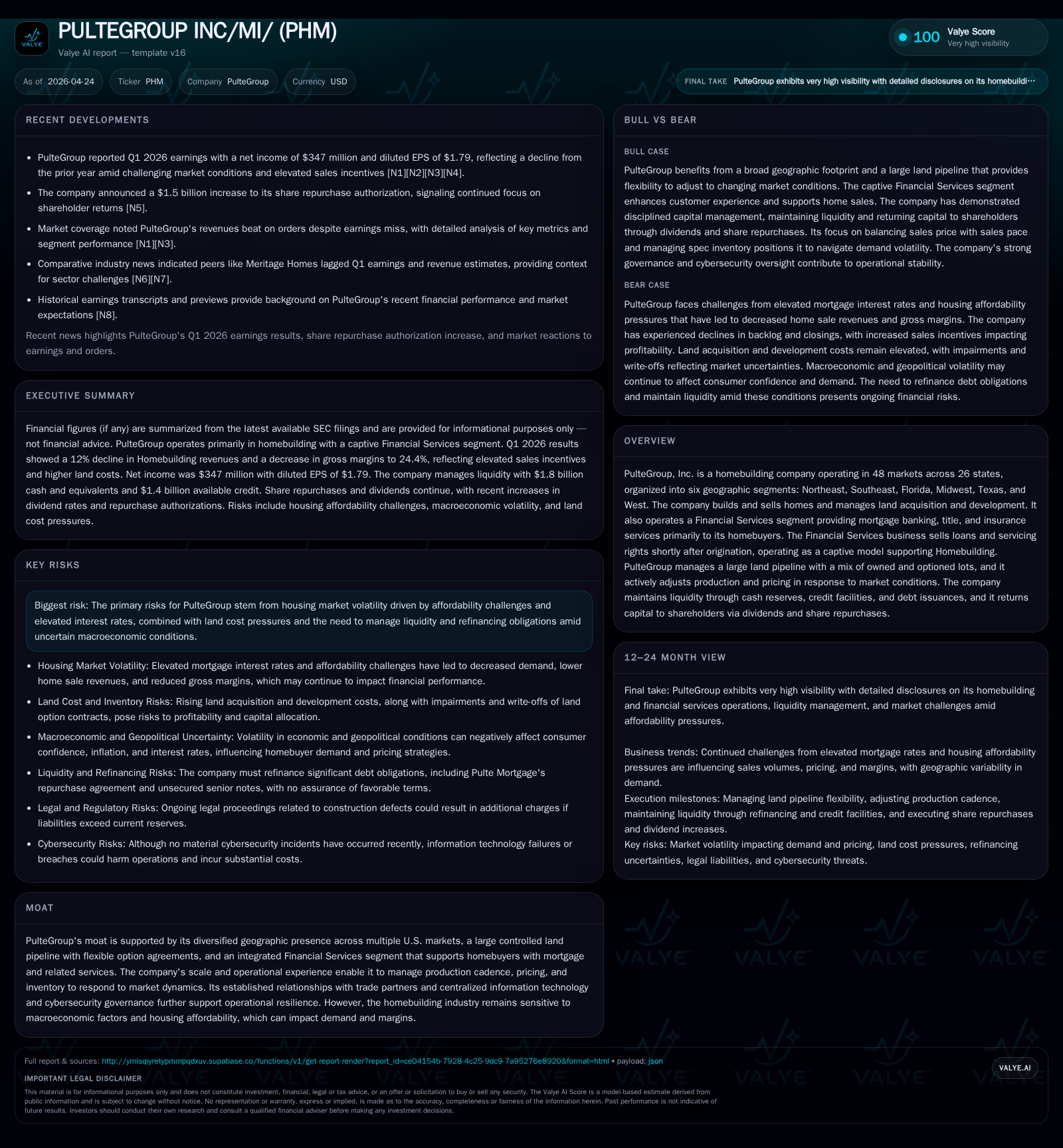
PulteGroup faced headwinds in early 2026 from sustained elevated mortgage rates and rising land costs, driving a significant earnings decline and margin compression. The company responded by adjusting production cadence, rebalancing inventory mix toward build-to-order homes, and updating its land acquisition strategy. Its diversified geographic footprint and integrated financial services segment provide operational resilience, but near-term demand challenges persist. PulteGroup maintains a robust liquidity position and has increased capital returns, signaling confidence in navigating volatile market conditions.
Q1 2026 Operating Review: Demand Dynamics and Earnings Impact PulteGroup’s latest Form 10-Q for Q1 ended March 31, 2026 [S2] reveals a housing market still grappling with affordability constraints as elevated mortgage interest rates, rising building costs, and geopolitical uncertainty weigh on consumer confidence. Revenues fell materially: total Financial Services revenues declined by 21%, closely mirroring homebuilding volume reductions and lower net gains from mortgage sales. Income before income taxes dropped sharply by 65% year-over-year, reflecting these demand headwinds alongside margin pressure. Management responded with calibrated production cuts and pricing strategies aimed at maintaining inventory turnover while protecting market share. Sales incentives intensified, including targeted discounts on spec inventory (homes built without pre-existing customer orders), closing cost credits, and mortgage interest rate buydowns designed to offset buyer affordability challenges. These measures helped boost net new orders by approximately 3%, although average selling prices slipped around 5%, contributing to gross margin compression. Closings decreased by 7%, primarily because of a smaller order backlog entering the new year compared with Q1 2025. Geopolitical tensions exacerbated inflationary pressure in March, further dampening buyer sentiment. ## PulteGroup’s Business Model and Revenue Drivers The company's business model integrates Homebuilding operations across six geographic segments: Northeast, Southeast, Florida, Midwest, Texas, and West [S1], supported by Financial Services operations that provide captive mortgage banking, title insurance, and related services primarily to PulteGroup homebuyers [S23]. This vertical integration enhances customer retention through convenience and potential pricing leverage but also means Financial Services revenues are heavily correlated with Homebuilding volume. PulteGroup manages a significant controlled land pipeline composed of both owned lots and strategic option agreements [S2]. This mix affords the ability to adjust production levels responsively without over-committing capital when demand softens. The underwriting standards for land options have been recently tightened; management has selectively walked away from some agreements where pricing or risk profiles no longer align with market realities. A notable strategic shift is an intentional reduction in spec home inventory against an increase in build-to-order backlog. This change accelerates delivery times for buyers while limiting exposure to unsold finished homes during unpredictable demand cycles. ## Competitive Positioning Within the Homebuilding Sector Operating across nearly half of U.S states (26), PulteGroup's geographic diversification cushions risks inherent in localized economic shifts or regulatory changes [S25]. Compared to peers who may concentrate regionally or have less optionality in land control, Pulte's flexible production cadence benefits its ability to respond swiftly to cyclical market swings. Its scale confers bargaining power with trade partners—crucial amid industry-wide inflationary material cost increases—enabling more effective cost management than smaller builders facing similar input price pressures [S2]. However, all players currently contend with significant land cost inflation which creates a lag effect: price hikes flow through only after long development cycle times blur immediate financial impacts. The integrated Financial Services arm adds differentiation by capturing loans mostly from its own customers [S23]. Despite the recent downturn in originations aligned with lower home sales volume (-7% originations), this segment supports overall profitability when housing markets are stable. ## Growth Catalysts and Risks Amid Affordability Constraints Despite near-term softness, management underscores favorable underlying demographics supporting structural housing demand over time—millennial household formation rates remain robust alongside ongoing replacement need for aging housing stock [S2]. Yet macro factors such as persistently high interest rates act as significant short-cycle headwinds suppressing buying power. Rising land acquisition/development expenses continue to pressure margins; tightness exists between passing increased costs through via home prices without further eroding already fragile affordability. This delicate balancing act informs PulteGroup's maintenance of elevated sales incentives and dynamic starts pacing intended to optimize cash flow and market responsiveness. Geopolitical uncertainties injecting volatility into inflation expectations compound risks around consumer purchasing behavior [N2]. High cancellation rates (~12%) indicate buyer retrenchment amidst fluctuating confidence levels [S2]. ## Strategic Inventory and Land Management Practices A critical operational pillar involves judicious management of the land pipeline consisting of owned acreage plus substantial option deposits totaling about $735 million as of quarter-end [S15]. Land option contracts confer rights without immediate full capital commitment but require ongoing reassessment; unfavorable terms have prompted walkaways recently as part of credit discipline practices. Inventory is shifting intentionally toward sell-through (build-to-order) homes offering quicker delivery windows preferred amid uncertain timelines for typical buyers. Spec inventory has been trimmed accordingly—helping reduce carrying costs during slower transactional periods. Overhead cost structure adjustments are ongoing to reflect anticipated lower volume in certain markets while preserving capacity for rebound opportunities [S2]. These financial controls parallel efforts with trade partners updating labor/material pricing arrangements responsive to evolving input costs. ## Capital Structure, Liquidity, and Shareholder Returns ### Historical performance (annual) | FY | Net ($bn) | CFO ($bn) | Capex ($mm) | Net YoY |
| --- | :---: | :---: | :---: | :---: | | 2025 | 2.2 | 1.9 | 123 | -28.0% | | 2024 | 3.1 | 1.7 | 119 | +18.5% | | 2023 | 2.6 | 2.2 | 92 | -0.6% |
| 2022 | 2.6 | 0.7 | 113 | | Source: SEC companyfacts cache [F1]. ### Capital returns and efficiency (annual) | FY | Div ($mm) | Buybacks ($mm) | FCF ($bn) | | --- | :---: | :---: | :---: | | 2025 | 177 | 1200 | 1.7 | | 2024 | 168 | 1200 | 1.6 | | 2023 | 142 | 1000 | 2.1 | | 2022 | 144 | 1075 | 0.6 | Source: SEC companyfacts cache [F1]. PulteGroup’s liquidity position remains robust entering mid-2026: unrestricted cash and equivalents totaled approximately $1.8 billion at quarter-end [F1],[S2], complemented by $1.4 billion available capacity under a recently amended revolving credit facility extended through February 2031 with increased total commitments up to $1.75 billion plus accordion options expanding potential availability to $2.5 billion [S4],[S5]. The company has undertaken opportunistic refinancing actions in early 2026, including extending and expanding its revolving credit facility and repaying $589 million of senior notes. Other notes payable, which are secured and non-recourse, totaled $38.4 million at March 31, 2026 [S2]. Capital return initiatives remain prioritized despite operating volatility: Q1 saw accelerated buybacks totaling $308 million (~2.4 million shares repurchased) plus an 18% hike in quarterly dividends effective January payment ($0.26 per share vs prior $0.22) [S21],[N11]. The Board authorized a further $1.5 billion increase in share repurchase authorization shortly after quarter close signaling continued shareholder distribution emphasis [N11]. ## Monitoring Key Milestones and Market Signals Looking ahead, key factors warrant close tracking include: backlog growth trajectory reflecting order intake vs cancellations; shifts in cancellation rates which could presage consumer sentiment inflection points; housing start activity indicating production responsiveness; margin evolution signaling success/failure of pricing vs cost management tactics; efficacy of sales incentives especially mortgage buydowns impacting absorption rates; material developments around the August 2026 refinancing of Pulte Mortgage’s repurchase agreement—the company acknowledges refinancing uncertainty but expresses confidence given liquidity safeguards [S17],[N2]. Its scale across diverse U.S regions coupled with an integrated Financial Services offering underpin operational flexibility uncommon among many peers. While short-term earnings are pressured reflecting these headwinds (net income fell approximately one-third Q/Q-Y/Y), fundamental demographic drivers sustain longer-term growth outlooks—barring material macro shocks—and balanced capital allocation demonstrates confidence in managing cyclicality pragmatically. --- Disclaimer: This analysis is based on information available as of April 24, 2026, including SEC filings (10-K filed February 4, 2026; latest 10-Q filed April 23, 2026) and related news reports. It does not constitute investment advice or recommendations but reflects an informed examination of PulteGroup’s operational context and strategic positioning within the homebuilding industry as understood from disclosed data.
Disclaimer: This is research-only, informational analysis and not investment advice. It may include AI-generated interpretation and general industry context. Always verify important details using primary sources.

Comments