
Picard Medical Advances Implantable Artificial Hearts Amid Financial and Listing Challenges
The latest quarter reveals clinical progress with the Emperor Total Artificial Heart alongside ongoing liquidity constraints and NYSE compliance risks.
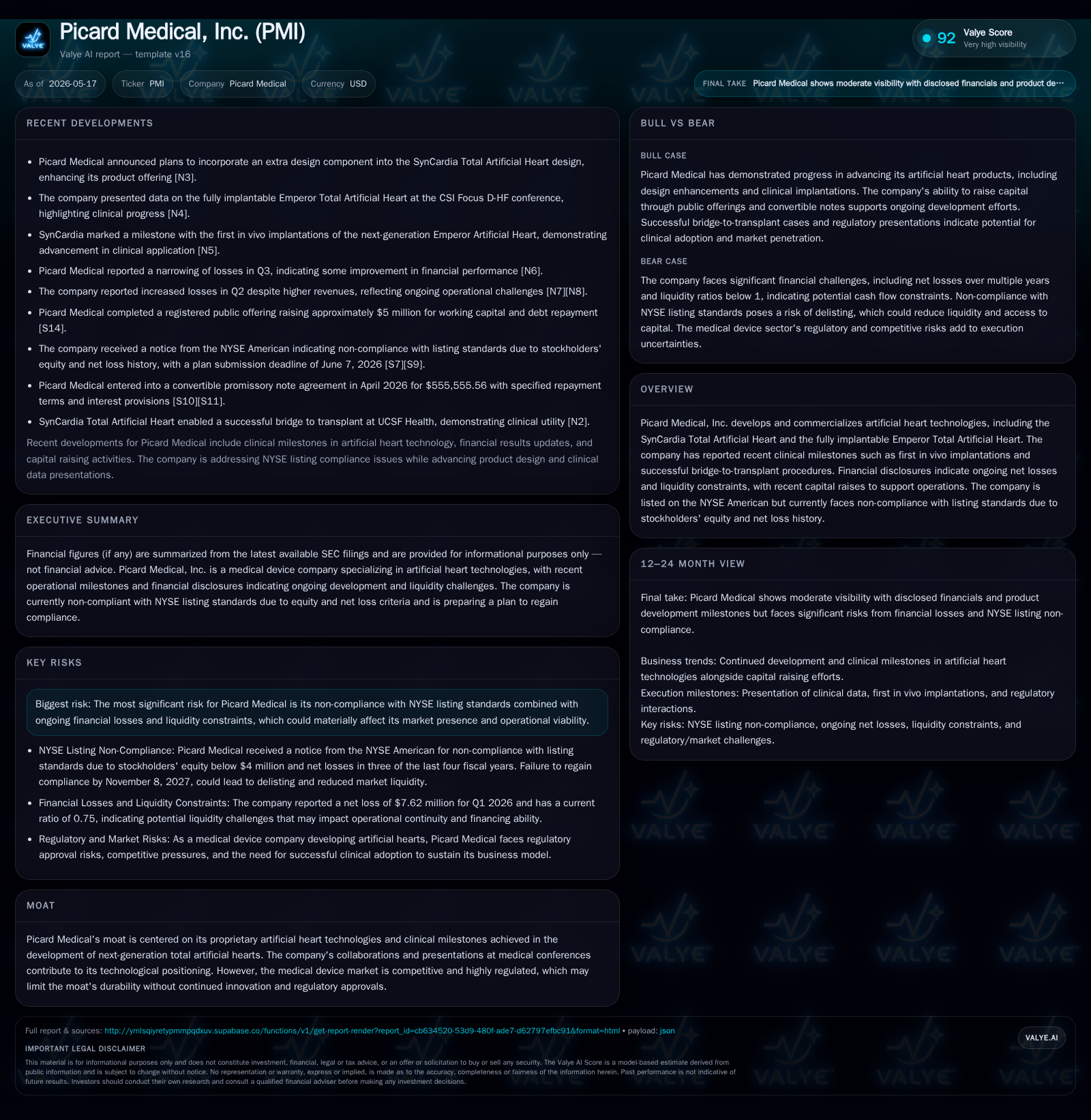
Picard Medical, Inc. reported key clinical milestones for its fully implantable artificial heart technology, including initial in vivo implantations and bridge-to-transplant successes, while confronting a NYSE notice for non-compliance due to stockholders' equity below $4 million and recurring net losses. The company’s recent $5 million gross capital raise seeks to bolster working capital and debt reduction amid a constrained balance sheet. Picard’s business centers on advanced artificial heart devices sold primarily to specialized hospitals, with growth dependent on regulatory approvals and market adoption within a competitive medical device landscape.
Latest Quarterly Operational Update and NYSE Compliance Status
In its May 15, 2026 Form 10-Q filing [S2], Picard Medical disclosed important clinical progress with its next-generation artificial heart portfolio. Notably, the company reported initial in vivo implantations of the fully implantable Emperor Total Artificial Heart device alongside successful bridge-to-transplant procedures. These milestones validate the technological advancement beyond its established SynCardia external pneumatic system, underscoring potential commercial viability for fully implantable solutions aimed at end-stage heart failure patients.
However, in conjunction with these operational advances, Picard received a formal notice from NYSE American on May 8, 2026 [S3] indicating non-compliance with Section 1003(a)(ii) listing standards. This is due to stockholders’ equity reported at approximately $3.8 million as of December 31, 2025—below the $4 million threshold—and net losses incurred in three of the last four fiscal years. The company’s common stock continues trading under the symbol “PMI” but now carries a ".BC" designation signaling below compliance status. Picard must submit a remedial plan by June 7, 2026 aiming to regain compliance by November 8, 2027 or risk delisting proceedings.
Business Model: Advanced Artificial Heart Devices for Specialized Clinical Use
Picard Medical specializes in developing total artificial hearts designed as bridge-to-transplant therapies for patients with biventricular heart failure who are not candidates for conventional left ventricular assist devices [S1]. Its flagship products include the FDA-approved SynCardia system—a portable external pneumatic device widely used in transplant centers—and the Emperor Total Artificial Heart representing an innovative leap toward fully implantable mechanical circulatory support.
Revenue generation stems from sales of these devices primarily to specialized hospitals and transplant centers capable of performing complex implantation surgeries. Pricing reflects device sophistication coupled with surgical support services and is influenced by reimbursement frameworks applicable to life-saving cardiac interventions. Buyer decision-making emphasizes device reliability, clinical outcomes, patient quality of life improvements, and integration into established hospital care pathways.
The Emperor device’s fully implantable design aims to reduce infection risks associated with external driveline systems inherent in SynCardia’s technology, potentially expanding market adoption by addressing critical patient quality-of-life concerns. Switching costs remain elevated due to required surgical expertise and post-operative management protocols.
Industry Dynamics and Competitive Landscape
The artificial heart sector faces stringent regulatory scrutiny given the high-risk nature of implantable devices where failure can be fatal. Picard leverages patented mechanical circulation technologies supported by accumulating clinical data that underpin safety and efficacy claims [S1]. Competition includes manufacturers developing alternative mechanical circulatory support systems such as continuous flow left ventricular assist devices or hybrid biological-mechanical solutions.
FDA approval timelines are typically protracted requiring robust clinical evidence against predicate devices. Market adoption post-approval tends to be gradual due to conservative hospital procurement cycles shaped by surgeon training requirements and payer reimbursement alignment. Manufacturing specialized components also imposes capacity limitations on rapid scaling.
Ongoing innovation is vital for Picard to defend intellectual property positions against emerging biotech approaches focused on myocardial recovery or cellular therapies rather than full mechanical replacement.
Growth Drivers: Clinical Validation and Regulatory Progress
Clinical milestones serve as primary growth catalysts for Picard. Recent disclosures confirm initial human implants of the Emperor device successfully tested in vivo along with documented bridge-to-transplant case successes [S2]. These achievements provide tangible proof points supporting future commercial adoption.
Presentations at cardiology conferences enhance visibility among key opinion leaders potentially accelerating hospital interest and procurement pipelines. Implantation volume metrics per quarter will be important KPIs reflecting market acceptance trends.
Regulatory progress remains crucial; pending FDA premarket approval decisions or expanded labeling indications would open broader commercial markets beyond compassionate-use scenarios.
Risks and Watchpoints: Financial Stability and Market Access Challenges
Financial health poses significant risks. As of March 31, 2026, cash & equivalents stood at about $121 thousand against current liabilities exceeding $12.65 million [F1], resulting in a constrained current ratio near 0.75 that highlights liquidity stress. Total debt approximates $1 million with net debt around $879 thousand [F1], indicating leverage amid ongoing operating losses exceeding $13 million annually [F1].
The May 2026 registered public offering generated roughly $5 million gross proceeds via common stock issuance plus warrants [S3], intended for working capital enhancement including partial debt repayment but leaving limited buffer against operational burn.
NYSE non-compliance adds uncertainty; failure to regain listing standards could lead to delisting from NYSE American with shares relegated to OTC markets—potentially reducing liquidity, analyst coverage, investor interest, and future financing options [S2][S3]
Additional sector-specific risks include reimbursement delays or shortfalls that may slow hospital uptake of costly new devices while competitors advancing clinical profiles or efficiencies could intensify switching challenges.
Near-Term Catalysts to Monitor
- Submission of NYSE compliance plan by June 7, 2026 outlining corrective measures toward restoring equity thresholds [S2][S3].
- Continued tracking of Emperor device implantation volumes as indicators of commercial traction [S2].
- Updates on FDA regulatory review status or new submissions that could unlock expanded approvals.
- Quarterly financial disclosures signaling burn rate moderation or revenue growth reflecting operational stabilization.
Financial Snapshot Summary
As reported in the latest quarter ending March 31, 2026 [F1], Picard Medical held cash & equivalents near $121 thousand against current liabilities over $12.65 million yielding a current ratio of approximately 0.75—indicating tight near-term liquidity. Total debt stood near $1 million with net debt around $879 thousand as of May 5, 2025 metrics [F1]. The recent public offering secured about $5 million gross proceeds before expenses [S3], directed towards working capital needs including debt servicing.
Operating losses remain substantial with FY2025 showing an operating deficit surpassing $13 million [F1], underscoring the importance of regulatory success and commercialization progress for long-term financial sustainability.
This analysis is based exclusively on information contained within Picard Medical’s latest SEC filings dated May 15, 2026 (10-Q) and related event filings combined with validated companyfacts data through early Q2-2026. It refrains from speculative forecasts or unsupported extrapolations beyond documented disclosures.
Disclaimer: This is research-only, informational analysis and not investment advice. It may include AI-generated interpretation and general industry context. Always verify important details using primary sources.

Comments