
Public Policy Holding Company’s Liquidity and Loss Trends Spotlight Capital Structure Risks
Recent quarterly disclosures expose persistent net losses and moderate liquidity that underscore the challenges of capital management for this emerging growth holding company.
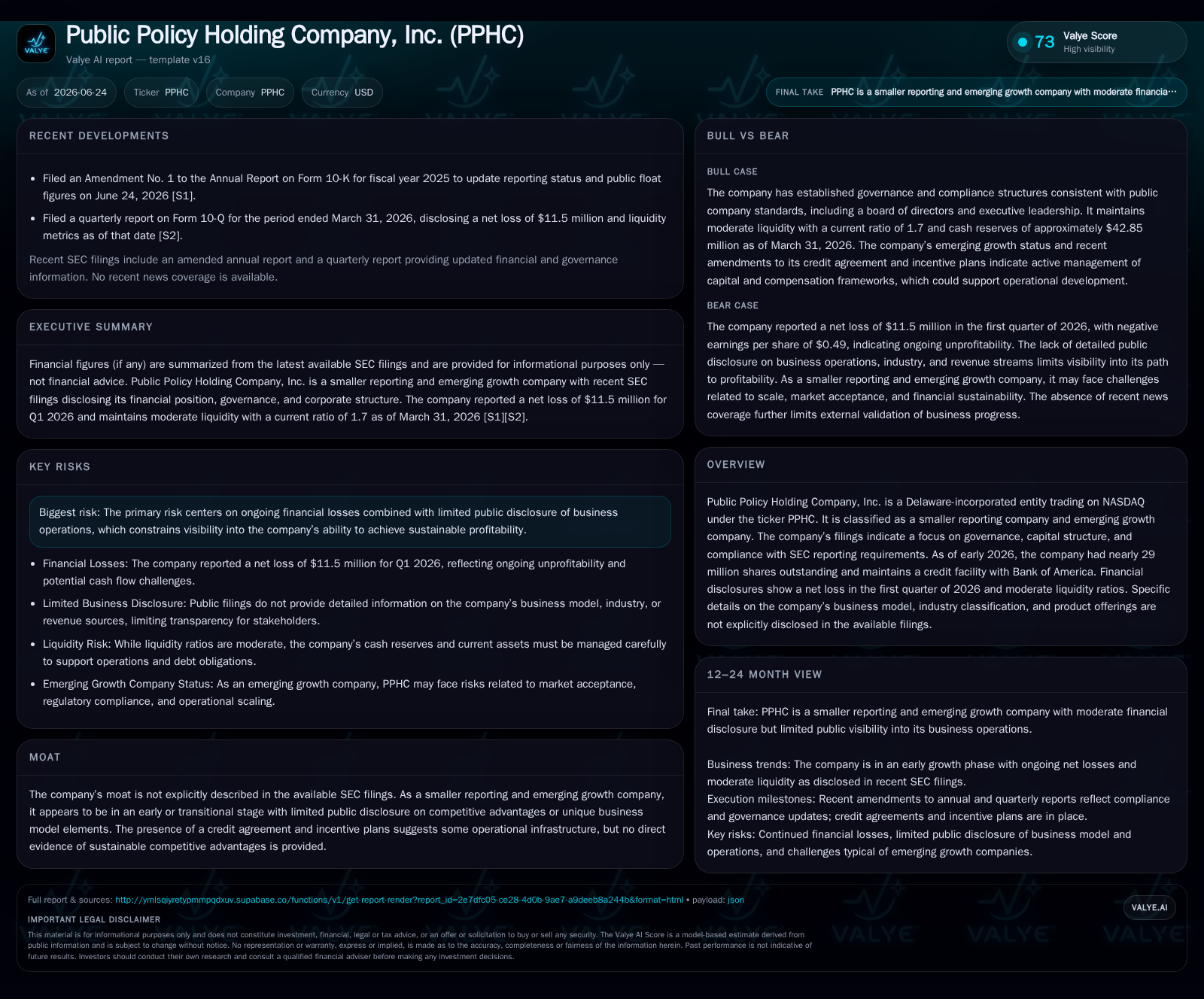
Public Policy Holding Company, Inc. (PPHC) reported continued financial losses in its Q1 2026 filing, with net income showing a significant deficit despite maintained liquidity supported by a credit facility. As a smaller reporting and emerging growth company, PPHC focuses on governance and regulatory compliance while lacking detailed public disclosure on operational subsidiaries. The company’s capital structure and credit agreement with Bank of America are central to sustaining liquidity amid ongoing losses. Growth is dependent on typical drivers for financial holding companies such as subsidiary performance improvements and potential portfolio expansion, though no specific guidance is provided. Investors should monitor future quarterly results, liquidity ratios, and any amendments to credit arrangements as key indicators of stability and progress.
Latest Quarterly Results Reveal Continued Losses and Moderate Liquidity
Public Policy Holding Company disclosed its Q1 2026 financial outcomes in the May 14, 2026 10-Q filing [S2], reaffirming its status as an emerging growth entity still navigating sustainability challenges. The latest quarter revealed an operating loss contributing to a net loss around $39 million on an annualized basis [F1], consistent with prior quarters demonstrating difficulty achieving profitability. Meanwhile, the balance sheet displays a moderate liquidity profile: cash and cash equivalents measured roughly $42.85 million against total debt near $44.62 million as of March 31, 2026 [F1]. Current assets stood at approximately $88.5 million compared with current liabilities of $51.9 million yielding a current ratio close to 1.7—a generally acceptable short-term coverage metric but tempered by the sizable operating deficit [F1]. This combination underscores ongoing reliance on effective capital structure management to maintain operational viability amid negative income trends.
Public Policy Holding Company’s Business Model as a Financial Holding Entity
As framed in the amended annual report filed June 24, 2026 [S1], PPHC functions primarily as a holding company within the financial services sector—emphasizing governance oversight, capital allocation coordination, and SEC compliance rather than direct involvement in front-line financial services or product delivery. Typical of smaller reporting companies that occupy the early or transitional phase from emerging growth status, PPHC’s disclosures do not detail operating subsidiaries or revenue streams explicitly; however industry archetypes suggest revenue generation arises through ownership stakes yielding dividends, interest income, fees, or capital gains managed centrally at parent level.
The filing further confirms PPHC holds roughly 29 million shares outstanding [S1][F1], positioning it within the smaller reporting company classification that carries lighter regulatory disclosure obligations relative to accelerated filers but introduces structural implications for investor base composition and public float accessibility.
Capital Structure Emphasis Reflects Governance and Compliance Focus
PPHC maintains a credit facility agreement with Bank of America which forms a critical pillar of its liquidity strategy [S1][S2][S3]. This agreement affords access to debt capital essential for funding operations given ongoing negative net income results and moderated cash levels.
Governance details disclosed including executive incentive schemes align with norms for emerging growth firms seeking alignment without the extensive scale complexity found in large financial holding companies. The absence of explicit subsidiary performance data sharpens focus on parent-level capital structure management efficacy as an indicator of resilience.
Comparative Insights from Financial Holding Companies
Though lacking granular peer-by-peer data due to limited subsidiary information, PPHC’s overall positioning resembles nascent stages common among smaller financial holding entities that aspire toward more diversified operations reminiscent of heavyweight peers such as JPMorgan Chase or Berkshire Hathaway. Unlike these established groups managing multifaceted capital stacks across banking, insurance, asset management arms with robust earnings streams, PPHC must first demonstrate stabilization of losses and enhanced visibility into operational fundamentals before comparable valuation narratives become feasible.
Growth Drivers: Expansion Prospects and Regulatory Environment
Absent specific strategic commentary in recent filings [S1], growth drivers for PPHC can be inferred from general industry trends typical for financial holding companies: portfolio expansion via acquisition of additional subsidiaries or interests; improvements in profitability across existing holdings; favorable regulatory reforms enabling new lines of business; increasing demand for diverse financial products; efficient capital deployment strategies; and macroeconomic tailwinds propelling financial activity volume.
Given PPHC’s current developmental stage indicated by its emerging growth profile coupled with modest public float adjustments noted in recent amendments (aimed at accuracy in disclosures) [S1], any concrete advancement toward these growth avenues remains prospective pending future operational updates.
Key Risks: Financial Losses, Disclosure Limits, Dependency Dynamics
PPHC faces meaningful risks compounded by sustained net losses eroding available capital resources over time [S13]. The scarcity of detailed subsidiary performance data constrains comprehensive assessment of underlying business quality or diversification benefits—heightening investor uncertainty. Further risk arises from reliance on regulatory compliance frameworks applicable to smaller reporting companies that may impose evolving disclosure obligations impacting cost structures.
What Investors Should Monitor Next
Investors should closely observe forthcoming quarterly earnings releases scheduled post-May 2026 to gauge whether loss trajectories improve or stabilize alongside liquidity fluctuations documented through updated balance sheets [S2][N2]. Changes to credit agreement terms or amendments could signal shifts in risk tolerance or refinancing capabilities critical for survival during prolonged loss periods.
Monitoring shifts in shares outstanding or public float dynamics—particularly given recent proxy votes consolidating governance control—may provide additional insight into shareholder engagement levels possibly influencing strategic direction.
Brief Financial Overview: Balance Sheet Snapshot
Summarizing PPHC's Q1-end balance sheet reflects cash & equivalents at approximately $42.85 million paired against total debt near $44.62 million resulting in modest net debt around $1.77 million [F1]. Current assets amounting to about $88.54 million versus current liabilities close to $51.93 million establish a current ratio near 1.7 – indicating reasonable short-term liquidity cushion despite ongoing operational losses evident from trailing twelve months net income showing nearly -$39 million [F1].
This analysis synthesizes Public Policy Holding Company’s latest SEC filings emphasizing its status as an emerging growth financial holding company grappling with recurring losses alongside moderate liquidity supported by credit facilities. While detailed subsidiary data remains undisclosed restricting deeper operational insight, stewardship over capital structure and governance frameworks emerges as pivotal themes shaping investor perceptions amid evolving public float considerations. Monitoring subsequent quarterly figures alongside credit agreement developments will be crucial for understanding trajectory toward sustainable profitability.
Disclaimer: This analysis is based solely on publicly available SEC filings and related disclosures without any investment advice or forward-looking statements beyond evidence presented.
Disclaimer: This is research-only, informational analysis and not investment advice. It may include AI-generated interpretation and general industry context. Always verify important details using primary sources.

Comments