
Pioneer Power Solutions Faces Strategic Challenges Post-PCEP Divestiture
Focus on Critical Power segment exposes Pioneer Power Solutions to concentrated customer risk and persistent operating losses.
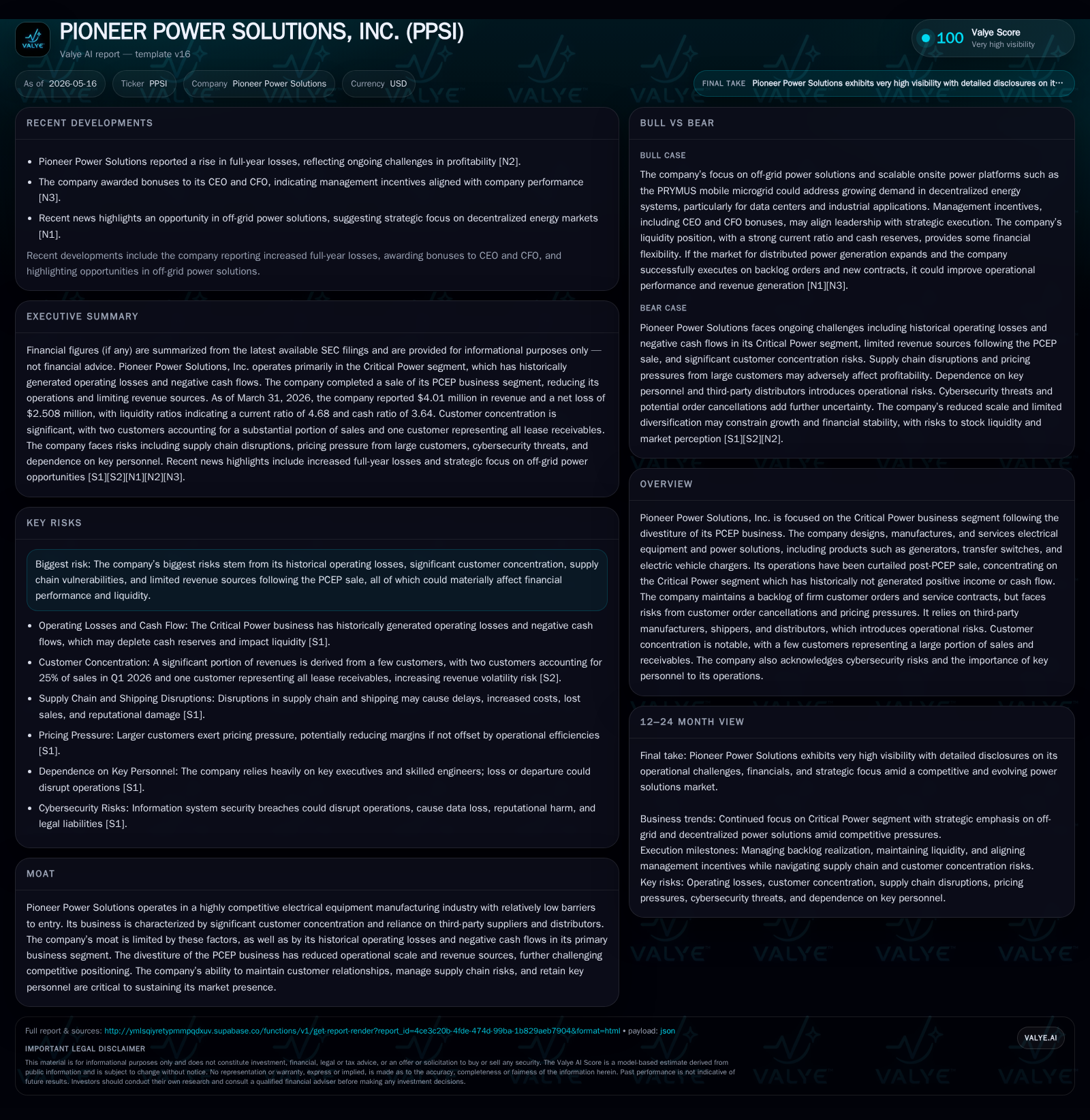
Pioneer Power Solutions has completed divesting its PCEP business, leaving the company reliant solely on its Critical Power segment, which continues to struggle with operating losses and negative cash flows. The latest quarterly disclosure underscores significant customer concentration, with two clients accounting for 25% of sales and one holding all lease receivables. The company's backlog remains firm but subject to cancellation risk amid pricing pressures from large customers and supply chain dependency. Growth avenues such as increasing data center power demand and EV charging infrastructure offer potential but are constrained by operational scale and industry competition. The firm maintains a strong liquidity position but faces ongoing challenges in profitability, customer retention, and internal controls.
Latest Quarterly Operating Update
Pioneer Power Solutions’ first quarter of 2026 reflects a narrowed operational focus exclusively on its Critical Power business following the divestiture of the PCEP segment. The latest 10-Q filing for the quarter ending March 31, 2026 reveals that two customers comprised approximately 14% and 11% of sales each—together accounting for about a quarter of total revenues [S2][S4]. Moreover, lease receivables are heavily concentrated, with one single customer representing 100% of this balance as of quarter-end. This extreme revenue concentration magnifies earnings volatility and exposes Pioneer to significant downside risk if orders from these customers diminish or cease.
The firm's backlog stood at $12.6 million at December 31, 2025 [S24], signaling stable forward revenue streams underpinned by firm purchase orders and service contracts. However, historical commentary warns that some backlog orders may be canceled with limited contractual revenue recovery beyond certain direct costs—potentially leading to asset underutilization expenses that pressure margins further. While the backlog offers some near-term revenue visibility, it cannot fully insulate against demand shocks or pricing concessions.
The Critical Power segment has continued its pattern of operating losses and negative cash flows post-divestiture [S1][S16], stressing cash resources despite a modest cash balance reported at year-end. This unprofitable base business curtails Pioneer’s ability to self-finance growth initiatives or endure prolonged market softness without external capital or operational restructuring.
Business Model and Product Portfolio
Following the PCEP sale finalized prior to 2026, Pioneer’s business has contracted sharply to focus solely on its Critical Power segment—specializing in design, manufacture, and servicing of electrical equipment including generators, transfer switches, and electric vehicle (EV) chargers [S1][S8]. Revenue is derived mainly from hardware sales complemented by service contracts for installation, maintenance, and ongoing support.
The company depends on third-party suppliers for core components such as engines and electrical parts, as well as outsourced manufacturing partners—introducing risks related to quality control and supply continuity [S10][S24]. Similarly, distribution relies on third-party shippers and independent channel partners who execute product delivery and installation services; any disruption or decline in their performance can compromise Pioneer’s ability to meet contractual commitments or degrade brand reputation.
Despite the strategic narrowing post-PCEP divestiture—which reduced product breadth and revenue diversity—the Critical Power unit has yet to generate sustained positive income or cash flow. Negative operating margins largely stem from pricing pressures exerted by large customers wielding purchasing power over prices as well as fixed costs that are difficult to pare without compromising capacity or quality [S8][S24].
Competitive Environment and Industry Dynamics
Pioneer operates within a highly fragmented electrical equipment manufacturing landscape known for low barriers to entry due to commoditized technologies underlying major products like generators and transfer switches. The company faces stiff competition from larger players with broader geographic footprints and greater financial resources capable of delivering scale advantages or absorbing pricing shocks more effectively. Such conditions limit Pioneer’s pricing power despite established customer relationships.
Customer concentration exacerbates this competitive tension; losing any major client could result in disproportional revenue declines given some customers contribute double-digit percentage shares quarterly [S2][S4]. Similarly, supplier dependence adds vulnerability since raw material shortages or price spikes can compress already thin margins.
Regulatory scrutiny around environmental standards for emissions from generators or safety protocols applies across the sector but currently does not appear as a distinct constraint uniquely impacting Pioneer’s operations compared with peers [S11][S15]. Nonetheless, compliance risks remain an embedded cost factor.
Growth Opportunities and Demand Drivers
Looking ahead, growth potential centers on expanding demand for reliable critical power infrastructure driven by proliferation in data centers supporting AI/Edge computing workloads—areas forecasted to increase electricity consumption globally over the medium term [S1][N2]. Should these projections materialize timely, Pioneer could benefit from increased volume sales of generators and power management systems tailored for high-availability environments.
Further incremental upside may arise from expansion into EV charging solutions—an emergent sector within their product portfolio—and ancillary service contracts that offer steadier recurring revenue streams compared to project-based hardware sales. However, scaling in this segment faces hurdles including nascent market penetration levels, competitive entry by specialized EV infrastructure firms, and Pioneer’s constrained operational footprint since shedding its PCEP operations.
Due to persistent operating losses in its sole remaining business unit combined with limited geographical reach after recent divestments, any volume uptick might be muted by execution capacity limits until investment in production scale or enhanced distribution channels occurs.
Risks, Constraints, and Operational Challenges
The corporate risk profile features several interlocking factors impairing operational stability:
- Continued reliance on a small set of large customers heightens exposure to order volatility; Blade-reactive demand shifts could abruptly erode revenues [S2][S4].
- Supply chain fragility tied to third-party manufacturers threatens consistent product availability amidst global logistic disruptions or component shortfalls [S10][S22].
- Documented material weaknesses in internal financial controls raise concerns about timely and accurate financial reporting integrity which could undermine investor confidence [S1][S15][S19].
- Loss or departure of key technical personnel presents challenges given specialized engineering skill sets required for product design and innovation remain scarce [S1][S16].
- Cybersecurity vulnerabilities inherent in their IT systems pose risks not only financially but also reputationally if exploited successfully by adversaries [S15].
- Pricing concessions demanded by dominant customers constrict margins further; inadequate cost management could amplify negative operating leverage effects [S8][S24].
- Order backlog cancellations impose direct cost recovery limits plus indirect penalties through underutilized production capacity harming margins [S24].
Collectively these constraints highlight the fragile balance Pioneer must strike between maintaining essential contractual relationships while systematically addressing structural operational shortcomings.
Key Near-Term Milestones and Monitoring Points
Investors should prioritize observing several concrete execution metrics:
- Trends in quarterly revenue contribution from top clients to gauge stability of core business order flow against backdrop of customer concentration risk [S2][S4].
- Rate of realization from backlog into recognized sales without significant cancellations which impacts near-term earnings clarity [S24].
- Progress made toward remediating material weaknesses in internal financial reporting controls flagged previously by auditors—a critical factor influencing market trustworthiness before potential capital raising needs arise [S2][S3].
- Execution effectiveness in managing supplier relationships amid ongoing global logistics uncertainty affecting both raw material inputs and finished goods distribution timing/costs [S22].
- Management commentary within earnings releases regarding strategic initiatives around cost optimization efforts or potential new product development particularly relating to emerging EV charger market participation [N2][S3].
- Cash burn trends relative to liquidity buffers over ensuing quarters given ongoing operating losses constrain runway duration without fresh funds infusion or improved profitability trajectories.
Financial Snapshot and Liquidity Overview
Latest financial snapshot
| Metric | Value | Period |
|---|---|---|
| Current assets | $24mm | |
| 2026-03-31 | ||
| Current liabilities | $5mm | |
| 2026-03-31 | ||
| Current ratio | 4.68x | |
| 2026-03-31 |
Source: SEC companyfacts cache [F1].
| Metric | Value |
|---|---|
| Cash & Equivalents | $17.999 million |
| Current Ratio | 4.68 |
| Total Debt | $21 thousand |
Pioneer entered Q1 2026 with nearly $18 million in cash supported by minimal debt outstanding ($21k), resulting in a strong current ratio near 4.68 reflecting solid short-term liquidity coverage through March-end [F1]. This liquidity cushion provides temporary insulation against ongoing operating deficits experienced in the Critical Power segment [S1][S16]. However, absent meaningful improvements in profitability or capital raising activities aligned with strategic execution milestones noted above, existing cash will erode progressively.
This analysis synthesizes material recent disclosures concerning Pioneer Power Solutions’ evolving strategic position following key divestitures reducing operational scale while leaving underlying segments challenged by profitability hurdles. Vigilance over concentrated client dependencies alongside rigorous review of execution against financial control remediation plans will be crucial indicators shaping Pioneer’s proximate trajectory within highly competitive electrical equipment markets characterized by sustained pricing pressures amid incremental growth opportunities emerging from AI-driven infrastructure demands.
Disclaimer: This report is an independent industry analysis based solely on publicly available regulatory filings and news releases as cited; it does not constitute investment advice or recommendations.
Disclaimer: This is research-only, informational analysis and not investment advice. It may include AI-generated interpretation and general industry context. Always verify important details using primary sources.

Comments