
Primo Brands Corp’s Scaling Strategy Drives Profit Gains and Capital Intensity in Bottled Water Market
The company leverages its extensive distribution and brand portfolio to harness recurring revenue streams in a competitive North American bottled water sector.
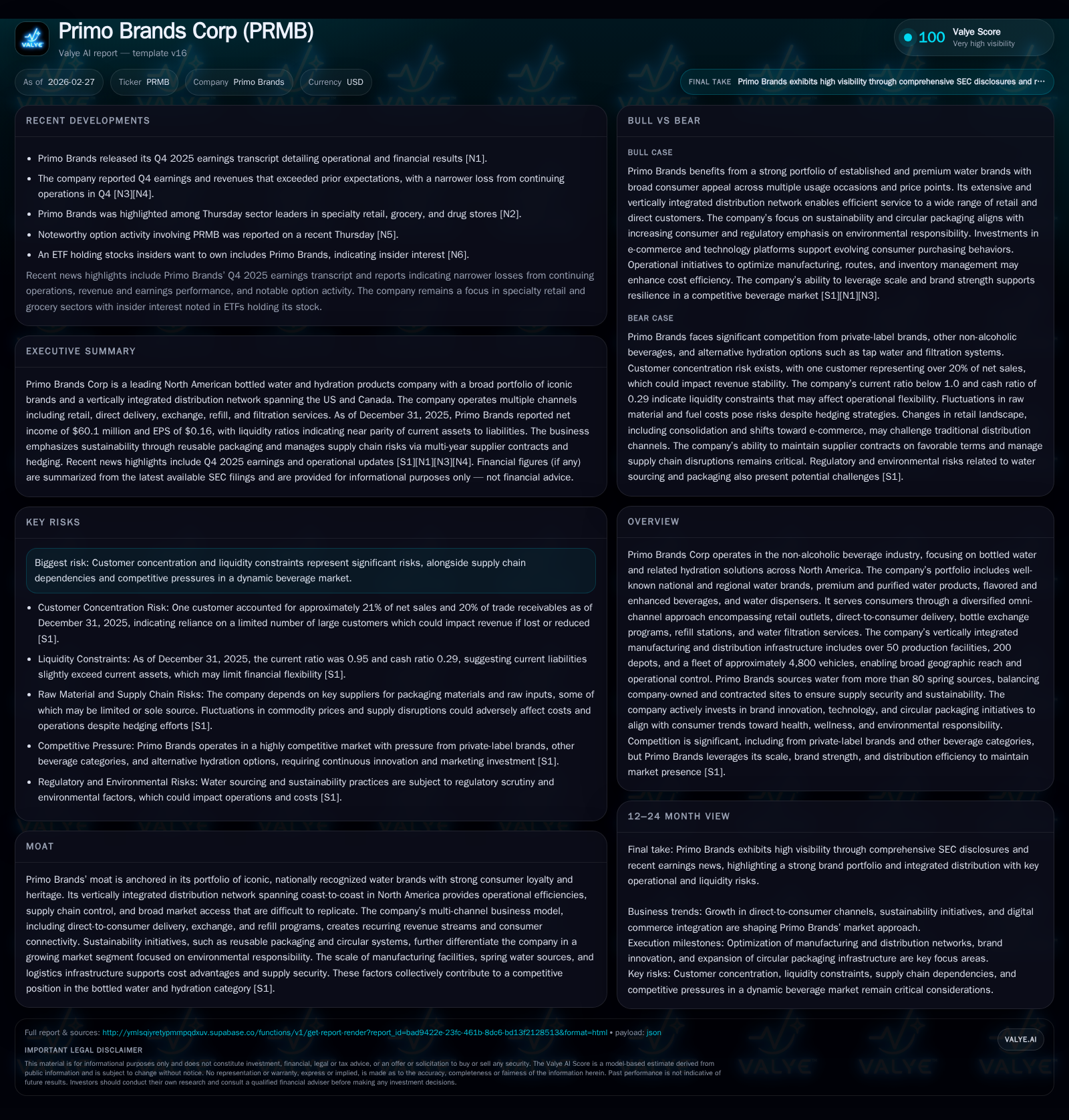
Primo Brands Corp has demonstrated meaningful operating income growth supported by an expansive vertically integrated network and multi-channel product offerings. Its portfolio of nationally recognized water brands, combined with direct-to-consumer solutions and sustainability initiatives, underpin a durable competitive position. However, capital expenditures surged sharply as the company invests in infrastructure and capacity, leading to negative free cash flow despite net income improvement. Customer concentration and supply chain factors remain key risk vectors to monitor.
Company Overview
Primo Brands Corp is a leading player in the North American non-alcoholic beverage sector with a strong focus on bottled water and hydration solutions. The company's extensive portfolio features well-established national brands such as Poland Spring®, Pure Life®, Arrowhead®, Deer Park®, Ice Mountain®, Ozarka®, Zephyrhills®, as well as premium labels like Saratoga® and The Mountain Valley®. It also markets purified water brands Sparkletts® and Primo Water™, alongside enhanced beverages such as Splash Refresher™ and AC+ION®. A standout characteristic is its vertically integrated coast-to-coast production and distribution infrastructure encompassing over 50 manufacturing plants, more than 200 depots, and a delivery fleet approximating 4,800 vehicles that serve retail outlets across all U.S. states and Canada [S8],[S12],[S28].
This scale allows Primo Brands to supply multiple consumer access points including grocery chains, drugstores, wholesale clubs, convenience stores, restaurants, hospitality venues, healthcare facilities, educational institutions as well as direct-to-consumer delivery programs. Its business model also incorporates bottle exchange networks (~26,500 locations), self-service refill stations (>23,500), and water filtration services that cumulatively create diversified recurring revenue streams anchored in consumer convenience and sustainability efforts [S8],[S12].[N1]
Historical Growth & Performance Drivers
The company's financial trajectory over recent years reflects steady operational improvement underpinned by volume gains within its branded bottled water category combined with efficiency initiatives.
Historical performance (annual)
| FY | Net ($mm) | OpInc ($mm) | Capex ($mm) | Net YoY |
|---|---|---|---|---|
| 2025 | 60 | 430 | 377 | +466.5% |
| 2024 | -16 | 360 | 150 |
Source: SEC companyfacts cache [F1].
Capital returns and efficiency (annual)
| FY | Div ($mm) | Buybacks ($mm) | ROE% |
|---|---|---|---|
| 2025 | 151 | 422 | 2.0 |
| 2024 | 36 | 10 | -0.5 |
Source: SEC companyfacts cache [F1].
Source: [F1] filings
Revenue drivers include strong consumer loyalty to iconic water brands combined with increased penetration of direct delivery and circular packaging programs enhancing frequency of purchase cycles. Operational efficiency gains were enabled by SKU rationalization and optimization of logistics routes leveraging the company's dense depot network.
Profitability converted significantly higher operating income into positive net earnings after absorbing prior-year losses due mainly to integration expenses associated with strategic acquisitions completed recently [N1],[S1]. Meanwhile capital expenditures jumped meaningfully into capex-heavy investments supporting expanded production capacity alongside upgrades to refill station infrastructure and replenishment fleets [F1].[N1]
Future Growth Prospects
Growth opportunities lie in demand for healthy hydration amid evolving consumer trends favoring sustainability credentials and premiumization within bottled water categories. Primo Brands' substantial multi-channel reach enables it to capitalize on emerging formats including e-commerce subscriptions—an area under expansion as consumers increasingly seek convenience through digital platforms [S6],[S12].
The company's commitment to reusable packaging systems aligns with regulatory pushbacks against single-use plastics thus widening differentiation compared to traditional single-serve bottled water competitors.
Continued spring source diversification reduces reliance on any single geographic supply point while providing flexibility needed to withstand natural fluctuations or regulatory constraints linked to water resource management [S8],[S21].
Key constraints may emerge from potential customer concentration risk given large retail partners’ importance accounting for around one-fifth of trade receivables and sales combined which could pressure negotiating leverage if purchasing patterns shift abruptly or consolidation accelerates among retailers [S6]. Other headwinds include raw material input volatility—especially PET resin prices—and logistics fuel cost inflation affecting expense control despite use of derivative hedges to mitigate shocks [S21]. Competition intensifies not only from branded beverages but private-label lines launched by dominant retailers leveraging expansive distribution footprints often at lower price points which challenge brand premium positioning [S26].
Forecasts & Milestones to Watch
While explicit guidance was not disclosed in the latest filings for full-year or quarterly metric targets beyond historical figures released through Q4 earnings calls dated February 2026 [N1],[N2], monitoring key developments such as:
- Integration progress on recent acquisitions impacting costs,
- Trajectory of capex spend versus cash flow generation,
- Expansion pace of direct-to-consumer subscriptions,
- Retention success surrounding core retail partnerships important for volume stability,
- Evolution of pricing strategies responding to competitive environment,
- Sustainability initiatives enhancements especially circular packaging adoption rates are vital indicators for medium-term outlook.
Capital Allocation & Returns
Primo Brands’ capital allocation strategy shows an aggressive approach toward shareholder returns juxtaposed against heavy reinvestments required for infrastructure expansion.
Dividends paid advanced sharply by more than fourfold year-over-year to $151.3 million in fiscal 2025 supported by net profitability turnaround while share repurchases escalated massively from $10.4 million in prior year up to $421.5 million reflecting management's confidence regarding valuation levels or cash deployment priorities [F1],[S17].
Despite these distributions outflows coupled with high capex drove negative free cash flow estimated around -$377 million (derived from operating cash flow less capex), signaling potential liquidity constraints or reliance on external funding sources if current investment pace continues unabated without commensurate incremental operating cash inflows immediately materializing [F1]. Equity declined modestly possibly due to buyback effects overshadowing retained earnings growth amidst this phase.
Return on equity based on available data stands near approximately 2%, indicative of early stages post-investment cycle where capital intensity depresses near-term profitability ratios although longer term asset base improvements might yield higher returns upon stabilization [F1].
Competitive Positioning & Risks
Primo Brands holds a competitively defensible position supported by:
- Iconic scale brands with strong market shares,
- Vertical integration over manufacturing-to-delivery operations enabling control over costs and service quality,
- Multi-channel customer engagement including home delivery plus exchange/refill programs reinforcing customer loyalty,
- Sustainability leadership addressing growing environmental concerns among consumers.
However notable risks persist like heavy customer concentration tied primarily to one large retail partner representing about one-fifth of revenues which poses vulnerability should this relationship weaken or renegotiate unfavorable terms [S6]. Supply chain dependencies for critical packaging inputs such as PET resin or aluminum cans also pose risk given limited supplier bases and potential price fluctuations exacerbated by commodity market volatility impacting gross margins [S21]. The broader competitive landscape evolves rapidly with private-label entrants expanding aggressively feeding off retailer scale advantages while alternative hydration technologies create indirect displacement threats beyond traditional bottled offerings [S26].
Regulatory compliance including labeling laws such as Proposition 65 requirements introduces legal overheads with possibility of product recalls or warnings that could disrupt sales channels if violations emerge unexpectedly despite ongoing controls [S18].
Conclusion
Primo Brands Corp exhibits robust operational momentum capitalizing on its broad distribution footprint across North America complemented by a rich brand mix addressing diverse consumer usage occasions spanning mass retail through direct home/business delivery channels.
The firm’s aggressive reinvestment into equipment capacity alongside share repurchases highlights a dual focus on growth capture plus capital return discipline albeit creating short-term free cash flow pressure requiring close monitoring.
Balancing sustainability commitments with supply diversification efforts furthers its moat against intensifying competition at a time when beverage market dynamics increasingly value convenience plus eco-conscious offerings.
Future scrutiny should focus on how management navigates customer concentration risks alongside cost inflation pressures while growing e-commerce penetration remains a promising yet executionally demanding avenue.
This comprehensive view aims to assist stakeholders understanding Primo Brands’ strategic basis rooted in scalability yet tempered by near-term capital intensity constraints within a changing bottled water competitive set.
This report is prepared solely for informational purposes reflecting publicly available data as of the filing date without providing investment advice or recommendations.
Disclaimer: This is research-only, informational analysis and not investment advice. It may include AI-generated interpretation and general industry context. Always verify important details using primary sources.

Comments