
Plus Therapeutics’ Strategic Milestones in Nanomedicine Reflect Market and Capital Realities
Plus Therapeutics navigates its nanomedicine development amid significant liquidity constraints and regulatory complexities.
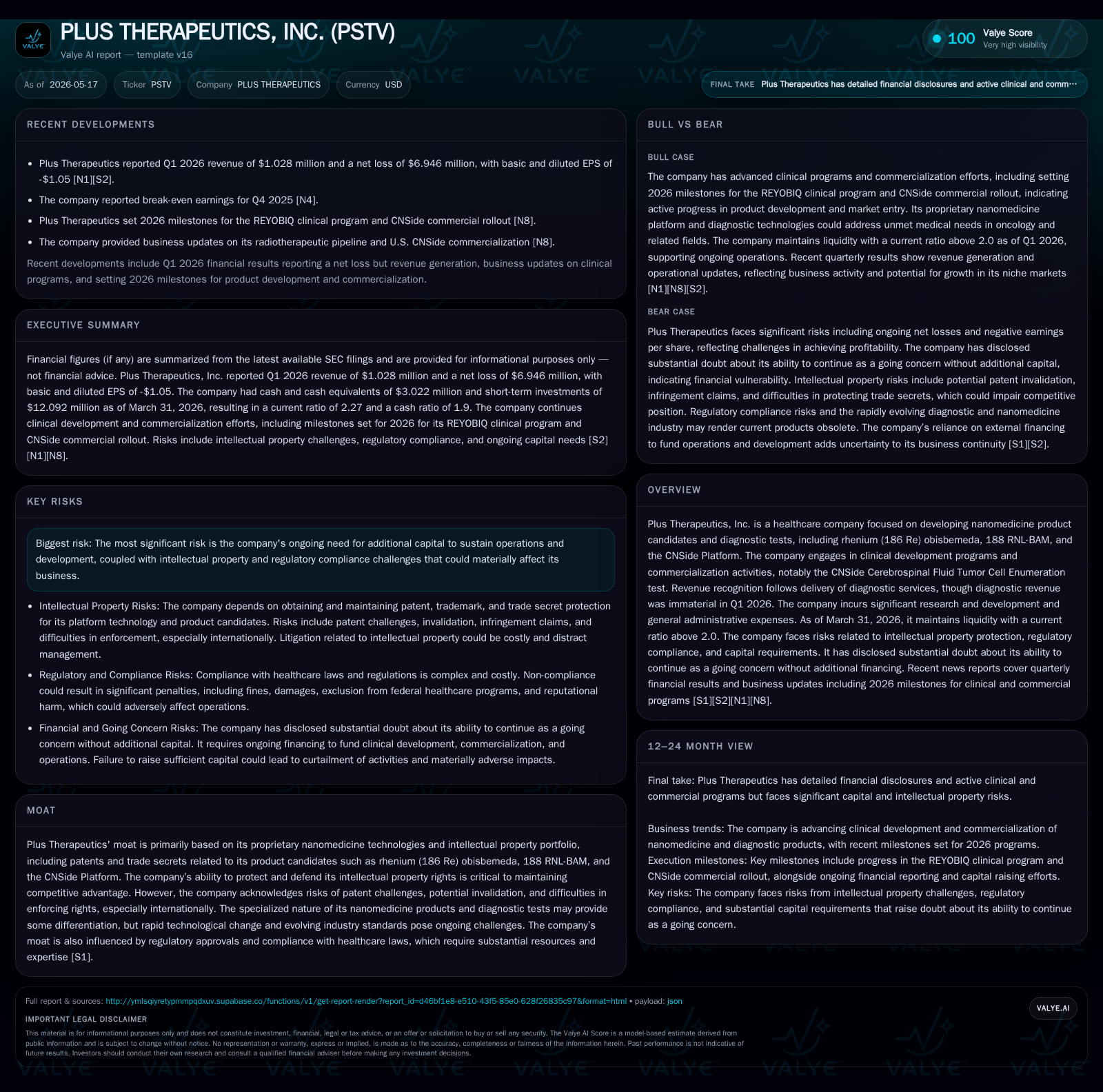
In Q1 2026, Plus Therapeutics reported operating results reflecting ongoing net losses alongside a stable current ratio exceeding 2.0, indicating short-term liquidity but persistent capital challenges. The company’s business centers on proprietary radiopharmaceuticals and diagnostic tests, emphasizing its CNSide platform and rhenium-based therapies, but commercialization remains nascent with currently immaterial diagnostic revenues. Competitive positioning benefits from a specialized intellectual property portfolio in nanomedicine, though risks persist from regulatory compliance, intellectual property enforcement, and evolving diagnostic technologies. Near-term growth catalysts depend heavily on clinical trial progress and the launch trajectory for CNSide, while capital raises remain critical to sustain operations and product development.
Latest Quarter Highlights and Their Implications
Plus Therapeutics' Q1 2026 financial disclosures reveal steady yet strained operational footing. The company maintains a current ratio of approximately 2.27 as of March 31, 2026, indicative of sufficient short-term assets relative to liabilities [F1]. However, it records continued net losses consistent with previous periods—earlier nine-month data from September 2025 notes a $16.7 million loss [S4], underscoring persistent operational burn driven largely by intensive development costs.
Despite these losses, the company reports no allowance for expected credit losses on its available-for-sale securities [S2], suggesting prudent risk assessment of financial assets but no material income streams offsetting expenses at this stage. The fair value accounting of certain derivative instruments (notably warrants issued in February 2025) reflects Level 3 inputs per ASC 480 standards [S2], adding balance sheet complexity but not immediate cash benefit.
Business Model Overview: Proprietary Nanomedicine and Diagnostics
Plus Therapeutics operates primarily as a clinical-stage biotech focused on developing radiopharmaceuticals leveraging nanomedicine platforms — notably rhenium isotopes such as 186 Re obisbemeda and the investigational 188 RNL-BAM agent [S1]. The business model also integrates complementary diagnostic offerings through its CNSide platform targeting cerebrospinal fluid tumor cell enumeration—a niche diagnostic addressing central nervous system (CNS) tumors.
Revenue recognition predominantly arises from service delivery in diagnostics, yet these contributions remain immaterial presently as the company is ramping commercialization efforts [S2]. Meanwhile, considerable R&D expenditures are expensed as incurred due to ongoing clinical trials and product development initiatives. The firm’s reliance on grant funding supplements capital but does not replace the need for external investment [S1].
The portfolio is protected by a substantive intellectual property regime encompassing patents related to radiopharmaceutical formulations and diagnostic assay methodologies. Yet the company acknowledges heightened vulnerability to patent challenges or unenforceability across jurisdictions [S1]. Overall, Plus Therapeutics’ business model reflects a classic biotech profile—high upfront R&D costs with deferred revenue reliant on regulatory milestones and market adoption.
Competitive Environment and Industry Dynamics
Within the nanomedicine space—especially radiotherapeutics—the competitive environment combines stringent regulatory scrutiny with rapid technological evolution. Plus Therapeutics' moat stems from proprietary nanomedicine technologies backed by patents for its rhenium-based compounds and diagnostics platform [S1]. However, enforcing these rights internationally can be challenging due to variable patent regimes.
Supply chain considerations present unique constraints; production and distribution of radioactive isotopes require specialized facilities adhering to nuclear medicine handling standards, limiting scale-up velocity relative to traditional pharmaceuticals. Pricing power tends to be muted in oncology therapeutics due to payer scrutiny, necessitating demonstrated clinical efficacy for reimbursement.
Moreover, the diagnostic testing arena faces accelerated innovation cycles spurred by breakthroughs in AI-driven analytics and molecular profiling. This implies Plus must continuously evolve its CNSide platform to maintain differentiation amid shifting industry standards [S1]. Regulatory compliance adds operational burdens given complex U.S. healthcare laws around fraud and abuse statutes that impose fines or sanctions if violated [S21].
Growth Catalysts: Pipeline Development and Market Adoption
Key growth vectors are tied closely to clinical progress with core product candidates. For instance, advancing clinical trials for rhenium-based therapeutic candidates towards FDA approval could unlock significant market opportunities conditional on safety and efficacy demonstration [S3].
Meanwhile, the commercial launch scale-up of the CNSide diagnostic test stands as a near-term revenue opportunity where clinician adoption could provide sustainable service income streams beyond grants or licensing [N1]. Increased awareness among oncologists regarding CNS tumor characterization may catalyze uptake given unmet needs in this specialty area.
Collaborations or licensing agreements expanding distribution networks or development capabilities would further support growth metrics. Monitoring data readouts from pivotal trials will serve as critical KPIs indicating regulatory feasibility and commercial readiness [S3].
Risks and Constraints: Liquidity, Intellectual Property, and Regulatory Compliance
The foremost risk surrounds Plus Therapeutics’ ongoing capital requirements. The company holds approximately $3 million in cash equivalents against $8 million in current liabilities as of March 31, 2026, yielding a current ratio of about 2.27, reflecting adequate near-term liquidity cushions [F1]. Capital raises have historically come through issuance of convertible notes, shares, or warrants—all dilutive mechanisms with execution risk amid market conditions.
Intellectual property enforcement challenges represent another material threat; patents may be narrowed or invalidated via third-party actions that could erode exclusivity advantages [S1]. Regulatory compliance complexity imposes potential legal costs or penalties under healthcare fraud statutes if inadvertent violations occur—a pervasive issue across healthcare biotechs subject to intense oversight [S21].
Additionally, rapid scientific advancements in molecular diagnostics require sustained innovation efforts lest current products risk obsolescence—a significant expenditure that competes with limited cash resources [S1]. These confluences impose execution strain on management teams balancing development milestones against solvency pressures.
Key Milestones to Watch in the Coming Quarters
Investors will monitor upcoming clinical trial progress updates on rhenium agents—data releases that could affect valuation assumptions significantly. Progress towards FDA submissions or approvals would act as major catalysts for perceived product maturation.
Equally important is observing the commercial trajectory of CNSide test deployments—metrics like clinician adoption rates or reimbursement coverage evolve into leading indicators of scaling success [N1].
Financially, watchpoints include announcements around refinancing or capital raising efforts as these directly influence survival prospects amid substantial cash burn trends documented in recent quarters [S2][N1].
Financial Snapshot: Liquidity and Capital Structure
Latest financial snapshot
| Metric | Value | Period |
|---|---|---|
| Cash & equivalents | $3mm | |
| 2026-03-31 | ||
| Current assets | $18mm | |
| 2026-03-31 | ||
| Current liabilities | $8mm | |
| 2026-03-31 | ||
| Current ratio | 2.27x | |
| 2026-03-31 |
Source: SEC companyfacts cache [F1].
| Metric | Value (USD Millions) |
|---|---|
| Cash & Equivalents | 3.02 |
| Current Assets | 18.03 |
| Current Liabilities | 7.96 |
| Current Ratio | 2.27 |
As of Q1 2026 end, Plus Therapeutics holds approximately $3 million in cash equivalents against $8 million in current liabilities yielding a current ratio of about 2.27 reflecting adequate near-term liquidity cushions [F1]. This snapshot belies a broader net debt position factoring total liabilities substantially exceeding liquid assets.
The company applies fair value measurement techniques consistently without recorded impairments on goodwill or intangibles during recent periods [S2], indicating stable asset valuations though no immediate enhancement to capital structure strength.
This analysis is based solely on disclosed SEC filings and incorporated public information as of May 2026. It does not constitute investment advice or recommendations.
Disclaimer: This is research-only, informational analysis and not investment advice. It may include AI-generated interpretation and general industry context. Always verify important details using primary sources.

Comments