
PTC INC.: Cybersecurity-Backed Aerospace Growth Driving Resilient Financial Momentum
PTC’s recent earnings surge, fueled by aerospace deal momentum, is underpinned by a rigorous cybersecurity governance framework that bolsters its competitive edge.
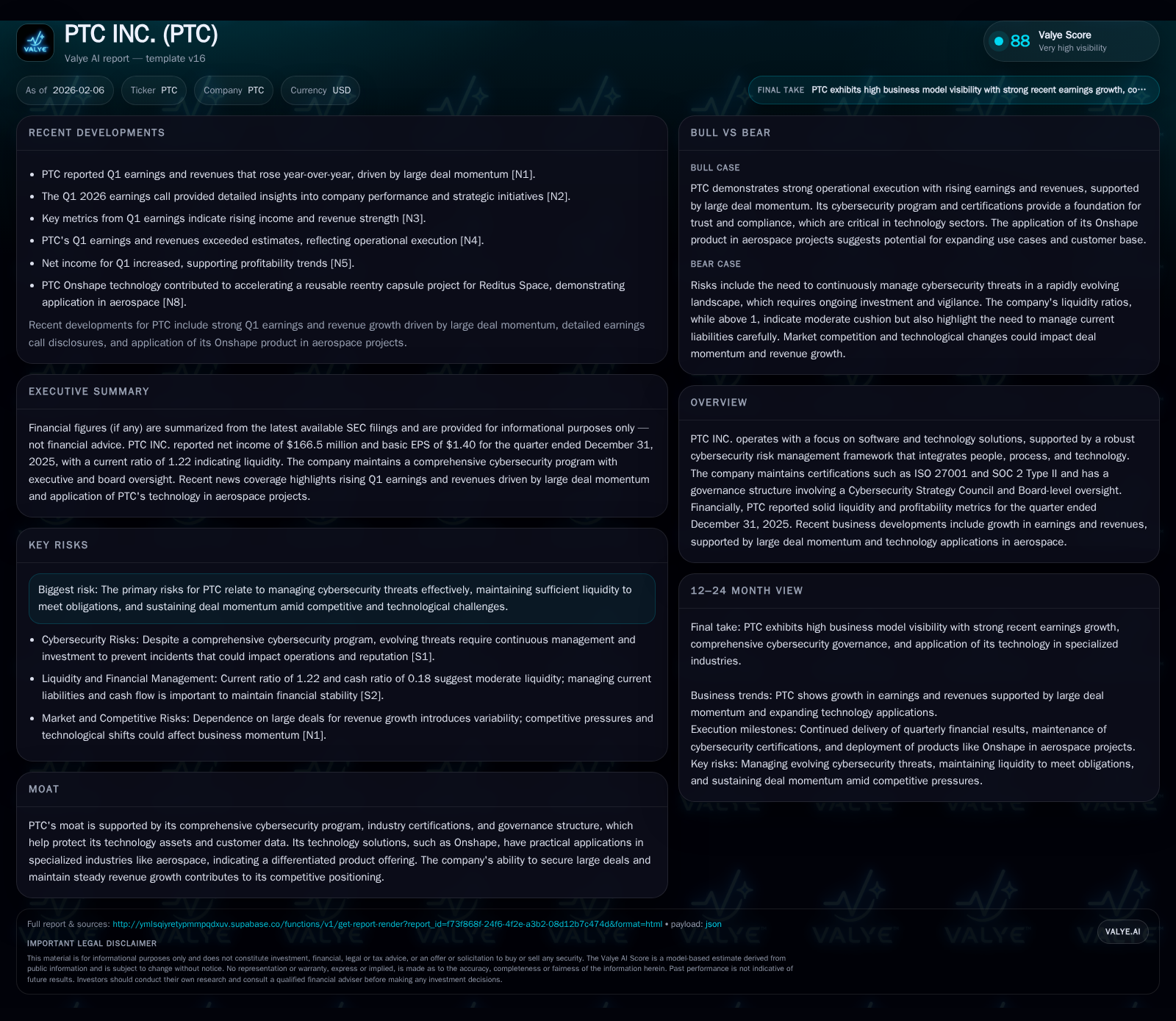
PTC reported robust fiscal Q1 2026 results, exceeding expectations through sizable aerospace-related contracts and growing adoption of its Onshape platform. This top-line strength is supported by a multi-layered cybersecurity program anchored in people, process, and technology, as well as ISO and SOC certifications that fortify customer confidence. Financially sound with a current ratio around 1.22 and $210 million in cash, PTC balances growth with prudent liquidity management. Board-level cyber oversight and proactive risk governance further reinforce its moat against operational threats amid a competitive industrial technology market.
Earnings Highlights: Momentum Behind the Numbers
PTC INC.’s fiscal Q1 2026 results showcase a notable blend of revenue and earnings growth that outpaced market expectations. Key drivers include large-scale aerospace deals alongside sustained demand for core software offerings. According to multiple sources from early February 2026, the company’s earnings and revenues topped estimates year-over-year, exemplifying strength in both top-line expansion and operational execution [N1][N4][N8]. This performance is particularly remarkable given the macroeconomic uncertainties prevailing globally.
Financial data supports this narrative: PTC reported net income of approximately $166.5 million for the quarter ending December 31, 2025, coupled with cash and equivalents around $210 million. The current asset position stood at $1.387 billion versus current liabilities of $1.138 billion, yielding a current ratio of roughly 1.22 — signaling adequate liquidity to sustain working capital needs amidst growth initiatives [F1]. This balance sheet robustness provides a foundation for continued investment in technology innovation and strategic customer acquisition.
The momentum behind these numbers correlates closely with sector-specific traction; aerospace customers leveraging PTC’s solutions represent significant deal size uplifts. Notably, Onshape — PTC’s cloud-native CAD platform — is gaining foothold in aerospace innovation projects such as those undertaken by Reditus Space in reusable reentry capsule development, evidencing high-value market applications that differentiate PTC from broader software competitors [N9].
Cybersecurity as a Competitive Asset: More Than Compliance
Beyond financial indicators lies PTC’s sophisticated cybersecurity program that transcends basic compliance requirements. As detailed in the company’s latest disclosures, PTC adopts an integrated triad approach encompassing people, process, and technology to safeguard innovation and customer data integrity [S1][valye_report_excerpt].
The organization follows Defense-in-Depth strategies augmented by next-generation Zero Trust principles — an evolutionary leap emphasizing stringent identity verification and least-privilege access throughout network interactions. This layered defense reduces attack vectors unpredictability while enhancing real-time threat detection capabilities.
Importantly, this cybersecurity strategy forms part of executive leadership mandates through the Cybersecurity Strategy Council comprising cross-functional experts including the Chief Product Security Officer and Chief Information Security Officer. Its governance model applies the “Three Lines Model” framework balancing operations control, risk monitoring, and audits under continuous review [S1]. Regular updates at board-level Cybersecurity Committee meetings underscore visibility on risk posture and responsiveness.
This comprehensive approach underpins PTC’s moat by reinforcing trustworthiness among customers who increasingly demand robust security assurances before committing to enterprise agreements.
Onshape and Aerospace: Niche Technologies Driving Growth
PTC’s portfolio features innovative technologies tailored for specialized industrial segments. Among these is Onshape’s cloud-based Computer-Aided Design (CAD) platform which has attracted aerospace firms seeking agile design collaboration capabilities unattainable via traditional desktop solutions.
Reditus Space’s utilization of Onshape to accelerate development of its reusable reentry capsule exemplifies this technological alignment with real-world aerospace challenges—combining iterative design cycles with collaborative workflows essential for rapid prototyping [N9][valye_report_excerpt].
Such domain-specific integration elevates PTC beyond generic software providers by deeply embedding its products within mission-critical workflows in sectors where precision engineering meets cutting-edge innovation.
Consequently, these niche use cases serve dual purposes: driving deal momentum through referenceable success stories while creating stickiness around proprietary platforms difficult for competitors to replicate quickly.
Financial Stability and Liquidity: Navigating Current Obligations
Amid growth pursuits, PTC maintains commendable financial discipline reflected in its liquidity metrics. As of December 31, 2025, its cash reserves stood near $210 million—a considerable sum providing operational cushioning.
Current assets reached approximately $1.39 billion against current liabilities close to $1.14 billion resulting in a current ratio around 1.22 [F1]. This ratio indicates sufficient short-term asset coverage over liabilities — a signifier of sound financial health enabling both investment flexibility and creditor confidence.
Prudent cash management complements ongoing revenue generation from renewed contracts and new bookings within aerospace verticals along with other industries adopting PTC technology suites. This balance allows measured capacity to withstand potential economic headwinds yet sustain competitive positioning through targeted R&D spendings.
Boardroom Oversight and Governance: Strategic Cyber Leadership
Governance structures elevate cybersecurity from a technical function to integral enterprise-wide risk management discipline at PTC. The company institutionalizes this via its Cybersecurity Strategy Council leading operational activities while reporting directly to executive leadership.
The council implements the “Three Lines Model,” delineating clear accountability layers involving frontline operational teams (Line One), risk management functions (Line Two), and internal audit (Line Three) coordinating efforts toward cohesive control environments [S1].
In addition to frequent engagement with the Board-level Cybersecurity Committee—which convenes quarterly—this ensures that incident response readiness aligns tightly with evolving threat landscapes while empowering swift executive decision-making when warranted.
Embedding cybersecurity oversight at both staff specialization and governance apexes cultivates organizational resilience essential for sustaining client relationships dependent on secure service delivery.
Risks in Context: Cyber Threats Meet Market Realities
While PTC demonstrates clear strengths, it navigates notable risks particularly arising from dynamic cybersecurity threats coinciding with intensifying competitive pressures within the industrial software arena.
As articulated in recent SEC filings, risks center on maintaining pace with increasingly sophisticated cyberattack methodologies despite multilayered defenses; preserving liquidity amidst fluctuating deal cycles; plus guarding against technology commoditization fostering margin erosion [S1][S2][valye_report_excerpt].
Deal momentum linked heavily to aerospace exposure may also vary with sector-specific budget cycles or geopolitical factors affecting capital spending trends—introducing variability into forecast models even as overall pipeline health remains strong.
Through active vendor risk management programs meticulously vetting third-party access controls combined with ongoing maturity assessments utilizing external consultants, PTC endeavors to anticipate vulnerabilities before exploitation becomes material problematics stages [S1].
This holistic risk framing grounds caution without diluting confidence in the company’s capability to adapt strategically.
Customer Trust Through Certifications and Vendor Scrutiny
Trust is foundational for SaaS vendors targeting regulated or security-conscious customer segments—a premise fulfilled by PTC through rigorous external validations aligned with industry-best practices.
Notably holding ISO 27001 (information security), SOC 2 Type II (operational controls), and FedRAMP authorizations reflects compliance across confidentiality, integrity, availability dimensions key for federal clients or enterprises demanding elevated diligence levels [S1][valye_report_excerpt].
Furthermore, Vendor Risk Management enforces strict due diligence prior to granting any external party access to sensitive IP or data environments—ensuring contractual obligations align with mandatory security safeguards.
These layers enable transparent engagement postures wherein incident response plans are routinely tested internally via tabletop exercises following recognized frameworks (e.g., NIST SP800-61). Such openness enhances buyer confidence facilitating large contract win rates particularly important in aerospace or defense sectors where data stewardship remains highly scrutinized.
The Path Forward: Innovation and Risk Management in Tandem
Looking ahead, PTC continues threading innovation with vigilant risk management as dual pillars supporting sustainable growth objectives. Recent portfolio upgrades incorporating Codebeamer & Pure Variants signify sharpening tools aimed at application lifecycle management improvements responsive to customer demands for traceability and variant complexity handling [N11][valye_report_excerpt].
Simultaneously maintaining active cybersecurity program maturity assessments—including third-party independent validations—demonstrates commitment beyond reactive protection toward anticipatory control evolution aligned with emerging threats.
This calibrated approach underscores executive awareness that market differentiation increasingly depends not solely on product features but the robustness of underlying trust infrastructures alongside adaptive business models able to navigate rapid technological shifts seamlessly.
Such balanced stewardship positions PTC advantageously amid ongoing transformations characterizing industrial technology sectors intersecting with digital innovation trends.
Disclaimer: This analysis is provided strictly for informational purposes reflecting publicly available disclosures as of February 2026; it does not constitute investment advice or recommendations.
Disclaimer: This is research-only, informational analysis and not investment advice. It may include AI-generated interpretation and general industry context. Always verify important details using primary sources.

Comments