
PubMatic’s Earnings Rebound Shadowed by Intensifying Legal and Market Risks
PubMatic shows strong cash flow resilience despite operating losses amid ongoing regulatory challenges and evolving digital advertising dynamics.
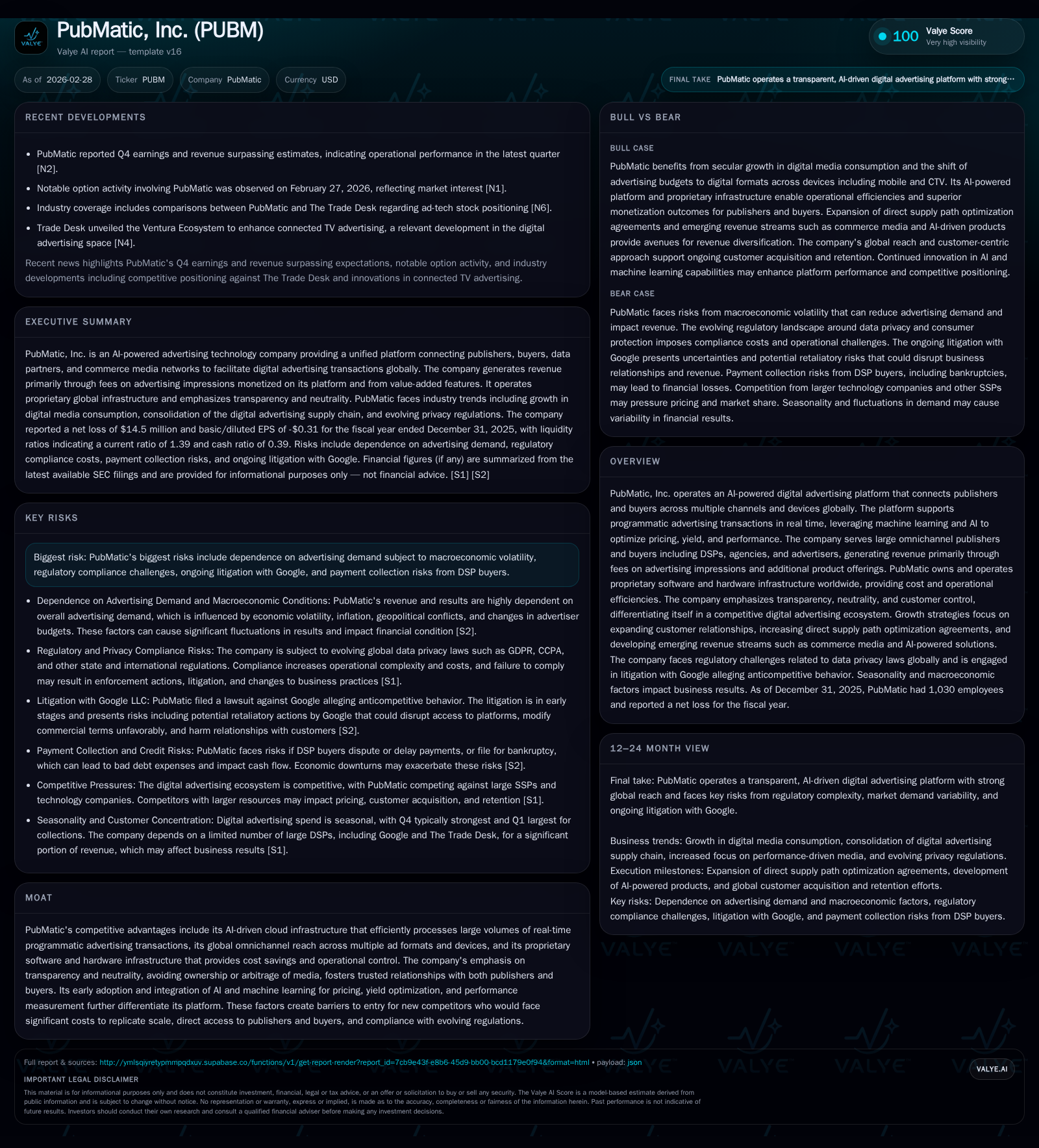
PubMatic, Inc. delivered a robust operating cash flow performance in 2025 despite swinging to an operating loss as the company invests in expanding its AI-driven omnichannel platform. While revenue growth prospects hinge on deepening direct supply path optimization agreements and capturing emerging channels like connected TV (CTV), ongoing litigation with Google and regulatory pressures around data privacy pose material risks. Management sustained aggressive capital returns through significant share repurchases funded by healthy free cash flow, underscoring financial discipline amid uncertainties. Investors should monitor developments around Google’s potential retaliatory actions and adoption trends in emerging digital ad formats as key near-term indicators.
Historical Performance: Growth Patterns and Profitability Challenges
PubMatic’s financial trajectory over the past four fiscal years underscores a narrative of punctuated volatility driven by both internal strategic shifts and broader industry headwinds. Operating income peaked at $40.5 million in 2022 before sharply deteriorating to a loss of $17.3 million in 2025—a staggering -539.5% year-over-year (YoY) decline [F1]. Correspondingly, net income reversed from profitability ($12.5 million in 2024) to a net loss of $14.5 million in 2025 (-215.7% YoY). This inflection marks the first sustained period of operating losses since 2022 and reflects intensified investments across technology development and market expansion.
Notably, despite the swing into negative earnings territory, PubMatic's core operating cash flow (CFO) demonstrated resilience—rising by over 10% YoY to $81.1 million in 2025 [F1]. Reduced capital expenditures (capex), down nearly 18.5% YoY to $14.3 million, helped drive free cash flow (FCF) generation solidly positive at approximately $66.7 million [F1]. This divergence between accounting earnings and cash flows suggests robust underlying business operations with effective working capital management amidst margin pressure.
Historical performance (annual)
| FY | Net ($mm) | CFO ($mm) | OpInc ($mm) | Capex ($mm) | Net YoY |
|---|---|---|---|---|---|
| 2025 | -14 | 81 | -17 | 14 | -215.7% |
| 2024 | 13 | 73 | 4 | 18 | +40.8% |
| 2023 | 9 | 81 | 2 | 11 | -69.1% |
| 2022 | 29 | 87 | 41 | 36 |
Source: SEC companyfacts cache [F1].
Capital returns and efficiency (annual)
| FY | Buybacks ($mm) | FCF ($mm) | ROE% |
|---|---|---|---|
| 2025 | 46 | 67 | -5.5 |
| 2024 | 75 | 56 | 4.5 |
| 2023 | 59 | 71 | 3.0 |
| 2022 | 0 | 51 | 9.2 |
Source: SEC companyfacts cache [F1].
Caution is warranted interpreting this volatile earnings pattern; PubMatic's results reflect cyclical factors inherent to digital advertising spend seasonality—but also strategic repositioning costs related to scaling omnichannel AI solutions.
Technology Differentiators Fueling Competitive Moat
PubMatic’s valuation proposition is deeply rooted in its proprietary platform architecture that fuses AI-driven cloud computing with integrated software-hardware infrastructure optimized for real-time programmatic advertising across multiple channels—display, video, mobile web/app, and particularly connected television (CTV) [S10]. This combination enables efficient processing of high volumes of auction-based ad impressions leveraging machine learning algorithms for pricing precision and yield maximization.
The company’s technology stack includes support for sophisticated workflows such as header bidding wrappers—an industry-standard method allowing publishers to offer inventory simultaneously to multiple demand sources—and direct supply path optimization (SPO) agreements with advertisers aimed at streamlining media buying efficiency by bypassing intermediaries [S10]. These SPO arrangements not only increase transaction volumes but also reduce per-impression technology costs.
Additionally, PubMatic emphasizes platform transparency and neutrality; it neither owns media nor arbitrages inventory which helps foster trust on both sell- and buy-sides—particularly favored by large DSPs (demand-side platforms), agency trading desks, and premium publishers wary of conflicts inherent in vertically integrated competitors [S10][S11]. The proprietary nature of its AI models combined with global data sovereignty controls presents formidable barriers to entry for nascent players who must replicate scale plus regulatory compliance.
Evolving Digital Advertising Trends Driving Platform Adoption
The digital advertising ecosystem continues rapid evolution with consumer media consumption migrating heavily toward connected devices—especially OTT/CTV streaming services—and retail-commerce media leveraging transactional attribution [S10][N8]. PubMatic's strategy targets these growth vectors through expanded video/mobile capabilities aligned with shifting advertiser budgets favoring outcome-based spending.
Outcome measurement frameworks are gaining traction among brand advertisers demanding closed-loop attribution linking ads directly to commerce transactions—a focus area for PubMatic's data-driven products like Activate and Connect designed to enhance buyer visibility while maintaining consumer privacy safeguards [N8]. As Trade Desk recently unveiled new CTV advertising tools indicating market commitment to this channel [N8], PubMatic’s growing footprint in premium video positions it well to capitalize on increasing ad dollars flowing from linear TV catalogs into programmatic streaming inventories.
Furthermore, PubMatic continues integrating emerging AI-native environments and mobile ecosystems that deliver richer behavioral signals than traditional browser-based contexts—essential for optimal bid strategies that undergird their programmatic platform model [S10]. However, adoption rates depend on overcoming entrenched header bidding wrappers legacy systems used by some publishers—a known switching inertia challenge highlighted by management [S1].
Regulatory Landscape and Litigation Risks Impacting Operations
Litigation against Google represents one of the most material risks facing PubMatic today [S4][S6][S8]. Filed in September 2025 following a U.S. District Court ruling against Google's monopolistic practices in ad tech markets earlier that year, this lawsuit challenges Google's dominance in open-web display advertising via alleged anticompetitive conduct impacting publisher ad servers and exchange markets.
Google remains both a significant commercial partner via DV360 DSP buys as well as a direct competitor—comprising a substantial portion of PubMatic's revenue base [S6]. Potential retaliatory measures from Google could range from restricted platform access to unfavorable commercial terms or deprioritization of PubMatic services—all scenarios that jeopardize revenue continuity [S4][S6]. Given early-stage proceedings with uncertain outcomes and timing, management flags possible diversion of resources plus reputational risks [S8].
On the data privacy front, tightening legislation such as GDPR enforcement in Europe alongside new U.S.-state laws targeting health-related digital data have compounded operational complexity [S7][S13][S21]. Privacy advocacy groups fuel increasing class-action litigation focusing on allegedly improper use or sharing of consumer data within programmatic ecosystems—affecting SSPs like PubMatic despite their compliance efforts [S7].
Additionally, regulatory regimes covering political advertising under the Transparency Treaty Political Advertising Act (TTPA) may impose further obligations disrupting supply chain participation or amplifying compliance costs [S13]. The legal uncertainty surrounding statutes such as California Invasion of Privacy Act (CIPA) has introduced notable risk related to tracking technologies frequently employed across digital ads [S14].
Collectively these overlay complicated macroeconomic factors including softening ad spend due to inflationary pressures, geopolitical tensions impacting product costs (e.g., labor) mostly concentrated across North American and European markets where majority revenue resides [S1].[N1]
Capital Allocation: Cash Flow Strength Amid Operating Headwinds
A highlight amidst earnings pressure lies in PubMatic’s disciplined capital deployment underpinned by stable cash flow generation capabilities [F1][S9]. Operating cash flow improved modestly (+10.4%) even as accounting profits turned negative—with capex reduced nearly one-fifth YoY facilitating free cash flow near $67 million [F1]. This robust liquidity foundation enabled continued share repurchases totaling approximately $46.5 million during fiscal 2025, sustaining prior years’ buyback momentum ($75+ million in 2024) without accompanying dividend payouts [F1].
Current assets outstrip current liabilities yielding a liquidity ratio about 1.39x —a comfortable cushion supporting ongoing operational funding needs plus R&D investment required for AI model development and infrastructure scaling [F1]. With no borrowings under secured credit facilities reported year-end, leverage remains conservative offering flexibility amid an uncertain regulatory environment [F1][S9]. However lower equity alongside net losses resulted in a negative approximate return on equity near -5.5%, reflecting profitability headwinds but manageable within an investment-heavy growth context.
Outlook and What to Watch: Customer Expansions and Market Dynamics
Though explicit forward guidance remains limited due to litigation uncertainties and evolving macro conditions, external signals suggest cautious optimism around platform adoption trends [S3][N1][N7]. A recent upgrade by B.Riley Securities highlights perceived value in PubMatic’s market positioning relative to peers driven by its omnichannel capabilities notably growing CTV inventory penetration alongside expanding direct supply path agreements boosting demand-side consolidation benefits [N7][N9].
Key metrics investors should monitor include volume uplift from new publisher integrations across premium video streaming inventories coupled with DSP participation levels influenced partly by competitive dynamics vis-à-vis Google's regulatory actions [N1][N9]. Attention should also focus on legal proceeding developments regarding Google's alleged retaliatory conduct given potential disruption magnitude described by management disclosures [S4][S6]
Macro sensitivity remains elevated reflecting broad-market ad budget moderation tied closely to economic outlooks—softened particularly in retail segments exposed to geopolitical volatility—but offset somewhat by rising demand for high-quality outcome-measured campaigns favored on PubMatic’s AI-backed platform architecture [S1][N8]. Emerging privacy requirements could also constrain available addressable impressions absent adaptive compliance innovations.
This analysis is based solely on information publicly available through February 28, 2026 including SEC filings ([F1], [S#]) and verified news sources ([N#]). It does not constitute investment advice but aims to provide an independent examination of PubMatic's financial position, strategic initiatives, industry context, risks, and capital priorities.
Disclaimer: This is research-only, informational analysis and not investment advice. It may include AI-generated interpretation and general industry context. Always verify important details using primary sources.

Comments