
QCR HOLDINGS' Multi-Bank Model Drives Profit and Liquidity Stability Amid Rate Shifts
QCR HOLDINGS leverages its network of regional banking subsidiaries to sustain growth and capital discipline against evolving credit and interest rate challenges.
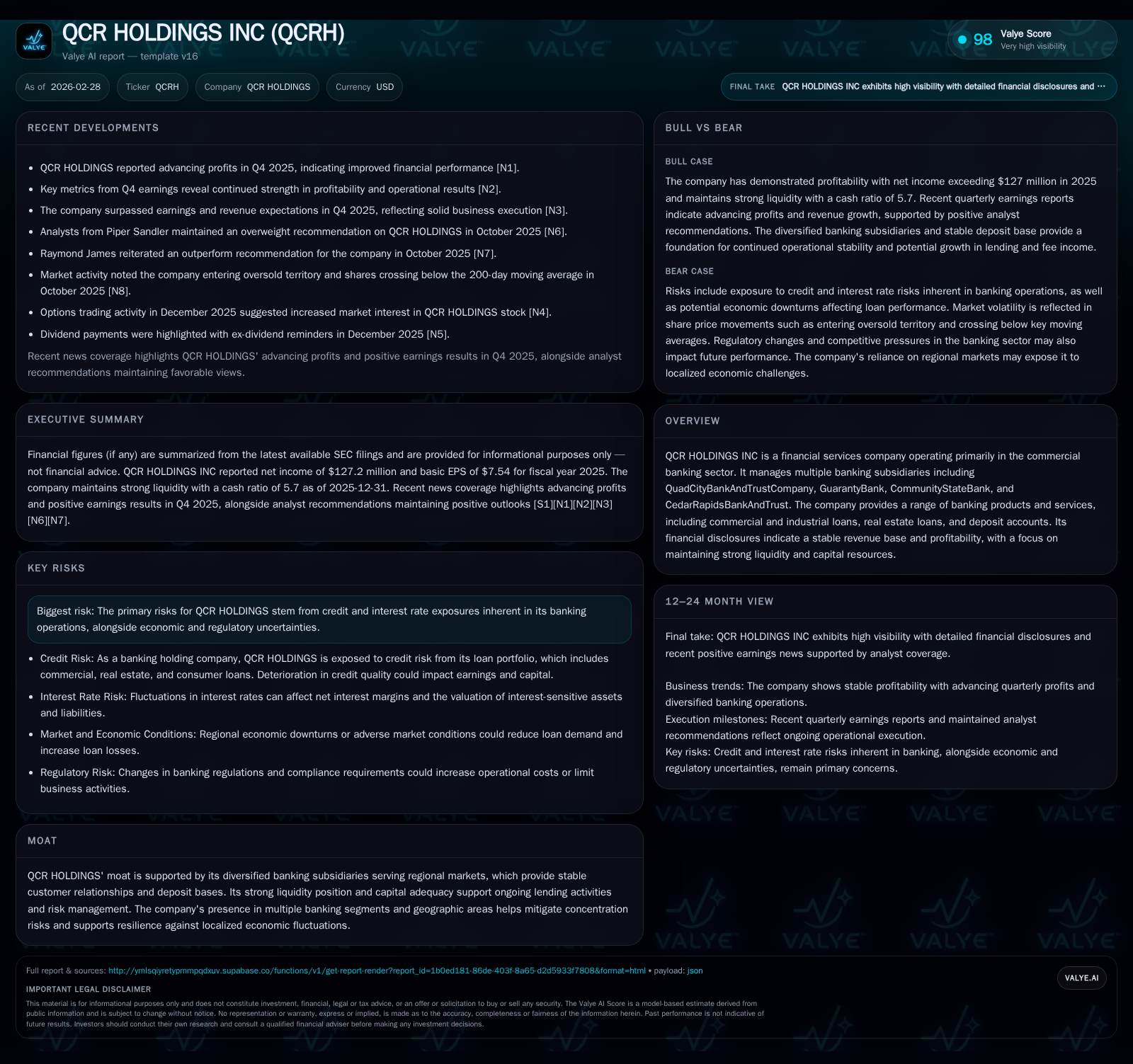
QCR HOLDINGS INC demonstrated robust revenue growth of approximately 20.7% in FY2025, supported by diversified commercial lending and a stable deposit base spread across its multiple subsidiaries. Despite a slight decline in operating cash flow, capital expenditures rose sharply, reflecting strategic investments. The company's prudent use of derivative instruments to hedge interest rate risk and a solid equity base underpin its resilient capital structure. Looking forward, regional market dynamics and disciplined credit management are poised to influence growth trajectories while dividend initiatives underscore a balanced approach to shareholder returns.
Historical Momentum: Revenue and Profit Expansion from 2017 through 2025
QCR HOLDINGS has demonstrated consistent financial growth over recent years, culminating in notable revenue acceleration in FY2025. According to company facts data, annual revenue increased substantially from $1.07 billion in 2014 to levels supporting net income of $127.2 million by the end of 2025 [F1]. The latest fiscal year marked a significant spike with revenue growing approximately 20.7% year-over-year compared with FY2024, supported by broad-based demand for commercial and real estate loans across the subsidiaries [F1][N2][N4]. Net income followed suit with an 11.7% rise over the same period.
Operating cash flow for FY2025 stood at $421.5 million, showing a moderate decline of about 5.2% compared to FY2024's $444.5 million [F1], a reflection possibly linked to increased working capital requirements and timing differences in loan repayments or collections within the portfolio segments. Capital expenditures nearly doubled (+51.6%) to $67.4 million, indicative of renewed investment in infrastructure or digital banking platforms across QCR’s regional banks aiming to enhance customer experience and operational efficiencies [F1]. Equity capital has grown commensurately, reaching just over $1.11 billion by the close of 2025 with an approximate return on equity of 11.4%, underscoring effective profitability relative to shareholders’ investment.
Historical performance (annual)
| FY | Net ($mm) | CFO ($mm) | Capex ($mm) | Net YoY |
|---|---|---|---|---|
| 2025 | 127 | 422 | 67 | +11.7% |
| 2024 | 114 | 445 | 44 | +0.3% |
| 2023 | 114 | 376 | 15 | +14.6% |
| 2022 | 99 | 119 | 33 |
Source: SEC companyfacts cache [F1].
Capital returns and efficiency (annual)
| FY | FCF ($mm) | ROE% |
|---|---|---|
| 2025 | 354 | 11.4 |
| 2024 | 400 | 11.4 |
| 2023 | 361 | 12.8 |
| 2022 | 85 | 12.8 |
Source: SEC companyfacts cache [F1].
Note: YoY growth rates are computed where data continuity permits; ROE is approximated as net income divided by year-end equity.
Diverse Subsidiary Strengths: Pillars of Stable Customer Relationships and Risk Mitigation
QCR HOLDINGS operates through four main banks: QuadCityBankAndTrustCompany, GuarantyBank, CommunityStateBank, and CedarRapidsBankAndTrust [valye_report_excerpt.ov]. This structural diversity underpins its competitive moat by fostering stable customer relationships across distinct yet complementary regional markets [valye_report_excerpt.moat]. Each entity maintains granular deposit bases that cushion against geographic or sector-specific swings—a notable advantage given recent volatility in commercial real estate and industrial sectors.
This subsidiarization also enables tailored portfolio diversification strategies typical within community banking franchises—balancing owner-occupied real estate loans with non-owner-occupied commercial real estate exposures as well as revolving commercial lines [S11][S17]. By avoiding concentration risk accumulation at any single subsidiary level or loan segment and practicing disciplined underwriting standards regionally —including continuous internal risk rating assessments—QCR mitigates default probabilities amid challenging credit conditions noted in wider financial services segments [valye_report_excerpt.risks][S4].
Interest Rate Environment and Credit Portfolio Challenges
Navigating a shifting interest rate landscape remains critical for QCR HOLDINGS. The company’s disclosures reveal active use of derivatives including interest rate swaps designated as fair value or cash flow hedges under US GAAP frameworks to manage sensitivity on variable-rate assets and liabilities [S8][S9][S13]. These hedging mechanisms help smooth net interest margins in environments where Fed policy adjustments impact loan yield curves unpredictably.
Credit risks inherent in the commercial loan book—especially within industrial loans—require ongoing vigilance given economic uncertainty that can precipitate payment delinquencies or asset impairment charges [valye_report_excerpt.risks][S4]. While QCR’s diversified portfolio affords some relief from sector-specific downturns—as expressed in their delinquency data segmentation—it must balance loan origination growth ambitions with prudent risk controls consistent with recent regulatory emphasis on credit quality standards manifested in loan loss reserves [N1][S6].
Capital Structure Overview: Liquidity, Equity, and Derivatives Positioning
As of late FY2025 filings included in Q3 reports through November predominantly show strong liquidity buffers alongside substantial equity buildup totaling over $1.1 billion [F1][S5][S8], QCR remains well positioned to support ongoing lending operations without undue leverage pressure.
Their derivatives portfolio includes numerous interest rate swaptions and floors designated as either cash flow or fair value hedges to counterbalance fluctuations tied to fixed versus floating rate assets; this approach aligns with established banking practices optimizing balance sheet sensitivity management without excessive complexity that could impair transparency for stakeholders [S8][S9]. Capital adequacy ratios reported confirm regulatory compliance complemented by judicious short-term debt management focused mainly on asset-liability matching conventions common among mid-sized regional banks [S10][S23].
Dividend Initiatives and Buybacks: Approaches to Shareholder Returns
Reflecting confidence in its financial standing and future cash generation capacity—free cash flow approximates $354 million after accounting for capex—QCR declared a quarterly dividend at $0.10 per share payable April 3, 2026 [S3][N3][F1]. This payout marks a continuation of capital return discipline consistent with an approximate payout ratio aligned with the bank’s steady return on equity near 11.4%, balancing retained earnings for organic growth against external investor interests.
No recent substantial buyback programs have been noted explicitly; however the market upgrade signals favorable investor sentiment possibly reinforcing management’s commitment toward calibrated capital distribution alongside measured reinvestment to maintain competitive operating platforms.
2026 and Beyond: Growth Prospects Anchored by Regional Market Dynamics
Looking ahead into calendar / fiscal year 2026—informed by earnings beats noted early January—QCR expects continued momentum in loan originations supported by resilient regional economies served by its subsidiaries [N2][N3][S1]. However reported risk disclosures flag the need for caution around tightening regulatory stances on commercial real estate lending as well as evolving macroeconomic factors influencing borrower credit profiles.
Management commentary implies strategic prioritization will focus on sustaining proven customer deposit relationships while cautiously expanding credit exposure where underwriting standards remain stringent—the multi-bank operating design facilitating nimble responses to localized market conditions potentially mitigating systemic exposure risks.
Absent explicit detailed forecasts from official sources at this point invites attention toward key banking KPIs such as net interest margin trajectory influenced by Fed policy trends alongside asset quality developments tracked via delinquency metrics reported quarterly.
Monitoring Key Metrics: What Investors Should Watch Next
For those tracking QCR HOLDINGS' evolving story the following items warrant particular scrutiny:
- Quarterly earnings releases elucidating revenue mix shifts between net interest income vs fees,
- Natural hedge effectiveness evidenced within derivative fair value adjustments considering current volatile rate markets,
- Regulatory announcements potentially impacting capital requirements or lending guidelines,
- Detailed disclosures around commercial real estate portfolio health revealing concentration trends or emerging stress signals,
- Changes in deposit composition reflecting regional competitive dynamics or migration toward non-interest-bearing accounts affecting margin structures.
These elements collectively inform assessments pertaining to sustainability of profitability gains witnessed recently amid broader financial sector uncertainties [N1][S4].
This analysis synthesizes available data from public filings alongside news reporting up to February 28th 2026 without speculative extrapolation beyond stated facts or guidance from QCR HOLDINGS INC disclosures and acknowledged sources mentioned herein.
No investment advice is offered; this report aims solely at providing an informed analytical perspective according to provided evidence.
Disclaimer: This is research-only, informational analysis and not investment advice. It may include AI-generated interpretation and general industry context. Always verify important details using primary sources.

Comments