
Quaint Oak Bancorp Anchors Growth in Pennsylvania Commercial Real Estate Amid Competitive Banking Landscape
The latest quarterly filing confirms Quaint Oak’s steady operational footing, emphasizing commercial real estate loan growth balanced by deposit concentration risks within a regulated regional banking environment.
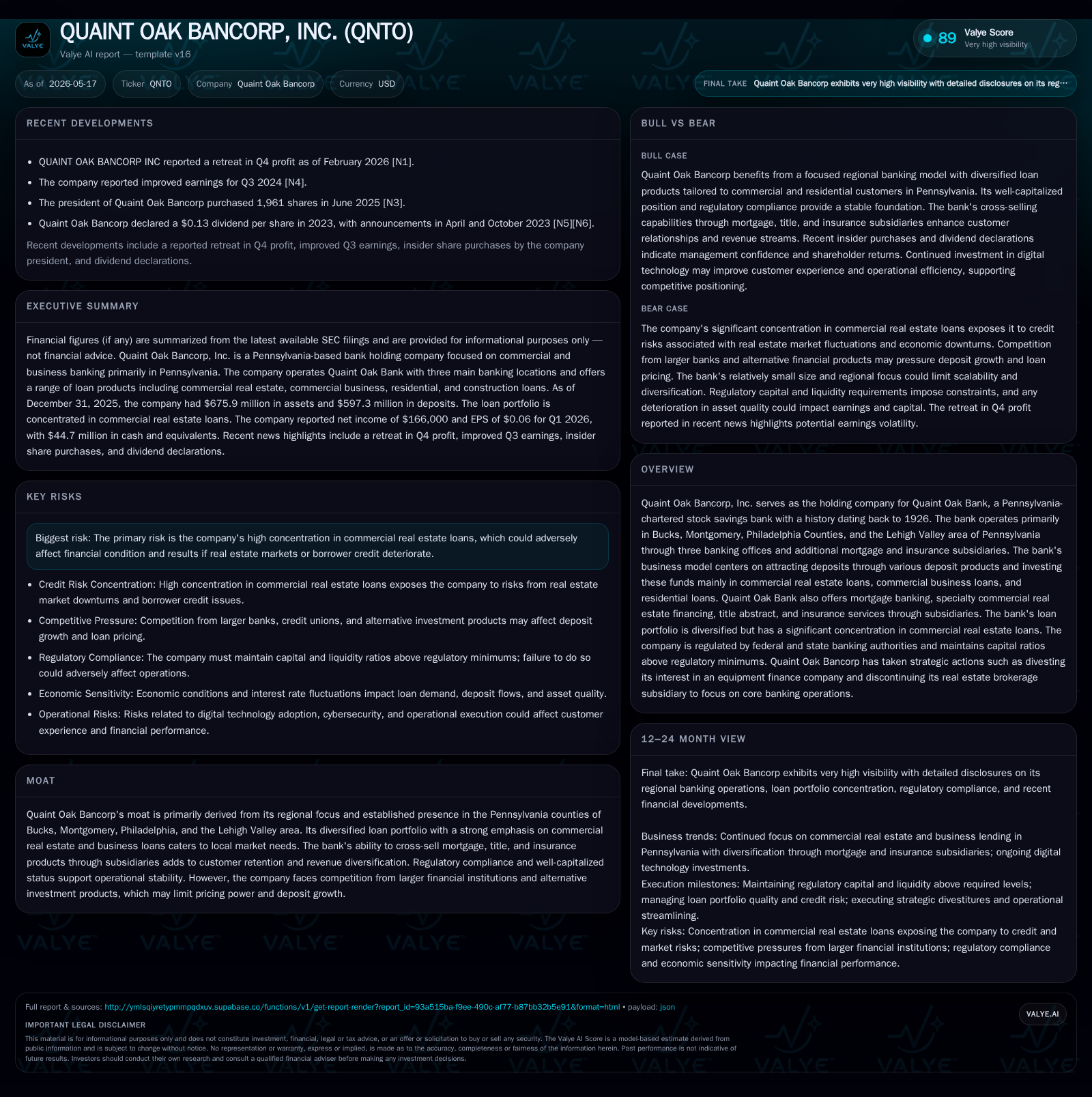
Quaint Oak Bancorp’s 2026 first-quarter results reaffirm its strategic focus on commercial real estate lending within its Pennsylvania core markets, supported by a diversified deposit base predominantly comprised of certificates of deposit. The bank’s subsidiaries expand fee income through mortgage, title, and insurance services, enhancing customer retention and revenue stability. Despite solid capitalization and liquidity positions, the firm faces notable risks from deposit concentration and concentrated commercial real estate exposure. Regulatory compliance and competitive pressures will remain key factors shaping its operational trajectory.
Latest Quarterly Operating Update: Key Takeaways from the 10-Q
Quaint Oak Bancorp’s latest quarterly filing dated May 15, 2026 ([S2]) presents an operational snapshot consistent with prior periods. There were no material changes to risk factors from the prior year-end disclosures ([S10]), reflecting steady control over key vulnerabilities such as liquidity and credit risk. Cash & equivalents stood robustly at approximately $44.7 million as of March 31, 2026 ([F1]), supporting near-term liquidity needs during a challenging interest rate environment for community banks.
The early 2026 quarterly results ([S3]) emphasize continued execution on Quaint Oak's localized deposit and lending strategy without evidence of downgraded asset quality or deposit outflows. No major debt or refinancing developments were reported that would materially shift balance sheet or funding cost structures, confirming stable operating conditions entering mid-year.
Business Model Overview: Local Focus and Product Integration
Quaint Oak Bancorp functions chiefly as the holding company for Quaint Oak Bank, a Pennsylvania-chartered stock savings institution with roots tracing back to 1926 ([S1]). The business model revolves around mobilizing deposits from regional consumers and businesses—particularly through certificates of deposit—which are then applied predominantly toward a diversified loan portfolio heavily skewed toward commercial real estate (CRE) loans at approximately 57% of total loans ([S1], [S20]).
Loan originations span owner-occupied residential real estate to commercial business loans, with underwriting anchored on conservative loan-to-value thresholds (75-80%) and minimum debt service coverage ratios around 1.20 ([S26]). Construction financing focuses on non-speculative projects associated with owner-occupied business premises.
Complementing banking operations are subsidiary entities specializing in mortgage banking (originating loans under government-sponsored enterprise guidelines), title abstracting, and insurance products including home, auto, life, and commercial policies ([S1], [S11]). These subsidiaries facilitate product bundling that increases customer stickiness and creates diversified fee income streams reducing reliance on interest spread alone.
Competitive Context and Industry Structure in Regional Banking
Within its regional footprint—Bucks, Montgomery, Philadelphia counties plus the Lehigh Valley area—Quaint Oak competes against both larger financial institutions offering broad product suites and alternative investment avenues such as money market funds or fintech solutions. This environment limits pricing power especially on deposits due to broader market interest rate awareness and switching possibilities ([S10]).
Depositors are largely attracted to competitive term certificate accounts locally but are mindful of yields offered elsewhere; notably brokered certificates sourced via national listing services comprised about 18% of CDs at December 31, 2025 ([S7]). Quaint Oak’s primarily cashless branch model leverages correspondent banking relationships for transactional needs but also adds dependency on third parties for liquidity facilitation ([S1]).
Regulatory frameworks enforced by FDIC impose capital adequacy requirements and restrict acceptance of brokered deposits when undercapitalized—a status comfortably avoided here given Quaint Oak is well-capitalized ([S4], [S5]). This positions Quaint Oak as "well-capitalized," ensuring access to brokered deposits without waivers under FDIC rules.
The bank's focus on conservative CRE underwriting coupled with required loan committee approvals based on borrower creditworthiness reinforces a disciplined credit culture designed to mitigate concentrated sector risks ([S19], [S21], [S26]).
Drivers of Growth: Deposits, Commercial Real Estate Loans, and Cross-Selling
Growth is principally driven by expanding regional deposits—mainly certificate accounts—with ongoing emphasis on maintaining competitive rates to renew brokered CDs which form a sizeable portion of liabilities (~61%) ([S7]). New loan origination efforts target commercial real estate projects primarily owner-occupied offices or mixed-use properties secured via stringent collateral valuation standards.
Mortgage banking subsidiaries originating conforming residential loans feed into secondary market sales boosting fee income while title abstracting and insurance subsidiaries deepen client wallet share with tailored product offerings ([S11], [S12]). This integrated service provision supports revenue stability despite limited scale compared to larger regional players.
Branch locations maintain a lean physical footprint focusing on digital-enabled processes augmented by correspondent banking for transactional cash flows—an approach designed to keep operating expenses low while enhancing efficiency relative to peer institutions reliant on high fixed cost branch networks ([S1]).
Risks and Constraints: Deposit Concentration and CRE Exposure
Concentration risks represent the most salient constraints facing Quaint Oak Bancorp. Chief among these is significant commercial real estate loan exposure representing over half the loan portfolio (about $310 million as of year-end) where adverse local economic or property market shifts could impair asset quality materially ([S20], [S21]). Although underwriting incorporates conservative measures such as loan-to-value caps under 80% for owner occupied properties and DSCR thresholds above industry median levels ([S26]), CRE remains inherently cyclical with potential for escalating delinquencies under stress scenarios.
Deposit concentration poses parallel risks; one large interest-bearing checking account accounted for nearly 6% of total deposits (~$35 million) at year-end while uninsured deposits measured roughly 41% overall necessitating careful retention efforts to avoid costly runoff or forced higher rates to attract replacements ([S27], [S10]). The volatility inherent in brokered CS issuance compounds this challenge given their customers’ heightened rate sensitivity observed in national listing services comprising nearly one-fifth of CDs ([S7]).
Potential margin compression could result if competitive pressures require elevated deposit pricing or if borrowing sources become more costly due to regulatory constraints or market conditions affecting small banks disproportionately compared to larger competitors.
Forward-Looking Factors: Monitoring Capital, Deposit Trends, and Market Signals
Key milestones revolve around ensuing quarterly reports tracking retention ratios on brokered CDs—renewal behavior here will importantly dictate funding cost trajectories—and delinquencies within the CRE lending segment which constitutes both the bulk of assets and greatest credit risk concentration.
Capital measurements will warrant close audience attention as rising interest rates impact aggregate earnings and regulatory bodies continue tightening oversight post recent regional banking stresses nationally; sustaining strong capital buffers will be critical for uninterrupted access to wholesale funding if needed.[S4]
Subsidiary performance in mortgage banking fee income generation alongside title insurance penetration will serve as barometers for successful cross-selling execution amid evolving customer preferences influenced by digital alternatives.
Lastly, emerging regulations affecting brokered deposit treatment or lending limits could modify operating constraints warranting early strategic calibration.
Brief Financial Summary: Capital Adequacy and Liquidity Snapshot
As of March 31, 2026—the closing date for the most recent quarter—Quaint Oak Bancorp held approximately $44.7 million in cash & equivalents providing ample buffer against short-term liquidity stress triggered by deposit withdrawals or unexpected funding needs([F1],[S2]). Total debt levels are effectively negligible when netted against liquid assets given historical best estimates indicating minimal outstanding borrowings([F1]), underscoring strong net cash positioning uncommon among peers within similar asset scales.
Operating income disclosed for full-year ended December 31, 2025 was $644 thousand supported by net income totaling $322 thousand which reflects earnings after provisions for credit losses consistent with portfolio composition([F1]). Capital ratios remain robust beyond regulatory minima ensuring continued well-capitalized status facilitating unrestricted access to brokered CDs without supervisory waivers([S4],[S5]).
This stable financial footing affords Quaint Oak room to maneuver tactically around pricing dynamics while investing selectively in subsidiary growth initiatives that enhance fee-based revenues offsetting traditional net interest margin pressures characteristic of community banks under current macroeconomic conditions.
This analysis synthesizes insights derived solely from filed SEC disclosures up through May 2026 without speculative extrapolations beyond documented facts. It does not constitute investment advice but aims to elucidate operational realities shaping Quaint Oak Bancorp’s strategy within its regional niche.
Disclaimer: This is research-only, informational analysis and not investment advice. It may include AI-generated interpretation and general industry context. Always verify important details using primary sources.

Comments