
QuantumScape’s Quest to Commercialize Solid-State Batteries: Technology and Financial Hurdles
QuantumScape pursues a breakthrough solid-state lithium-metal battery technology aimed at revolutionizing electric vehicles, while navigating technical scale-up and financial sustainability challenges.
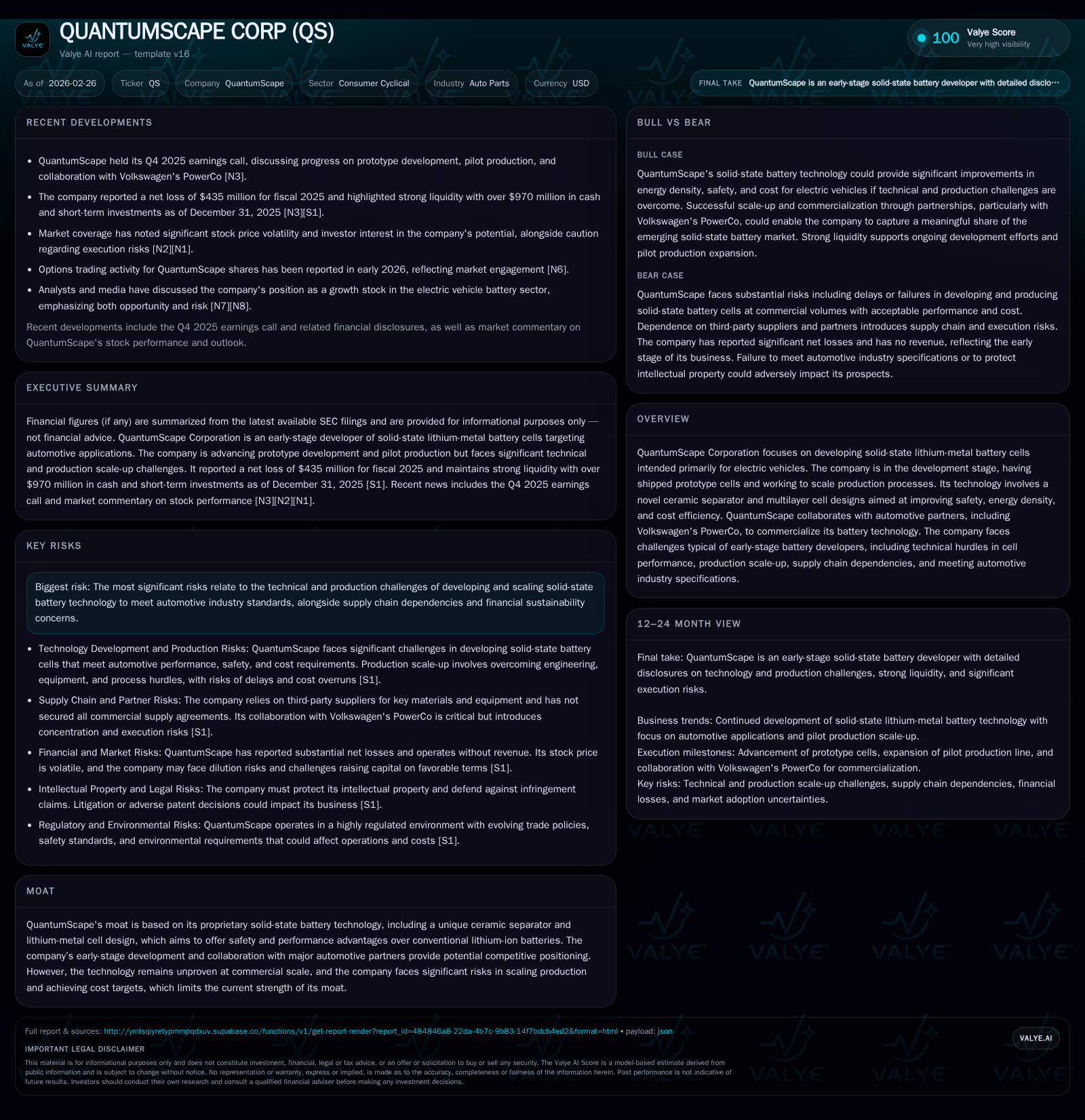
QuantumScape Corporation remains a pioneering presence in the development of solid-state lithium-metal batteries centered on its proprietary ceramic separator and multilayer cell designs. Over recent years, the company has shown incremental technological progress but continues to operate at a developmental stage marked by consistent operating losses and negative cash flows. Its collaboration with Volkswagen's PowerCo lends validation but also concentration risk as QuantumScape undertakes scaling production amid operational headwinds. Capital allocation focuses heavily on R&D and manufacturing build-out with no dividends or buybacks due to ongoing cash burn. Key near-term milestones center on scaling throughput, cost reduction, and customer qualification, crucial for transitioning from prototype to commercial volumes.
Corporate Evolution and Technology Foundation
QuantumScape Corporation was founded with the goal of disrupting electric vehicle battery technology by developing solid-state lithium-metal batteries that promise significant leaps in safety, energy density, and cost efficiency compared to conventional lithium-ion alternatives. Central to its innovation is a proprietary ceramic separator that forms part of the solid electrolyte interface—a critical component designed to prevent dendrite growth while enabling high-voltage operation. The company operates within the Consumer Cyclical sector under the Auto Parts industry classification [F1][S1][S4]. Despite being several years into development, QuantumScape remains firmly in the early-stage category as it continues refining its manufacturing process. The firm's strategic collaboration with Volkswagen’s PowerCo not only validates its underlying technology but also positions QS as a potential supplier for mass-market EVs contingent on meeting stringent automotive specifications.
Solid-State Battery Development: From Prototype to Production
To date, QuantumScape has shipped prototype battery cells incorporating multilayer designs that stack multiple ceramic separators to improve ionic conductivity and mechanical integrity. These prototypes serve as proof points enabling iterative performance enhancements. However, challenges persist around achieving separator uniformity during scale-up—which is vital for consistent cell reliability—as well as optimizing production line throughput to meet anticipated volume demands [N1][S2]. The complexity of rolling out sophisticated equipment capable of producing nanoscale ceramic layers under clean room conditions underscores engineering bottlenecks that delay full automation. While steady progress is noted quarterly, the path from lab-scale cells to automotive-grade module manufacturing remains uncertain.
Historical Financial Performance: Tracking Growth and Losses
QuantumScape’s financial history from fiscal years 2022 through 2025 presents a narrative typical of capital-intensive deep-tech startups progressing through pre-commercial phases. Operating income remains negative throughout this period though slightly improved in 2025 compared to prior years. Net losses follow a similar trend. Operating cash flow continuously registers substantial outflows illustrating ongoing investment into R&D and manufacturing capabilities. Capital expenditures have decreased sharply from $158.8 million in FY2022 down to about $36.3 million in FY2025, signaling a potential tapering as production scale initiatives stabilize [F1]. The balance sheet reveals a robust liquidity position with cash balances over $230 million and an exceptionally strong current ratio nearing 16x—indicative of sound working capital management despite no revenue generation yet.
Historical performance (annual)
| FY | Net ($mm) | CFO ($mm) | OpInc ($mm) | Capex ($mm) | Net YoY |
|---|---|---|---|---|---|
| 2025 | -435 | -242 | -473 | 36 | +9.0% |
| 2024 | -478 | -275 | -525 | 62 | -7.3% |
| 2023 | -445 | -240 | -479 | 85 | -8.1% |
| 2022 | -412 | -218 | -421 | 159 |
Source: SEC companyfacts cache [F1].
Capital returns and efficiency (annual)
| FY | FCF ($mm) | ROE% |
|---|---|---|
| 2025 | -279 | -37.2 |
| 2024 | -337 | -41.3 |
| 2023 | -325 | -33.3 |
| 2022 | -377 | -31.3 |
Source: SEC companyfacts cache [F1].
The table summarizes QuantumScape’s annual operating results and liquidity profile from FY2022-FY2025 illustrating sustained losses alongside cash consumption mainly invested towards technology maturation.
Partnership Dynamics and Industry Positioning
QuantumScape's exclusive partnership with Volkswagen’s PowerCo provides both validation of its solid-state battery concept and a runway towards commercialization [S2][N1]. This relationship entails close coordination over performance specifications including cycle life, charge rates, thermal management, and cost targets—parameters fundamental for integration into future EV platforms. However, this dependence introduces concentration risk since any delays or cancellations from PowerCo could materially impact QS's trajectory given limited alternative customers currently engaged publicly [S2]. Automotive supply chains operate under just-in-time principles requiring exacting quality standards; thus QuantumScape must align product readiness tightly with partner timelines to avoid disruptions.
Scaling Up Manufacturing: Challenges Ahead
Moving beyond laboratory-scale production towards multi-megawatt manufacturing lines spotlights several critical hurdles for QuantumScape [S2][S4]. Key among these are technical bottlenecks associated with roll-to-roll processing needed to produce continuous sheets of ceramic separators exhibiting uniform thickness without defects—imperative for consistent ionic conductivity metrics across cells. Yield improvements remain an ongoing challenge exacerbated by sensitivity to clean room environment fluctuations affecting particulate contamination levels [S4]. Moreover, raw material costs exhibit volatility which when combined with complex machinery uptime requirements can inflate unit costs potentially above market acceptable thresholds until further scale efficiencies materialize.
Capital Allocation and Cash Flow Considerations
Capital deployment has skewed heavily towards R&D investments underpinning core technology development alongside decreasing yet still meaningful capital expenditures focused on production equipment investment as per recent quarters [F1]. No dividends or share buybacks have been declared given persistent net losses coupled with negative free cash flow — approximated at around negative $279 million for FY2025 after subtracting capex from CFO [F1]. Return on equity remains deeply negative near minus 37%, underscoring that shareholders are financing an innovation cycle rather than enjoying income returns currently.
This capital-intensive model is characteristic of early-stage technology firms targeting industrial transformation within automotive supply chains rather than mature profit centers.
Risks Around Commercialization and Competitive Landscape
QuantumScape explicitly highlights numerous risks tied principally to technological execution uncertainties including failure to achieve targeted battery performance or production yields [S4][S5]. Reliance on third-party suppliers for components alongside vulnerability to raw material price swings form substantial operational exposures [S2]. Intellectual property protection represents another area of contest given the competitive race amongst battery developers globally [S4]. Concentration risk linked to Volkswagen’s partnership further intensifies commercial uncertainty since delayed customer qualifications could defer revenue generation substantially.
Additionally, entrenched incumbents specializing in advanced lithium-ion cells continue aggressive R&D efforts creating a highly competitive landscape where timeline adherence and cost competitiveness will dictate eventual market share capture.
Key Milestones to Monitor in 2026 and Beyond
Absent explicit forward-looking guidance by management recently [N1][N5], investors should monitor forthcoming updates focusing on several tangible inflection points: advancing production line throughput rates indicating scale progress; meeting cost per kilowatt-hour targets aligned with automotive benchmarks; new customer contract announcements diversifying revenue sources beyond core partner; successful completion of third-party validation testing particularly examining solid electrolyte interface durability under real-world cycling conditions.
Positive developments along these vectors would help translate QuantumScape’s promising battery architecture into commercial viability supporting longer-term business sustainability.
This analysis synthesizes publicly available data without providing any investment advice or recommendations regarding QuantumScape Corporation securities or related financial decisions.
Disclaimer: This is research-only, informational analysis and not investment advice. It may include AI-generated interpretation and general industry context. Always verify important details using primary sources.

Comments