
Rain Enhancement Technologies Advances Pilot Deployments Amidgoing Liquidity Constraints
The company progresses in operationalizing its proprietary rainfall enhancement technology while facing substantial funding and profitability challenges.
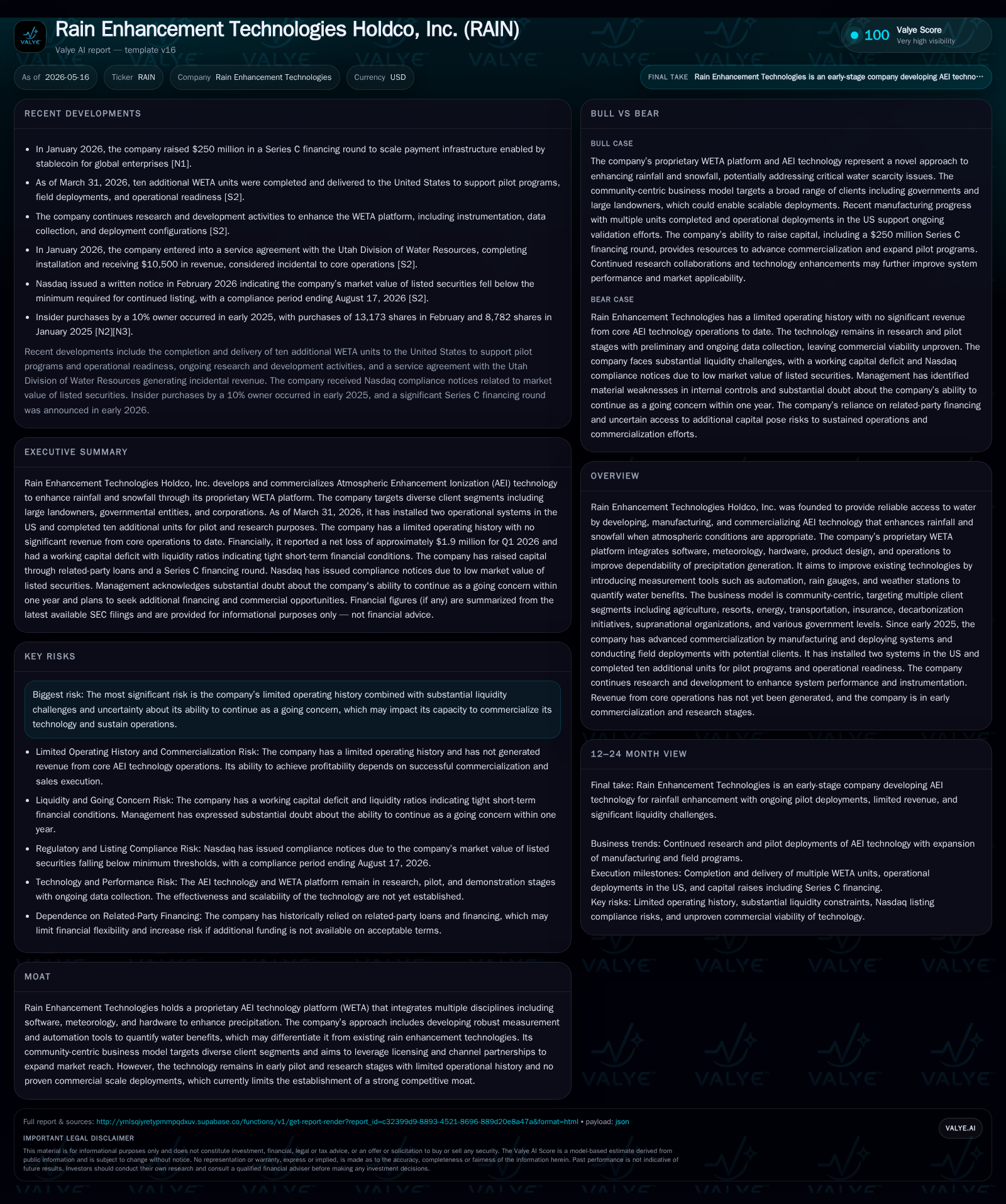
Rain Enhancement Technologies Holdco, Inc. (RAIN) has completed early-stage installations and pilot operations of its Atmospheric Enhancement by Ionization (AEI) systems in the U.S. during late 2025 and early 2026, marking tangible progress toward commercialization. However, the company remains in a limited operating history phase with no revenue-generating customer contracts beyond small service agreements and faces significant liquidity issues with a low current ratio and continued operating losses. Its one-to-many community-centric business model targets diverse sectors including agriculture and government but hinges on successfully scaling and validating its WETA platform technology amid regulatory and competitive uncertainties.
Recent Operating Update
Rain Enhancement Technologies Holdco, Inc. (RAIN) has advanced its pilot deployments of Atmospheric Enhancement by Ionization (AEI) technology during late 2025 through early 2026. The company installed its first two rain and snowfall generation systems within the U.S., which began operation in November 2025 [S10][S18]. These installations serve as live testbeds for system validation under real atmospheric conditions using meteorological and radar data. This marks RAIN's initial operational footprint beyond laboratory research into field deployment phases.
However, despite these technological deployments, commercial revenue remains minimal with the latest quarterly report showing only $10,500 earned from a Utah Division of Water Resources service agreement related to radiometer data ingestion installation [F1][S18]. There are no reports of material revenue-generating customer contracts yet; activities remain largely focused on system validation and pilot operations [S2][S18].
Financially, the company continues to operate at a loss with full year 2025 net losses near $9.1 million driven mainly by general and administrative expenses ($7.6 million), installation costs ($402k), research & development costs ($62k), stock-based compensation ($1.63 million), among others [S7]. The first quarter of 2026 reflected net losses around $1.9 million including G&A expenses of $1.8 million indicative of ongoing heavy operational expenditure during this pre-revenue phase [S18].
Liquidity poses a critical constraint: as of March 31, 2026, RAIN reported only approximately $581k cash against current liabilities exceeding $15.9 million resulting in an extremely weak current ratio near 0.07 [F1][S15]. Despite increasing the related party loan facility from $7 million to $10 million in March 2026 with borrowings now totaling around $11.8 million including rollover amounts [S16], the company discloses substantial doubt about ability to continue as a going concern over the next year unless additional funding is secured or revenues increase significantly [S15].
Business Model
RAIN's core business centers on developing, manufacturing, commercializing, and operating an innovative AEI technology platform dubbed WETA (Weather Enhancement Technology & Automation). This proprietary platform aims to enhance rainfall and snowfall under favorable atmospheric conditions through ionization methods combined with advanced software controls, machine learning analytics, real-time meteorology inputs, automation tools including rain gauges and weather stations to quantify water yield benefits [S1][S2].
Revenue generation is envisioned through a community-centric one-to-many model targeting multiple client verticals simultaneously rather than isolated direct-sales approaches. Key prospective customers include large-scale landowners such as agricultural farms, resorts leveraging snow or rain variability advantages; energy producers seeking climate resilience; transportation infrastructure operators; insurance/reinsurance companies focused on climate risk management; corporate decarbonization initiatives; supranational governmental bodies; as well as municipal to federal government agencies globally [S1][S2][S22].
Growth avenues also include licensing components of the water generation technology to third-party manufacturers or channel partners thereby expanding market reach through collaborative networks alongside direct system deployments [S2].
The technological offering distinguishes itself by integrating hardware-based ionization precipitation seeding methods with robust software measurement frameworks designed not only to induce precipitation but also rigorously document increased water supply yields at relatively low projected cost benchmarks (estimated around $0.10 per cubic meter excluding land costs) compared to alternative water augmentation solutions [S1].
Moreover, research extensions into adjacent applications such as fog mitigation (with preliminary Australian pilot observations suggesting influence of ionization on fog dispersal) and snow enhancement are underway albeit remaining at experimental stages without current commercial impact [S9][S10].
Industry Structure and Competitive Position
RAIN operates within a highly specialized atmospheric water enhancement industry intersecting environmental tech, climate adaptation infrastructure, and emerging water security markets. Competitors range from traditional cloud seeding operators using silver iodide or salt aerosols to innovative startups leveraging electrostatic or plasma-based precipitation stimulation techniques.
RAIN aims to differentiate through its WETA platform’s holistic integration of measurement instrumentation (automation sensors & weather stations), software analytics (machine learning), operational deployment expertise, and community-tailored business structures targeting multi-segment ecosystems instead of siloed applications.
However, the industry's nascent state—with sparse commercially scaled deployments worldwide—means competitive moats are largely undeveloped and performance consistency under diverse atmospheric conditions remains unproven at scale. In addition, regulatory approvals for artificial weather modification vary regionally adding complexity as market entry proponents.
RAIN's focus on quantification capabilities is strategic given end-customers like insurers or governments requiring defensible data on water benefit before committing capital.
Growth Drivers
- Technology Commercialization: Installing additional AEI systems per planned manufacturing pipeline expansion will generate incremental operational data essential for validating efficacy required by prospective clients.
- Pilot Program Expansions: Planned instrumented pilot studies in Oregon, California, Utah, Colorado throughout 2026 aim to refine ionization effects under variable fog types expanding potential application domains [S9][S10].
- Strategic Client Engagements: Building partnerships with governmental units (e.g., Utah Division of Water Resources engagement) could anchor broader municipal adoptions fostering proof-of-concept endorsements.
- Licensing & Channel Partnerships: Exploring indirect commercialization via licensing technologies to other manufacturers may scale distribution without commensurate capital expenditure.
- Climate Resilience Momentum: Increasing global demand for sustainable water augmentation amid drought pressures can structurally increase client receptivity across agriculture and utilities sectors.
Risks / Watchpoints / Growth Constraints
What to Watch Next
- Progress updates from expanded pilot programs scheduled across several U.S. states during 2026 focusing on measurable precipitation or fog mitigation impacts.
- Development milestones regarding manufacturing scale-up for additional AEI systems being prepared for deployment post initial two-unit installation.
- Capital raising initiatives including any new equity or debt funding announced that could alleviate current liquidity constraints.
- Any signed commercial contracts reflecting transition from pilots into recurring revenue-generating agreements with government or private clients.
- Regulatory outcomes particularly relating to environmental permits or legislation impacting weather modification technologies.
- Updates on control environment remediation addressing prior material weaknesses which can affect reporting reliability.
Financial Profile Summary
Latest financial snapshot
| Metric | Value | Period |
|---|---|---|
| Current assets | $1148000 | |
| 2026-03-31 | ||
| Current liabilities | $16mm | |
| 2026-03-31 | ||
| Current ratio | 0.07x | |
| 2026-03-31 |
Source: SEC companyfacts cache [F1].
Operating results continue to show steep losses driven by installational costs during pilot launches alongside fixed G&A overheads amid zero meaningful sales volume outside minor service contracts [F1][S7][S18]. The balance sheet stress arises mainly from high accrued obligations against scant liquid assets necessitating external financing extensions primarily from related parties [F1][S15].
This analysis synthesizes publicly available SEC filings up to May 15th, 2026 without offering investment recommendations or price forecasts.
Disclaimer: This is research-only, informational analysis and not investment advice. It may include AI-generated interpretation and general industry context. Always verify important details using primary sources.

Comments