
Arcus Biosciences' Financial and Clinical Trajectory as a Clinical-Stage Innovator
Arcus Biosciences advances late-stage oncology and autoimmune therapies while managing widening operating losses and strategic financing.
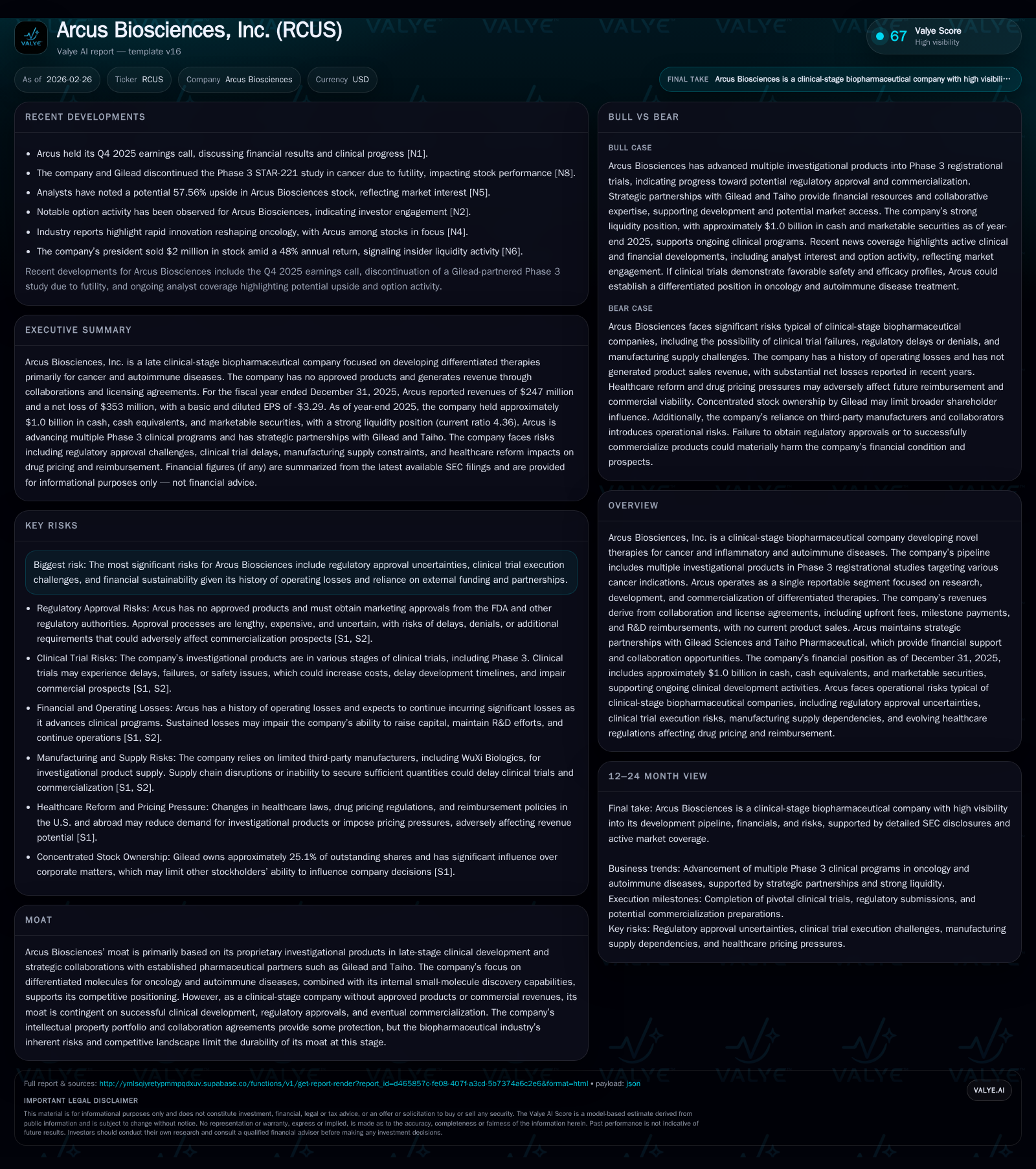
Arcus Biosciences remains deeply entrenched in clinical development with its pipeline advancing through pivotal Phase 3 registrational studies, primarily targeting cancer. Despite revenue reliance on collaboration and milestone payments from partners like Gilead Sciences and Taiho Pharmaceutical, the company's top-line showed a slight decline in 2025 compared to 2024, reflecting milestone payment timing variability rather than sales. Operating losses widened substantially, driven by increased R&D investments. The company has supplemented cash reserves through equity offerings and term loans, securing a solid liquidity position with a current ratio above 4x, yet anticipates continued capital needs amid clinical progression. Heightened regulatory uncertainties and pricing reforms impose additional external risks as Arcus seeks critical data readouts and potential regulatory filings that will define its path toward commercialization.
Revenue Trajectory and Collaboration-Based Growth Drivers
Arcus Biosciences’ revenue remains narrowly derived from collaboration agreements rather than product sales, consistent with its classification as a clinical-stage company focused on oncology and immunology drug development. For fiscal year 2025, Arcus reported revenue of approximately $247 million, down about 4.3% from the prior year's $258 million [F1]. This decline primarily stems from milestone payment timing shifts within its partnerships—particularly with Gilead Sciences and Taiho Pharmaceutical—and not any reduction in product demand or approvals since no products have been commercialized yet [N1][S1].
The company's financials show earnings concentrated in upfront fees, milestone-based payments triggered by successful clinical progress or regulatory events, and reimbursements for research activities [S1]. Such collaboration-dependent revenue tends to be lumpy with limited predictability quarter-to-quarter. This licensing model constrains top-line consistency but provides necessary funding as Arcus invests heavily in its investigational pipeline.
Historical performance (annual)
| FY | Rev ($mm) | Net ($mm) | CFO ($mm) | OpInc ($mm) | Rev YoY | Net YoY |
|---|---|---|---|---|---|---|
| 2025 | 247 | -353 | -482 | -386 | -4.3% | -24.7% |
| 2024 | 258 | -283 | -170 | -330 | +7.8% | |
| 2023 | -307 | -306 | -340 | -15.0% | ||
| 2022 | -267 | 438 | -280 |
Source: SEC companyfacts cache [F1].
Capital returns and efficiency (annual)
| FY | FCF ($mm) | ROE% |
|---|---|---|
| 2025 | -484 | -55.9 |
| 2024 | -176 | -58.4 |
| 2023 | -330 | -66.5 |
| 2022 | 432 | -40.6 |
Source: SEC companyfacts cache [F1].
Clinical Pipeline Advances and Regulatory Milestones on the Horizon
Arcus is advancing multiple late-stage candidates in registrational Phase 3 studies, notably casdatifan—a selective adenosine A2A receptor antagonist—and quemliclustat—a glucosylceramide synthase inhibitor aimed at inflammatory disease indications [N1][S1][S3]. Data from these pivotal studies are anticipated over the coming quarters, representing significant regulatory inflection points that could sustain subsequent tranches of funding under credit agreements.
Clinical endpoints in these registrational trials focus on efficacy markers typical in oncology drug assessments, including progression-free survival, overall response rates, and safety profiles. Given the high bar in oncology approvals alongside immuno-modulatory agents’ complexity, Arcus faces substantial operational challenges executing these studies [N1]. Success would drastically shift the company's valuation trajectory.
Investor Expectations: Analyst Sentiment and Market Perspectives
Investor interest appears cautiously optimistic but acknowledges binary risk inherent to clinical-stage biotech equities. Wall Street analysts project upside potential exceeding 50%, conditioned on successful data announcements [N5]. Goldman Sachs recently upgraded Arcus citing confidence in pipeline differentiation and partnership strategy [N6]. Meanwhile, options market activity suggests increased speculation around forthcoming catalysts [N3].
The binary nature of approval outcomes aligns investor risk appetite with event-driven volatility common within immuno-oncology stocks where commercial success depends heavily on surpassing stringent trial endpoints.
Capital Structure, Financing Activities, and Liquidity Management
Arcus bolstered liquidity through a series of financing maneuvers: In 2024 it secured $320 million via a strategic equity sale to Gilead at $21 per share along with equity distribution arrangements allowing share issuance up to aggregate offering prices of $200 million [S1][F1]. Following this, the company completed two underwritten public offerings in 2025 raising approximately $438 million before underwriting costs.
Complementing equity raises is the Hercules term loan facility totaling up to $250 million structured across multiple tranches tied to clinical milestones that provide staged access to funds supporting expansion efforts [S9][S11]. As of December 31, 2025, Arcus had drawn $100 million principal under this agreement with additional funds available subject to milestone achievement [F1][S9]. The amended loan bears an effective interest rate approximating 12.85% with a maturity extending to September 2030 [S9].
Cash equivalents totaled roughly $222 million at year-end with current assets close to $1 billion yielding a robust current ratio of about 4.36x—indicating sound short-term liquidity amidst increasing expenditures [F1]. However, operating cash burn indicates heightened consumption necessitating continued access to capital markets or milestone-triggered draws.
Operating Losses, Cash Flows, and Implications for Sustainability
Operating losses widened noticeably from -$330 million in FY24 to -$386 million in FY25 (a deterioration of ~17%) as escalating R&D expenses aligned with intensified clinical trial activities [F1]. Net loss amplified by around 24.7% YoY reaching -$353 million [F1], underscoring mounting investments without offsetting commercial inflows.
Operating cash flow starkly deteriorated by nearly 184%, plunging from -$170 million in FY24 to -$482 million in FY25 [F1][S2], reflective of heavier spending on investigational programs combined with reduced collaboration receipts ($37 million in ’25 vs. $232 million prior year). Capital expenditures pared back considerably amid focus on trial costs rather than fixed assets ($2 million capex in ’25 down from $6 million prior) [F1]. Free cash flow thus remained deeply negative at approximately -$484 million.
The financial pattern typifies clinical-stage biopharma players who operate at sizable losses pending product commercialization milestones; however, sustaining such burn rates demands vigilant capital management. Return metrics like ROE are inherently negative (-55.9% approx.) given absence of product revenues balancing costs [F1].
External Risks: Regulatory Environment and Market Access Dynamics
Arcus faces multifaceted regulatory headwinds intensified by recent U.S. healthcare reforms including the "One Big Beautiful Bill Act" enacted July 2025 which enforced substantial Medicaid funding cuts reducing insured populations eligible for drug therapies [S4][S5][S14]. These contractions could impair patient access and sales volume should investigational products gain approval.
Additionally, proposed pricing measures such as so-called most favored nation policies aim to tether U.S. drug prices to lower international benchmarks potentially exerting downward price pressures upon launch [S4][S14][S20]. Concurrently states are enacting prescription drug affordability boards and formulary restrictions that complicate reimbursement frameworks further—phenomena intensifying payer negotiation leverage resulting in compressed margins.
Such policy evolutions embed considerable uncertainty around prospective coverage decisions impacting marketing freedom as well as necessitating comprehensive cost-effectiveness evidence generation post-approval [S4][S5]. Biopharma companies are increasingly obligated to navigate additive hurdles like REMS (Risk Evaluation Mitigation Strategies), post-market commitments or restricted distribution models potentially elevating commercial complexity.
Strategic Partnerships’ Role in Expedition and Risk Mitigation
Partnerships with Gilead Sciences and Taiho Pharmaceutical are cornerstone components shaping Arcus’ developmental progress both financially and operationally [S1][N1]. These alliances provide upfront capital injections complemented by milestone-triggered fees linked directly to pipeline advancement fostering non-dilutive funding avenues partially insulating balance sheet strain.
Moreover, resource sharing under these agreements allows leveraging external capabilities enhancing trial execution efficiency while diffusing risks among stakeholders—termed “alliance economics” within sector vernacular. Performance obligations embedded contractually allocate expenses proportionally against premium valuations conferred during stock purchases such as Gilead's large-scale investment revealed last year [$320M] highlighting partner commitment intensity [S1].
Such collaborations do not eliminate all risks but serve as strategic de-risking mechanisms amplifying support during critical development phases while preserving internal focus on core molecular innovation.
Future Outlook: Key Milestones to Monitor for Commercial Viability
Looking forward (analysis), pivotal triggers include completion announcements of registrational Phase 3 data for casdatifan and quemliclustat—events likely activating further tranche availability under credit facilities as well as validation checkpoints for subsequent regulatory submissions like BLA (Biologics License Application) or NDA (New Drug Application) filings [N1][S3][S9].
Additional milestones encompass potential partnership expansions or amendments adding financial buffers or commercial reach alongside ongoing equity market dynamics influencing liquidity expansion opportunities. Monitoring quarterly collaboration income fluctuations will also shed light on near-term operational momentum.
Market watchers should maintain focus on FDA interactions regarding labeling negotiations or REMS imposition prospects following potential approvals given their direct bearing on launch speed and formulary inclusions shaping ultimate uptake patterns.
Disclaimer: This analysis is based solely on information explicitly disclosed by Arcus Biosciences through SEC filings and verified news sources as of February 26, 2026. It refrains from making investment recommendations or speculative forecasts beyond documented facts and established sector context. Readers should consider inherent uncertainties typical in biotechnology drug development when interpreting forward-looking statements or financial trends presented herein.
Disclaimer: This is research-only, informational analysis and not investment advice. It may include AI-generated interpretation and general industry context. Always verify important details using primary sources.

Comments