Deep Dive: Regeneron Pharmaceuticals’ Strategic Position and Industry Challenges in Early 2026
An in-depth analysis of Regeneron Pharmaceuticals’ business model, competitive landscape, financial health, and key risks as it navigates 2026.
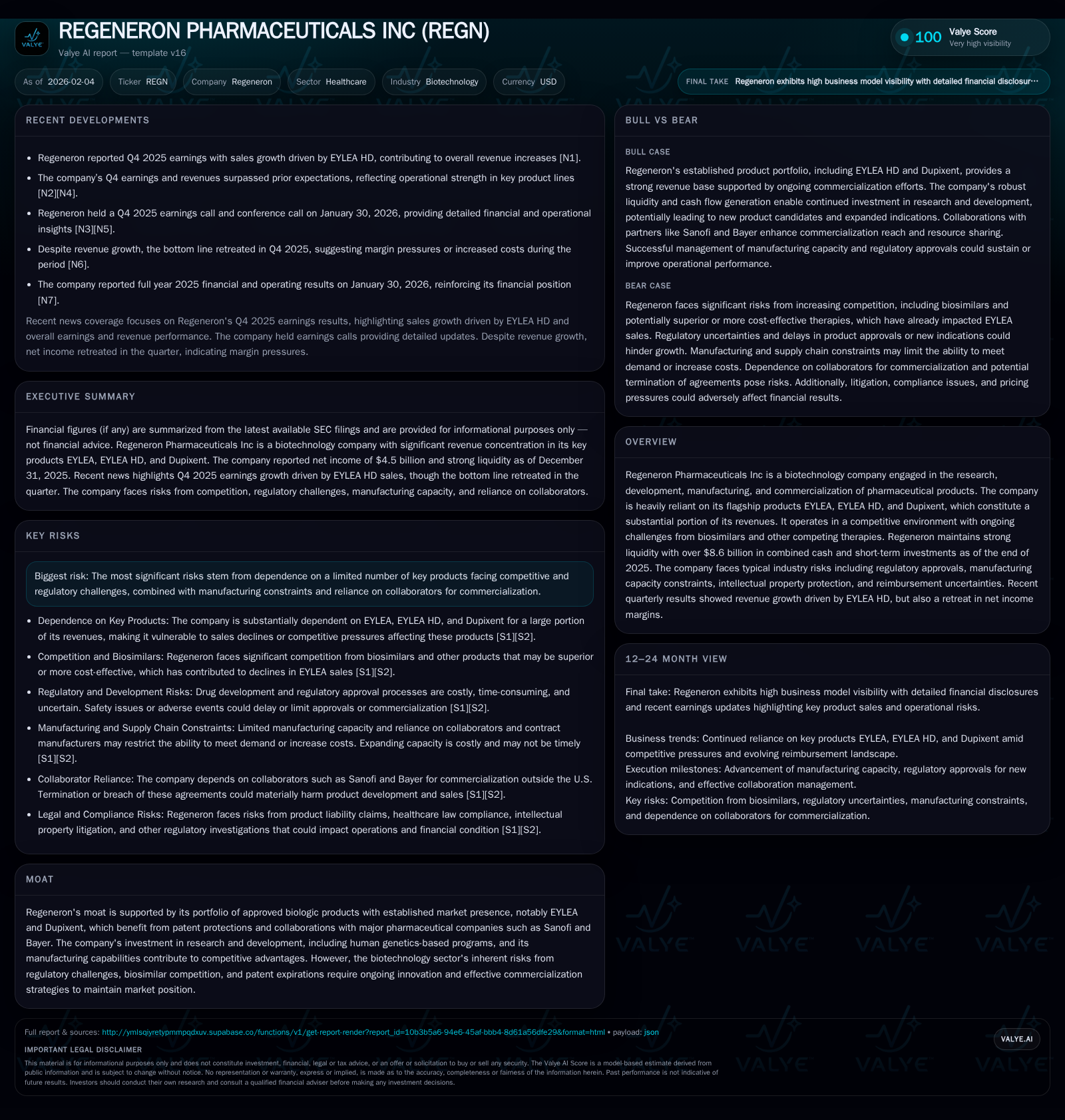
Regeneron Pharmaceuticals remains a prominent biotechnology firm driven largely by flagship products EYLEA and Dupixent, which continue to generate substantial revenues amid evolving market dynamics. The company faces intensifying competition from biosimilars and must manage regulatory and manufacturing complexities while investing heavily in R&D to sustain its competitive moat. Financially, Regeneron holds robust liquidity with a strong current ratio, though net income margins reflect pressures. Its partnership model, particularly collaborations with Sanofi and Bayer, underpins commercialization efforts but also introduces dependencies that compound operational risks.
Company Overview and Strategic Position
Regeneron Pharmaceuticals Inc is a fully integrated biotechnology entity engaged extensively in the invention, development, manufacturing, and marketing of innovative medicines targeted at serious diseases [S1]. Its commercial success today hinges predominantly on two biologic franchises: EYLEA (including EYLEA HD) for ophthalmologic conditions and Dupixent for inflammatory diseases. These products collectively contribute a sizable portion of the company's revenues as of late 2025 [S1][N2]. The firm also maintains a robust development pipeline with approximately 45 clinical-stage candidates, many based on internal research integrating human genetics insights — a pillar supporting future growth prospects [S1].
Complementing its R&D foundation are strategic collaboration agreements with pharmaceutical heavyweights Sanofi and Bayer. These partnerships are pivotal for both co-commercialization activities and shared development risk mitigation [S1]. However, this model creates an interdependency whereby Regeneron's financial outcomes partly hinge on collaborators’ operational effectiveness.
Financial Health: Strong Liquidity Amid Margin Pressures
Regeneron's financials reflect solid liquidity with over $8.6 billion held in combined cash equivalents and short-term investments by the end of fiscal 2025 [Valye overview][F1]. This liquidity supports ongoing research initiatives and absorbs fluctuations in commercial expenses. The company's current ratio exceeds 4x (current assets approximately $18 billion vs current liabilities near $4.4 billion), indicating robust short-term financial stability [F1].
Despite this strength, the latest quarterly results highlight a retreat in net income margins even as revenue grows, signaling increased costs from expanding commercialization activities — notably around EYLEA HD — alongside higher manufacturing expenses [N2][N6]. This margin compression underscores challenges navigating pricing pressures and ramping production capacities.
Market Dynamics: Competitive Landscape and Biosimilar Threats
Regeneron operates within the intensely competitive biotechnology domain where differentiated biologics command premium valuations but face looming biosimilar challenges post-patent expiry [S1][Valye overview]. EYLEA and Dupixent have enjoyed established market presence fortified by patent protections. Nevertheless, regulatory pathways facilitating biosimilar entry create an environment where these franchises require constant defense through label expansions, lifecycle management strategies, or new formulation innovations.
The threat extends beyond biosimilars alone; other competing therapies in ophthalmology and immunology may offer advantages in efficacy, safety profiles, or cost-effectiveness—factors critical to payer formulary decisions. Additionally, Sanofi’s noteworthy Q4 earnings beat with Dupixent further propels the spotlight on collaborative efforts fueling Regeneron's sales momentum yet simultaneously reflecting interwoven business fortunes [N8][N9].
Product Portfolio Concentration: Risk of Over-Reliance
Company disclosures emphasize substantial dependency on a narrow set of products — specifically EYLEA variants and Dupixent — comprising the majority of revenue streams [S1][S2]. Such concentration exposes Regeneron to acute commercial risks if any of these therapies encounter unforeseen regulatory hurdles, safety issues, generic competition, or reimbursement reductions.
While the pipeline is active with approximately 45 candidates ranging across therapeutic areas, none currently match the scale or profitability of these flagship drugs. Hence, near-to-mid-term business performance will likely remain sensitive to developments surrounding these core products.
Manufacturing and Supply Chain Challenges
Manufacturing biologics entails considerable complexity due to intricate processes requiring specialized facilities. Regeneron signals potential constraints as demand scales up for EYLEA HD and other products concurrently with pipeline maturation [S1][Valye overview]. Capacity limitations could delay product availability or inflate unit costs if not addressed promptly.
Further complicating supply chain robustness are dependencies on contract manufacturers alongside internal production sites; any disruptions or quality issues could impact regulatory compliance timelines or market supply continuity.
Regulatory Environment: Navigating Uncertainty
The biotech sector's regulatory milieu remains highly uncertain with stringent approval processes that impose significant timeframes and financial burdens [S1][S2]. Post-marketing surveillance also imposes risks if adverse events emerge after wider patient exposures.
For Regeneron’s marketed products aiming for label expansions or new indications—an essential mechanism for lengthening product life cycles—regulatory success is neither guaranteed nor rapid. Delays or denials would curtail anticipated revenue uplifts.
Pricing Pressures and Reimbursement Risks
Pricing environments worldwide increasingly prioritize cost containment amidst rising healthcare expenditures. In the U.S., governmental programs like Medicare/Medicaid heavily influence covered populations’ access via formularies while private insurers scrutinize medical cost-effectiveness [S1][S2].
Should pricing regulations tighten or reimbursement policies shift unfavorably—such as increased restrictions on copay assistance or heightened rebate obligations—Regeneron's revenue mix could face substantial headwinds.
This evolving backdrop necessitates dynamic engagement with payors to safeguard market share without compromising margin integrity.
Research & Development Focus: Genetics-Based Innovation
Regeneron's R&D endeavors leverage human genetics insights aiming to create novel therapies with distinct mechanisms of action that can translate into superior efficacy or safety profiles [S1]. This scientific strategy constitutes a crucial moat feature amidst generic competition threats.
Investment levels in R&D continue to escalate given the high cost structure inherent in biotech drug discovery coupled with extensive clinical trial requirements before commercialization readiness [S1]. Such resource commitment reflects prioritization towards sustaining long-term pipeline vitality beyond existing mature products.
Collaboration Ecosystem: A Double-Edged Sword?
Partnerships with Sanofi (notably for Dupixent) and Bayer (linked to EYLEA components) amplify Regeneron's market reach via shared commercialization responsibilities while distributing developmental risks [S1]. Yet reliance on external partners poses synchronization complexities—disparate corporate priorities or operational hiccups at collaborators can ripple through shared P&L outcomes.
Successful alignment remains imperative but introduces an additional layer of execution risk outside Regeneron's direct control.
Industry Trends Contextualizing Regeneron's Outlook (Analysis)
The broader biotechnology landscape is undergoing shifts that contextualize Regeneron’s challenges and opportunities:
- Accelerating biosimilar approvals globally threaten established biologics but also trigger price competition dividends benefiting healthcare systems.
- Precision medicine advances favor companies like Regeneron employing genomic data-driven pipelines.
- Drug delivery innovations increasingly integrate device combinations adding regulatory complexity but potential product differentiation avenues.
- Heightened regulatory scrutiny demands enhanced post-market safety vigilance particularly pertinent for blockbuster biologics under broad use.
- M&A activity persists as smaller firms seek large-cap collaborators for late-stage asset commercialization; Regeneron’s extensive collaboration network may provide strategic leverage here.
Summary Considerations
In sum, Regeneron Pharmaceuticals maintains leading-edge standing through flagship products buoyed by patent protection coupled with science-driven innovation rooted in human genetics research. However, dependence on a small product portfolio exposes it to evolving biosimilar threats alongside operational challenges involving manufacturing scalability and intricate collaboration dynamics.
Financially secured by ample cash reserves and strong working capital ratios, the company nevertheless exhibits margin compression indicative of increasing commercialization costs amid competitive pressures. Sustained success depends heavily on effective navigation across complex regulatory landscapes while dynamically managing reimbursement realities.
Continuous innovation remains imperative not just technologically but in business execution—to extend product lifecycles via new indications while broadening geographic reach through collaborative synergies without sacrificing operational agility.
Disclaimer
This memorandum presents an analytical overview based on publicly available information as of early 2026 intended solely for informational purposes. It does not constitute investment advice nor a buy/sell/hold recommendation regarding securities. Readers should consult independent professional advisors before making any investment decisions related to Regeneron Pharmaceuticals Inc or its industry context.
Disclaimer: This is research-only, informational analysis and not investment advice. It may include AI-generated interpretation and general industry context. Always verify important details using primary sources.

Comments