
Regentis Biomaterials Poised for Growth with Pivotal GelrinC Trial and Patent Strength
Regentis Biomaterials advances its distinctive cartilage regeneration technology through regulatory milestones and clinical trial progress while managing financial headwinds.
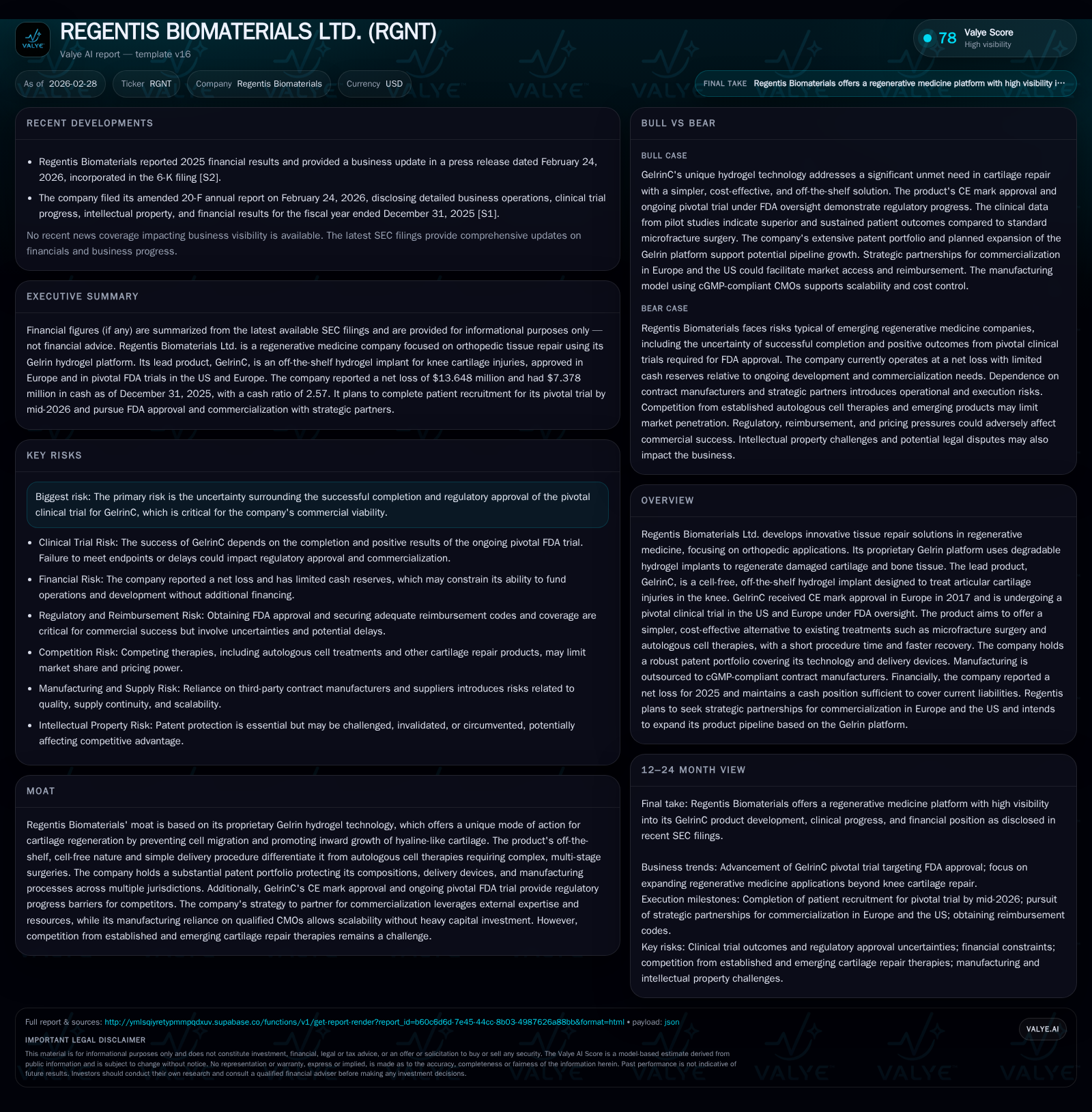
Regentis Biomaterials Ltd. focuses on innovative orthopedic regenerative solutions, notably the GelrinC hydrogel implant for knee cartilage repair. Having secured CE mark approval in 2017, the company is now in the crucial phase of a pivotal FDA-monitored trial in the U.S. The proprietary Gelrin platform’s unique mechanism—blocking cell migration to promote inward hyaline-like cartilage regeneration—sets it apart from competitive cellular therapies. Operationally, the biotech maintains a lean model by outsourcing manufacturing to cGMP contract providers, aiming to partner for European commercialization. Financially, ongoing clinical development contributes to persistent operating losses and negative ROE, with a cash reserve of $7.38 million as of end-2025. Regulatory approval results and partnership developments emerge as primary catalysts amid inherent clinical and market risks.
Historical Performance and Revenue Trajectory Through 2025
Regentis Biomaterials’ measured growth trajectory has been largely shaped by its clinical development milestones rather than broad commercial revenue generation to date. The company’s flagship product GelrinC obtained CE mark regulatory clearance in Europe back in 2017, positioning Regentis among rare regenerative medicine players targeting articular cartilage defects with an off-the-shelf hydrogel implant.
Financial metrics for the year ending 2025 show operating income of approximately -$6.97 million and net income deteriorated further to -$13.65 million [F1]. This reflects ongoing R&D expenditures concentrated on pivotal trials in the U.S. and Europe rather than realized sales revenue from products.
Cash and cash equivalents at December 31, 2025 stand at $7.38 million with current liabilities around $2.87 million [F1], indicating a cautious but sufficient liquidity buffer near term given the company's burn rate and absence of material capital expenditures [S19]. The negative return on equity of -287.7% [F1] underscores losses accumulated relative to equity invested thus far.
Notably, management reported no material positive or negative revenue trends throughout 2025 attributable to the product’s clinical stage status [S1]. No revenues are explicitly presented likely due to GelrinC’s limited commercialization confined currently to select European settings pending full market launch.
Historical performance (annual)
| FY |
|---|
| 2025 |
Source: SEC companyfacts cache [F1].
Table: Annual financial performance highlighting operating losses faced during clinical development phase [F1].
The GelrinC Ecosystem: Technology, Patents, and Differentiation
At the core of Regentis’ strategic moat lies its patented Gelrin platform—a degradable hydrogel matrix comprising polyethylene glycol diacrylate conjugated with denatured fibrinogen proteins . This composition serves as a durable scaffold implanted directly into articular cartilage lesions without requiring live cell harvesting or culture.
Unlike competing cell-based therapies which involve multiple surgeries—biopsy followed by cellular expansion and reimplantation—GelrinC is a single-stage procedure with an off-the-shelf product ready for immediate use [S27]. The mechanism uniquely inhibits cell migration away from lesion edges by creating an impenetrable barrier that encourages inward generation of hyaline-like cartilage tissue rather than fibrotic scar formation.
Additionally, many competitors utilize dual-layer mineral scaffolds requiring bone drilling despite healthy underlying bone—the GelrinC approach spares healthy bone tissue removing this procedural complexity [S27]. In contrast to biologically active materials prone to immune or inflammatory reactions, GelrinC is biologically inert, emphasizing simplicity and cost-effectiveness.
The company holds an extensive patent portfolio not only protecting gel composition but also covering device delivery apparatuses including UVA irradiation technologies essential for implant curing post-application [S25]. This broad IP coverage establishes barriers preventing easy copying by competitors.
Operationally, Regentis does not own manufacturing capacity but outsources production to contract manufacturers maintaining cGMP compliance , enabling scalable production without heavy upfront capital investment.
Clinical and Regulatory Progress: European Market Debut and U.S. Pivotal Trial Status
GelrinC’s commercial debut commenced with CE mark approval granted in 2017 for use within European markets . Following this early entry, Regentis expanded its clinical site network across Europe recently to support both commercialization efforts and ongoing post-market study requirements [S3].
Despite European clearance facilitating limited regional sales potential, regulatory authorities such as the FDA have yet to approve GelrinC for commercial use within the United States where a larger orthopedic device market exists.
Consequently, Regentis is conducting a pivotal FDA-supervised clinical trial across U.S. and European sites aimed at generating robust safety and efficacy data necessary for Premarket Approval (PMA) application submission [S2]. The outcome of this multi-center study represents a pivotal inflection point dictating whether broader U.S. commercialization can proceed.
Given that competitor products like Vericel’s MACI involve substantially longer procedures (two surgeries over months versus ~10 minutes single-stage delivery for GelrinC) there remains unmet patient demand potentially addressable if FDA approval ensues [S21]. However, timing uncertainties around trial completion remain significant.
Commercial Strategy and Partnership Pursuit in Europe
While GelrinC holds an EU CE mark enabling market introduction across member states , Regentis currently lacks active strategic commercialization partners in this region [S2]. Management emphasizes pursuit of licensing agreements or other partnership models as the principal commercial pathway forward in Europe given their limited internal sales infrastructure.
This partnership focus is pragmatically aligned with small biotech operational realities avoiding costly market-building expenditures while leveraging external expertise possessed by established orthopedic device or pharmaceutical companies [S27]. Achieving uptake will depend partly on demonstrating differentiated therapeutic value versus incumbent surgical strategies plus securing adequate reimbursement.
The regulatory validation via CE mark combined with expanding clinical footprint provides credibility aiding partner engagement discussions but successful alliances remain contingent on compelling commercial evidence from accumulating real-world usage data.
Financial Health: Operating Losses, Capital Structure, and Cash Flow Dynamics
As an emerging regenerative medicine firm concentrating capital resources primarily on late-stage product development initiatives, Regentis reports consistent operating losses incurred over recent years culminating in approximately -$6.97 million operating income for fiscal year 2025 [F1]. Net losses totaled roughly -$13.65 million during the same period reflecting R&D intensiveness typical within early commercial-stage biotechs.
Despite negative earnings trajectories indicated by a markedly adverse ROE ratio near -287.7% [F1], year-end cash balances stood at nearly $7.38 million providing a modest cushion supporting current operations through imminent pivotal trial milestones [F1][S22]. No dividends or share repurchase activities appear in disclosures consistent with early development focus prioritizing reinvestment over capital returns.
Liabilities were relatively contained with current obligations around $2.87 million primarily including accruals related to legal expenses from supply agreement disputes settled recently per management commentary [S16][S22]. Convertible debt instruments entail complex fair value assessment due to embedded conversion features affected by potential IPO or exit event probabilities under ASC guidance [S1][S26].
Capital expenditure requirements remain minimal owing largely to manufacturing outsourcing emphasizing asset-light business model minimizing fixed costs while maintaining cGMP standards [S19].
Risks Surrounding Clinical Trials, Regulatory Hurdles, and Competitive Landscape
The predominant risk tethering Regentis’ valuation relates directly to uncertainties surrounding successful completion of its pivotal FDA-regulated GelrinC clinical study alongside consequent marketing approval outcomes [S4][S5][S6]. Failure or delays could materially impair ability to commercialize broadly especially within the large U.S. healthcare market.
Additional regulatory risks include stringent compliance demands under evolving data privacy laws (e.g., HIPAA plus more restrictive state statutes) that necessitate continuous investments into IT security governance overseen directly by senior leadership with audit committee oversight noted as standard risk controls [S1][S4][S8]. Non-compliance risks could translate into costly sanctions or reputational damage impacting growth trajectories.
Externally driven reimbursement challenges linked to evolving healthcare payment reforms in both U.S. Medicaid/Medicare systems as well as private payor strategies create pressure on pricing adequacy potentially restricting hospital/physician adoption rates even post-approval [S17][S18].[S19]
Competitive pressures maintain potency given alternative regenerative therapeutics such as autologous chondrocyte implants demanding multistage procedures albeit more costly and complex; additionally new entrants like Smith & Nephew-acquired CartiHeal’s Agili-C device awaiting North American launch are poised to intensify market dynamics absent differentiation breakthroughs [S21][S27].
IP protection mitigates some imitation risks but patent challenges or invalidations remain possible contingent on future litigation not currently disclosed [S25].
Potential litigation related primarily to contractual disputes has been largely resolved via settlement agreements minimizing downside exposure though legal contingencies may persist sporadically though immaterial relative to operational scale at present [S16].
Outlook on Milestones: What Investors Should Monitor Next
Forward-looking catalysts hinge critically on enrollment pace and interim result dissemination from ongoing pivotal studies across U.S./European centers where additional sites were recently added underpinning scalability ambitions within targeted orthopedic indications per latest releases [S3][N2]. Success here would enable PMA submission anticipated as next regulatory landmark though explicit timing guidance remains undisclosed requiring monitoring corporate communications closely.
Commercial partnership announcements particularly across European markets represent another key variable potentially accelerating revenue ramp upon formal agreements consummated aligning marketing distribution channels with prescribed pricing frameworks supporting reimbursement strategies.[N2]
Capital adequacy beyond current cash reserves may spur fresh fundraising rounds depending upon trial duration extensions or accelerated pre-commercial launch investments necessitating shareholder attentiveness to equity issuance terms or potential dilution effects.
Finally consolidation activity within orthopedic biotech could reshape competitive landscape offering both acquisition upside or intensified rivalry influencing long-term franchise sustainability absent further technology pipeline diversification efforts being disclosed.
This report summarizes data drawn solely from publicly available SEC filings and company disclosures as of early 2026; it does not constitute investment advice but aims to provide an informed perspective on Regentis Biomaterials’ strategic position within orthopedic regenerative medicine.
Disclaimer: This is research-only, informational analysis and not investment advice. It may include AI-generated interpretation and general industry context. Always verify important details using primary sources.

Comments