
How Rocket Companies Leverages Scale and AI to Reshape Homeownership Services
Rocket Companies combines market leadership, strategic acquisitions, and advanced AI to drive growth amid profitability and liquidity headwinds.
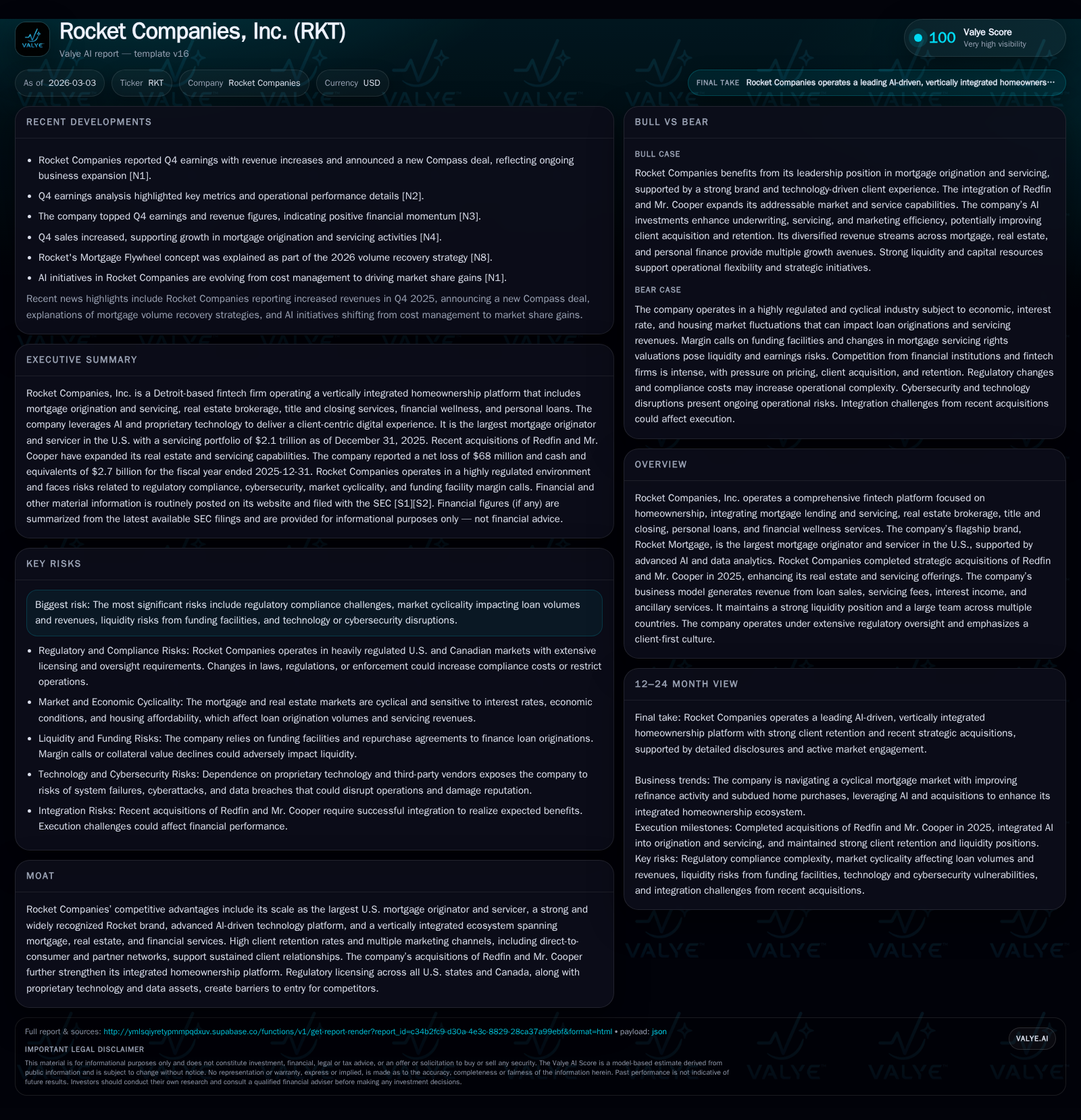
Rocket Companies solidified its position as the largest U.S. mortgage originator and servicer in FY2025, propelled by a 31% revenue jump driven by Redfin and Mr. Cooper acquisitions alongside its AI-powered platform. Despite record revenue of $6.7 billion, the firm reported a net loss and steep cash flow declines linked to integration costs and funding challenges. Its liquidity remains robust though contingent on maintaining funding facility covenants amid margin call risks. Regulatory pressures and market cyclicality pose ongoing challenges as Rocket pursues operational synergies and volume recovery through intensified AI deployment and a vertically integrated homeownership ecosystem.
Rapid Revenue Growth Fueled by Acquisitions and Market Share Gains
Rocket Companies accelerated its growth trajectory sharply in FY2025, delivering $6.7 billion in revenue—a significant 31.3% increase over $5.1 billion recorded in FY2024 [F1]. This leap was fueled largely by the company’s vertical expansion through two major acquisitions: Redfin in July 2025 and Mr. Cooper in October 2025 [S1]. Redfin added digital real estate brokerage capabilities while Mr. Cooper expanded Rocket’s mortgage servicing portfolio, now boasting an unpaid principal balance of approximately $2.1 trillion as of year-end 2025 [S1].
The growth also benefitted from robust market share gains across Rocket Mortgage's origination channels — direct-to-consumer digital platforms complemented by partner networks — leveraging proprietary AI-enabled processes that streamline underwriting and close loans efficiently [S12][N3]. Notwithstanding these topline improvements, net income turned negative ($68 million loss) after modest profits in prior year, underscoring integration costs and operational pressures [F1]. The firm’s historic strength in its gain-on-sale margins softened as supply/demand imbalances persisted in the secondary market.
Historical performance (annual)
| FY | Rev ($bn) | Net ($mm) | CFO ($bn) | Capex ($mm) | Rev YoY | Net YoY |
|---|---|---|---|---|---|---|
| 2025 | 6.7 | -68 | -3.9 | 91 | +31.3% | -331.5% |
| 2024 | 5.1 | 29 | -2.6 | 68 | +34.3% | +289.3% |
| 2023 | 3.8 | -16 | 0.1 | 60 | -34.9% | -133.4% |
| 2022 | 5.8 | 46 | 10.8 | 93 |
Source: SEC companyfacts cache [F1].
Capital returns and efficiency (annual)
| FY | Buybacks ($mm) | FCF ($bn) | ROE% |
|---|---|---|---|
| 2025 | -4.0 | -0.3 | |
| 2024 | 0 | -2.7 | 0.3 |
| 2023 | 0 | 0.0 | -0.2 |
| 2022 | 178 | 10.7 | 0.5 |
Source: SEC companyfacts cache [F1].
The table shows Rocket Companies’ revenue growth outpacing past cycles despite volatile net income and significant operating cash flow swings reflecting the capital-intensive nature of funding originations.
Leveraging AI for Client Experience and Operational Efficiency
AI remains central to Rocket's strategy to solidify its moat beyond scale alone. The company’s end-to-end digital mortgage origination uses advanced machine learning models in automated data retrieval, borrower risk assessment, fraud detection, and personalized client engagement [S12][N7]. These enhancements contribute directly to a strong net promoter score (NPS) of 70 for mortgage origination during full year 2025—a figure indicative of best-in-class customer satisfaction in financial services [S12].
Initially deployed for cost containment post-pandemic, AI’s role is shifting towards fueling market share expansion through faster underwriting turn times and improved prediction of borrower behavior [N7]. Marketing spend optimization via AI-driven attribution models has improved client acquisition efficiency across both direct consumer and partner network segments.
Integration of Redfin and Mr. Cooper: Synergies and Execution Risks
The July acquisition of Redfin introduced an expansive digital brokerage platform under Rocket’s umbrella with access to multiple listing service (MLS) data across numerous U.S. markets [S1][S11]. While this integrated offering promises end-to-end home buying experience enhancements—from search through financing—Redfin’s dependency on external MLS data poses risks if access is restricted or delayed due to compliance failures or contractual disagreements with realtor associations [S11].
Similarly, the October purchase of Mr. Cooper absorbed a large servicing portfolio but involved restructuring roughly $5 billion of legacy unsecured debt to improve liquidity footing [S6]. Integration challenges include assimilating different technology stacks, harmonizing servicing protocols, and mitigating potential client attrition especially as cross-selling opportunities develop.
Failure to realize projected operational synergies could exacerbate pressure on earnings already impacted by escalated expenses related to compliance programs given increased regulatory scrutiny associated with each acquisition [S11]. Nevertheless, these moves strategically reinforce Rocket’s vision for a contiguous ecosystem encompassing home search, mortgage origination/servicing, title services, and personal loans.
Profitability, Cash Flows, and Capital Allocation Under Pressure
Despite record revenues peaking at nearly $6.7 billion in FY2025, Rocket Companies confronted a sharp earnings contraction culminating in a net loss of $68 million compared with modest profits the prior year [F1]. Operating cash flow plunged by almost half year-over-year to -$3.9 billion driven by elevated working capital needs from loan inventory buildups amid slower secondary market sales [F1][S2]. Capex rose moderately (+34% YoY) attributable principally to technology investments supporting AI infrastructure expansion.
These dynamics led free cash flow (operating cash flow minus capex) deep into negative territory around -$4 billion in FY2025 [F1], marking stress on internal capital generation capabilities amid aggressive growth moves.
Return on equity hovered near zero (~-0.3%) given the minimal bottom line result against elevated equity base inflated by acquisition-related accounting entries reaching $22.9 billion at year-end [F1]. No share repurchases were executed through FY2024 or FY2025 indicating management focus prioritized liquidity conservation over capital returns during this transformational phase [F1]. Dividends remain suspended pending re-establishment of sustainable profitability.
Liquidity Profile and Debt Structure: Navigating Margin Calls and Funding Risks
Rocket Companies maintains a substantial liquidity pool with approximately $2.7 billion in cash & equivalents at December 31, 2025 alongside extensive loan funding facilities totaling ~$28.5 billion capacity across twenty-one agreements—mostly evergreen or staggered maturities into 2026-27 [F1][S10]. These facilities are primarily secured master repurchase agreements collateralized by originated loans held for sale.
However, lenders retain rights to mark collateral values periodically; declines trigger additional collateral calls or reductions (margin calls) that require prompt company response or risk termination of facilities causing acute funding disruption risks [S4][S8][S27]. Nearly two-thirds of loan funding capacity is uncommitted subject to lender discretion on continuation heightening refinance risk under adverse conditions.
The company increased revolving credit availability up to $2.3 billion post-acquisitions improving cushion for working capital needs [S6], yet covenant thresholds tied to tangible net worth minima, liquidity ratios, leverage caps and pre-tax income must be vigilantly maintained lest cross-defaults cascade eroding credit line access further [S9][S14].
Market & Regulatory Risks Impacting Origination and Servicing Businesses
Rocket operates within an intensely regulated environment involving federal agencies like CFPB alongside multiple state jurisdictions plus Canadian oversight following geographic expansion [S11][S17]. The CFPB’s heightened rulemaking activity subjects Rocket's originations/servicing practices—including fee disclosures, underwriting integrity, servicing advance obligations—to frequent compliance audits that increase administrative burden.
The servicing segment faces additional risks managing portfolios with elevated proportions of credit-challenged borrowers requiring costly monitoring per new regulatory mandates; some agency programs impose repayment advances absent guaranteed reimbursement threatening liquidity if defaults surge unexpectedly [S21][S11].
Emerging regulatory frameworks seek accountability for brokers’ fee practices baked into loan costs amplifying liability exposure even when brokers act independently but represent Rocket products—adding legal complexity [S18][S20].
Ongoing digital dependence heightens cybersecurity risks exposing customer data as well as reliability concerns for API-accessed third party MLS feeds powering Redfin listings that could disrupt home search continuity if compromised [S11][S19]. Such vulnerabilities require continuous investment in security controls.
Competitive intensity remains fierce among fintech incumbents leveraging different digital strategies competing not only on price but speed-to-close and integrated product breadth—Rocket aims to differentiate through scale combined with comprehensive ecosystem offerings supported by AI insights that optimize client lifetime value metrics such as its strong servicing retention rate at ~97% annually [S12].
Forward Outlook: Volume Recovery, AI Adoption, and Competitive Dynamics
Looking ahead into calendar year 2026 as articulated publicly by management reports following Q4 earnings release [N1][N13], Rocket anticipates rebounding origination volumes stimulated by recent stabilization in mortgage interest rates after prolonged volatility reduced refinancing activity dramatically.
Key performance monitors include synergy capture timing from integration initiatives intended to unlock cross-selling efficiencies across financing-real estate-title silos while continuing prudent investment into AI tools enhancing underwriting automation accuracy along with marketing funnel conversion optimization [N7].[N13]
Market watchers should track loan sales gain margins which have been compressing due to competitive pricing pressures post-acquisition wave; any sustained margin improvement could materially shift profit dynamics favorably absent incremental cost inflation.
Regulatory developments warrant close attention especially evolving state-level CRA application expansions potentially increasing complexity beyond federal requirements impacting community lending profiles. Maintaining uninterrupted secured facility access without triggering margin calls or covenant breaches will critically underpin operational continuity given currently tight credit market conditions.
Ultimately Rocket Companies' ability to leverage its dominant scale combined with proprietary technology assets rooted heavily in AI promises differentiation potential distinct from traditional lenders where slower innovation cycles prevail yet substantial execution risk persists requiring vigilant financial discipline amidst macroeconomic uncertainties.
This analysis synthesizes available disclosed financials from SEC filings alongside recent news coverage without conjecture beyond documented data points or management commentary provided through public disclosures. It is intended solely for informational purposes without constituting investment advice or recommendations.
Disclaimer: This is research-only, informational analysis and not investment advice. It may include AI-generated interpretation and general industry context. Always verify important details using primary sources.

Comments