Ralph Lauren's Brand Resilience and Surprising Market Reaction Amid Q3 Beat
Despite robust holiday-driven earnings and an upward FY26 revenue revision, Ralph Lauren's shares entered oversold territory, prompting a deeper analysis.
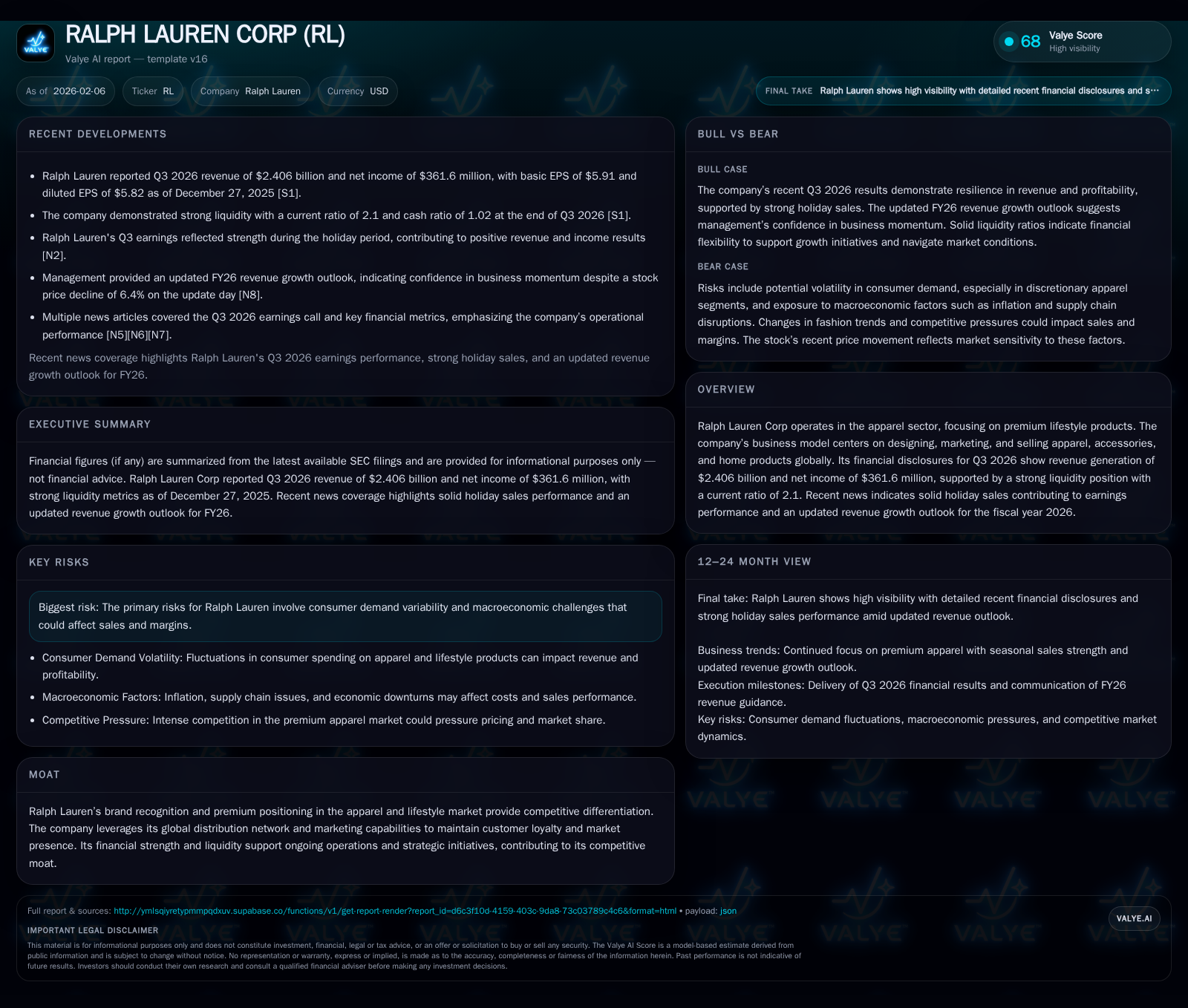
Ralph Lauren Corp delivered a notable Q3 2026 performance, powered by strong holiday sales that exceeded analyst expectations, culminating in $2.406 billion revenue and $361.6 million net income. This operational strength supported management’s raised FY26 revenue outlook, reflecting confidence in the brand’s enduring market appeal and liquidity position. Yet paradoxically, the stock sold off sharply post-announcement, entering oversold territory amidst broader market rotation and profit-taking dynamics. This report navigates RL’s financial health, moat sustainability, and the nuanced investor sentiment shaping its near-term outlook.
Ralph Lauren's Holiday Surge: Earnings That Defied Expectations
Ralph Lauren Corp significantly outperformed expectations for its Q3 2026 earnings, buoyed chiefly by strong consumer demand during the holiday season. The company disclosed revenue of $2.406 billion along with net income tallying $361.6 million[ F1 ], surpassing most analyst estimates on both counts[ N2 ][ N5 ]. Management highlighted in its earnings call that the holiday campaign resonated strongly with customers across key markets, supporting a robust top-line rebound[ N4 ]. A remark from CEO notably emphasized: “Our holiday results validated the strength of our brand and go-to-market strategy across all channels.” This outsized seasonal performance marked a pivotal inflection point given ongoing macroeconomic uncertainties facing discretionary categories. The ability to harness consumer enthusiasm at this critical time illustrates Ralph Lauren’s marketing efficacy and inventory management precision.
Dissecting The Numbers: Q3 Financials & Liquidity Insights
Breaking down the quarter’s financial anatomy reveals not only impressive revenue scale but also solid underlying financial health as reflected in liquidity metrics[ F1 ][ S2 ]. With cash and equivalents exceeding $2 billion by fiscal Q3 end, combined with current assets comfortably outpacing current liabilities ($4.19B vs. $1.99B respectively), RL reported a healthy current ratio approximating 2.1—a notable buffer indicating sound short-term solvency[ F1 ]. These resources provide runway for strategic investments and cushioning against potential market fluctuations. Net income margins also remained healthy despite inflationary pressures pervasive across the industry landscape. The evidence suggests Ralph Lauren is leveraging cash flow prudently while maintaining operational efficiency — an encouraging sign amid an apparel sector grappling with demand variability.
Brand Power and Global Footprint: The Moat That Holds
At the heart of RL’s resilience lies arguably one of fashion’s most recognizable brands—an asset nurtured over decades to command loyalty beyond mere product features[ valye_report_excerpt.moat ]. Its premium positioning enables it to differentiate from mass-market peers while accessing affluent customer segments worldwide via an extensive distribution network spanning retail stores, franchises, and e-commerce platforms. This wide geographic footprint coupled with targeted marketing initiatives maintains engagement across mature and emerging markets alike[ N4 ]. Management commentary consistently referenced efforts to deepen direct-to-consumer relationships through tailored digital experiences—indications of an evolving yet steady moat well adapted to present-day consumption trends.
Market Sentiment Puzzle: Why Did Shares Sell Off?
Despite this suite of positive fundamentals and optimistic guidance revisions (detailed later), Ralph Lauren shares experienced a surprising decline exceeding 6% following earnings release[ N7 ][ N14 ]. This counterintuitive selloff can be partly attributed to sector rotation dynamics seen in broader markets where investors shifted capital away from discretionary stocks into defensive or cyclical sectors as macro concerns lingered. Another plausible factor involves profit-taking after preceding run-ups amid renewed optimism around luxury spending recovery[ N14 ]. Technical indicators flagged the stock entering oversold conditions—a dichotomy where strong results clashed with cautious trading patterns creating potential entry points for discerning investors sensitive to valuation nuances.
Broadened FY26 Revenue Outlook and What It Means
Reflecting confidence gained from Q3 momentum, management updated its full-year 2026 revenue outlook upwards[ N7 ][ S2 ]. While specifics were guarded due to prevailing economic unpredictability—including fluctuating consumer confidence metrics and currency headwinds—the revision underscored expectations for sustained top-line growth driven largely by continued product innovation and geographic expansion efforts. However, underlying assumptions embed caution; supply chain complexities and inflation risks remain variables that could recalibrate forecasts should adverse scenarios develop post-reporting period.
Macroeconomic Headwinds and Consumer Demand Risks
Notwithstanding recent gains, Ralph Lauren acknowledges palpable risks tied to consumer purchasing behaviors shifting in response to macroeconomic conditions such as interest rate dynamics, labor market fluctuations, and inflation impacting disposable income[ valye_report_excerpt.risks ]. Apparel remains a category sensitive to discretionary spending cutbacks during economic slowdowns. Heightened uncertainty around global trade policies or geopolitical tensions further complicates forecasting efforts. These factors recommend vigilance as they could influence both volume growth trajectories and margin profiles moving forward.
Peer Context: Apparel Sector Comparisons for RL’s Positioning
In context against apparel peers like Columbia Sportswear—another recent earnings winner albeit with sales declines year-over-year[ N9 ]—Ralph Lauren's premium lifestyle angle provides distinct competitive advantages but also exposes it to luxury consumption cyclicality not shared uniformly across players focused on mass or outdoor markets. While some competitors grapple with inventory overhangs or shifting channel mixes, RL’s integrated global approach offers flexibility but requires balancing omnichannel execution complexity.[Analysis context]
Strategic Levers and Potential Growth Catalysts Ahead
Looking ahead, Ralph Lauren appears poised to capitalize on several strategic levers hinted at in recent communications: expanding e-commerce penetration through enhanced digital platforms; leveraging data analytics for personalized marketing; refreshing product assortments aligned with contemporary style trends; and deepening sustainability initiatives aimed at increasingly eco-conscious consumers[ N4 ][ valye_report_excerpt.moat ]. Such initiatives align with evolving consumer preferences while reinforcing brand relevance in crowded competitive landscapes.
Valuation Takeaways: Risk-Reward in Oversold Territory
Combining fundamental strength—manifested in solid Q3 delivery, improved liquidity stance, and broadened revenue outlook—with perplexing market-driven price weakness crafts a nuanced valuation picture for RL. The stock’s descent into oversold territory contrasts sharply with business execution meritocracy evident from reported figures[ F1 ][ N14 ][ valye_report_excerpt ]. For buy-side professionals parsing risk versus reward matrices, this juxtaposition singles out Ralph Lauren as a case study in balancing premium brand durability against near-term macro volatility-induced skepticism. It underscores the importance of factoring qualitative moat considerations alongside quantitative metrics when assessing apparel/lifestyle equities under pressure.
This analysis has synthesized publicly available data sources alongside sector knowledge without providing explicit investment recommendations or price predictions. Investors should weigh disclosed risks carefully within their individual frameworks before considering any action related to Ralph Lauren Corp shares.
Disclaimer: This is research-only, informational analysis and not investment advice. It may include AI-generated interpretation and general industry context. Always verify important details using primary sources.

Comments