
Royalty Management Holding Corp Q2 2026: Stable Operating Performance and Positive Working Capital
Royalty Management Holding Corp reports positive working capital and stable operating expenses in Q2 2026, reflecting ongoing management of royalty assets amid revenue concentration risks.
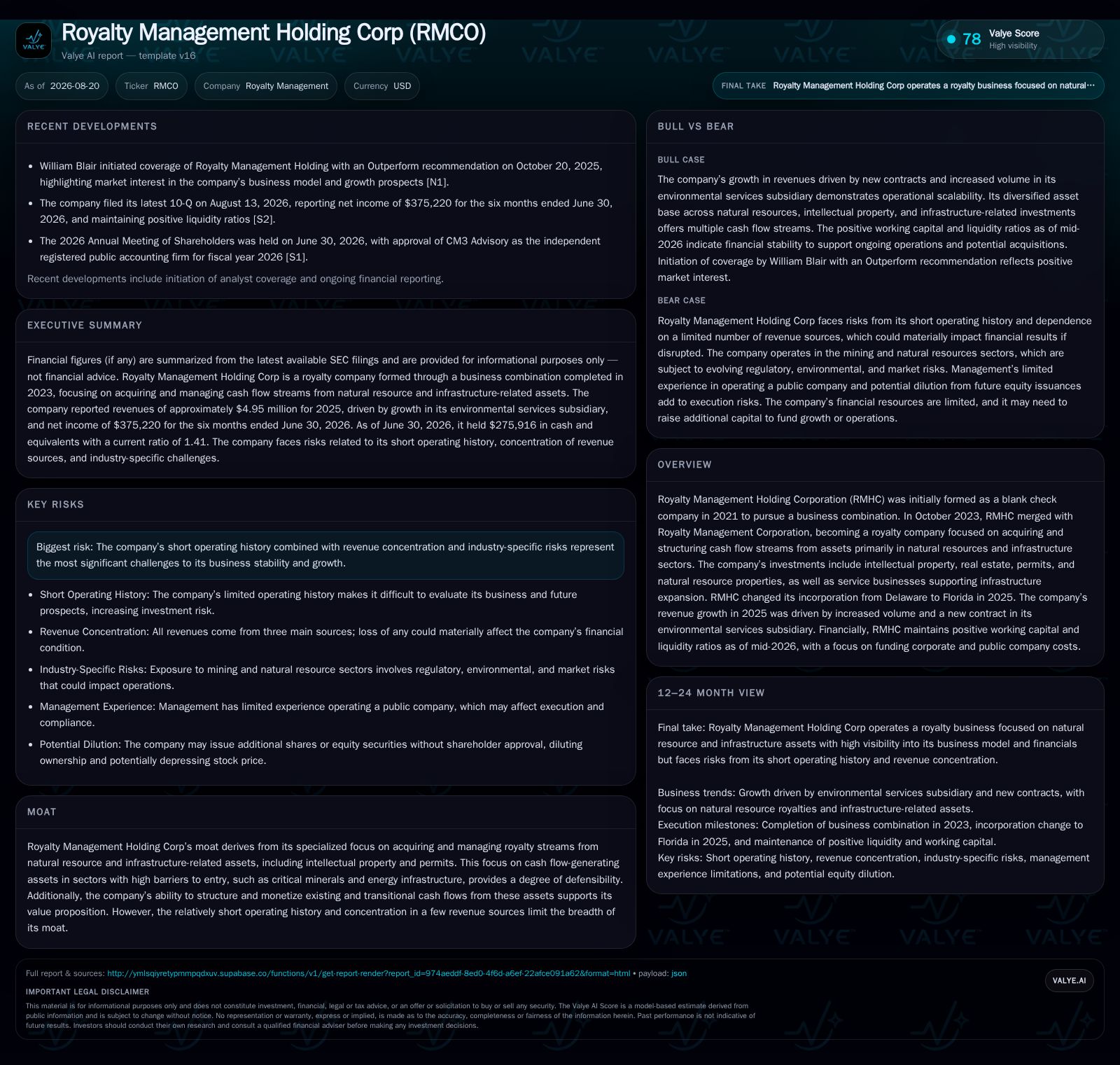
Royalty Management Holding Corp's Q2 2026 filing reveals a current ratio of 1.41 with positive working capital supporting corporate costs. The company’s revenue growth in 2025 was driven by increased volume and a new environmental services contract, though operating expenses remained stable, indicating limited operating leverage. RMCO’s business model centers on monetizing royalty cash flows from natural resource and infrastructure assets, but its short operating history and concentrated revenue streams present notable risks. Future financial stability depends on revenue diversification and contract expansion.
Royalty Management Holding Corp (RMCO) reported a current ratio of 1.41 as of June 30, 2026, with current assets of $2.21 million and current liabilities of $1.57 million, resulting in positive working capital of approximately $640,000 [F1]. This liquidity position provides a moderate buffer to meet short-term obligations and fund ongoing corporate and public company expenses without immediate external financing [S2]. The company’s assets include intellectual property, real estate, permits, natural resource properties, and service businesses supporting infrastructure expansion, such as its environmental services subsidiary [S1]. Revenue is generated through structured royalty payments tied to these assets and recurring service contracts, with contract volume and utilization influencing cash flow generation.
In 2025, RMCO experienced significant revenue growth driven by increased volume and a new contract in its environmental services subsidiary, effective February 2025 [S1]. This expansion led to a substantial increase in cost of revenues—from $22,699 in 2024 to $4,145,139 in 2025—reflecting higher service delivery volume, while operating expenses remained stable around $1.1 million, indicating limited operating leverage [S1]. The stable operating expenses despite revenue growth suggest margin improvements depend on further scale or contract diversification.
RMCO’s business model centers on acquiring and structuring cash flow streams from royalty assets primarily in natural resources and infrastructure sectors, including intellectual property, real estate, permits, and service businesses supporting infrastructure expansion [S1]. Subsidiaries like RMC Environmental Services LLC provide environmental services contracts that generate recurring cash flows based on contract volume and utilization. Customers include holders of royalty assets and clients in natural resource industries who pay royalties or fees tied to asset cash flows or service contracts.
Revenue mechanics involve structured royalty payments linked to owned assets and service contracts generating recurring income [S1][S2]. Margins and cash conversion are influenced by contract volume growth and cost management in the environmental services subsidiary, as well as the stability and collection efficiency of royalty cash flows. However, RMCO’s relatively short operating history and concentration of revenues from three primary sources limit the breadth of its competitive differentiation and expose it to revenue concentration risk
The positive working capital and current ratio of 1.41 as of mid-2026 demonstrate RMCO’s ability to cover short-term liabilities with current assets, supporting corporate and public company costs without immediate liquidity concerns [F1][S2]. Cash and equivalents stood at $275,916 as of June 30, 2026, indicating moderate liquidity to fund ongoing operations [F1]. The company’s primary use of cash flow has been to fund corporate holding and public company expenses, with no off-balance sheet arrangements reported [S1].
Operating expense stability despite increased cost of revenues suggests margin expansion depends on further contract volume growth or revenue diversification [F1]. Since inception, revenues have derived from only three primary sources, and loss or decline of any could materially affect financial performance [S2]. This concentration risk, combined with limited operating leverage, may lead to volatility in margins and cash flows.
RMCO faces sector-specific risks tied to natural resource and infrastructure markets, including commodity price fluctuations and regulatory changes, which can impact royalty cash flows [S2]. The company’s limited track record increases uncertainty for investors assessing long-term prospects. Management’s limited experience operating a public company and potential dilution risks from additional equity issuance further compound these challenges [S2].
RMCO’s short operating history makes it difficult to fully evaluate the business and future prospects, increasing investment risk [S2]. Since all revenues derive from three main sources, loss or decline of any single revenue stream could materially affect financial condition and results [S2]. This concentration risk heightens exposure to operational disruptions or contract non-renewals.
The company’s portfolio holdings in mining and natural resource industries expose it to evolving sector-specific risks, including commodity price volatility, regulatory changes, and environmental considerations [S2]. These factors affect the stability and growth of royalty cash flows underpinning RMCO’s revenue base. Additionally, attracting and retaining qualified personnel and key executives is essential for sustaining growth and managing operational complexities [S2].
A positive scenario is RMCO successfully expanding its royalty asset portfolio and service contracts, diversifying revenue beyond current concentrated streams. Such growth could stabilize and increase cash flows, support margin improvements, and enhance financial flexibility [S1][S2]. Confirmation would come from quarterly filings showing revenue diversification, contract renewals and expansions, improved margins, and stronger cash flow.
Conversely, failure to diversify and loss or decline in limited royalty streams or service contracts could compromise financial stability [S1][S2]. This bear case is plausible given the short operating history and concentrated revenue sources. Confirmation would include quarterly results showing revenue declines, margin compression, negative working capital, or liquidity deterioration.
Key watchpoints for investors include quarterly revenue and margin trends to assess contract growth and operating leverage, liquidity and working capital ratios in future filings, announcements of new royalty asset acquisitions or contract wins, and changes in share issuance or equity dilution. These indicators will provide insight into RMCO’s ability to diversify revenue sources and sustain financial stability amid sector cyclicality and operational challenges.
In summary, RMCO’s Q2 2026 financials reflect stable operating performance with positive working capital of approximately $640,000 and liquidity supported by cash and equivalents of $275,916 as of June 30, 2026 [F1]. The company maintains a current ratio of 1.41, indicating a moderate liquidity buffer [F1]. However, its short operating history and concentrated revenue streams remain significant risk factors. Future performance hinges on successful diversification of royalty assets and service contracts, and effective management of sector-specific risks and operational expenses.
Disclaimer: This is research-only, informational analysis and not investment advice. It may include AI-generated interpretation and general industry context. Always verify important details using primary sources.

Comments